Stop... start... stop... start. If you make a habit of driving in city
traffic, you'll know it can be a huge waste of time. What's less obvious is that it's
also a waste of energy. Getting a car moving needs a big
input of power, and every time you hit the brakes all the
energy you've built up disappears again, wasted in the brake pads as
heat. Wouldn't it be good if you could store this energy somehow and reuse it
next time you started to accelerate? That's the basic concept of
regenerative ("regen") brakes, which are widely used in electric
trains and the latest electric cars. What are they?
How do they work? Let's take a closer look!
Photo: Typical regenerative brakes are electric motors, like this.
Working normally, motors turn electricity into motion. When they run in reverse, they turn motion into electricity that can be stored for reuse. Photo courtesy of NASA and DVIDS.
If you get about town on a bicycle, it's
very obvious that braking is a huge waste of
energy. You have to pedal to get yourself going, and each time you
brake and come to a standstill you waste all the momentum you've
gained. Next time you want to move off, you have to start from scratch all over again. Put your
hands anywhere near the brake pads on a bicycle and you'll know
exactly where the energy goes: each time you brake and the rubber
pads clamp on the wheel, friction between
rubber and metal converts the energy you had when you were moving into
heat, which disappears uselessly into the air, never to be seen again.
(WARNING: Be very careful if you try this because brakes can get really hot!)
Car drivers are pretty much oblivious to the energy that braking wastes
because driving doesn't require any real, physical effort. Not only
that, but car brakes are hidden out of sight, inside the wheels, where you can't see the
heat energy they're wasting. But the heat they generate is extraordinary:
according to one manufacturer, Brembo, the brakes in formula-1 race cars can heat up as high as 1000°C (1830°F)!
Chart: Friction brakes in ordinary cars (orange) and formula-1 race cars (red) heat up to extraordinary temperatures, wasting huge amounts of energy as heat.
Sponsored links
How could we make better brakes?
Let's try to imagine designing a better braking system for a bicycle by thinking about the
science. When we're riding along, our bodies and bikes have
kinetic energy (the energy that all moving objects have);
when we brake to a stop, all
that kinetic energy has to disappear. When we start up again, we need
more kinetic energy. An ideal braking system would involve temporarily putting
our kinetic energy to one side without throwing it away forever (as we do
when we hit conventional brakes)—a way of storing the energy so we can get it
back again in the future.
Artwork: Regenerative braking by using a ramp to store kinetic energy as potential energy.
How could we achieve this? If you're a cyclist, one easy but rather impractical way would be
to carry a gigantic ramp around on your back. Each time you wanted to stop, you could throw the
ramp down on the road up ahead of you so you'd bicycle up it and
gradually come to a halt, some distance in the air. As you went up
the ramp, it would be like going up a hill: your kinetic energy would be rapidly
converted into potential energy and you'd slow down and stop. When
you were ready to start off again, you'd simply roll down the other side of
the ramp and you'd get back (most of) your original energy (the stored
potential energy would be converted back to kinetic energy, just as it is
when you bicycle down a hill). Of course, you'd also need to attach the ramp to your body
with a bungee cord so it would snap onto your back again, automatically, as you cycled off.
Okay, this is a little bit bonkers—so what else could we do? If your bicycle has a
dynamo
(a small electricity generator) on it for powering the lights, you'll
know it's harder to pedal when the dynamo is engaged than when it's
switched off. That's because some of your pedalling energy is being
"stolen" by the dynamo and turned into electrical energy in the
lights. If you're going along at speed and you suddenly stop pedalling
and turn on the dynamo, it'll bring you to a stop more
quickly than you would normally, for the same reason: it's stealing your kinetic
energy. Now imagine a bicycle with a dynamo that's 100 times bigger
and more powerful. In theory, it could bring your bike to a halt
relatively quickly by converting your kinetic energy into
electricity, which you could store in a battery and use again later.
And that's the basic idea behind regenerative brakes!
What are regenerative brakes?
Electric trains, cars, and other electric vehicles are powered by
electric motors connected
to batteries.
When you're driving along, energy flows from the
batteries to the motors, turning the wheels and providing you with
the kinetic energy you need to move.
When you stop and hit the brakes, the whole process goes into reverse: electronic circuits cut the power to the motors. Now, your kinetic energy and momentum makes
the wheels turn the motors, so the motors work like generators and
start producing electricity instead of consuming it. Power flows back
from these motor-generators to the batteries, charging them up. So a
good proportion of the energy you lose by braking is returned to the
batteries and can be reused when you start off again.
In practice, regenerative brakes take time to slow things down, so most vehicles
that use them also have ordinary (friction) brakes working alongside
(that's also a good idea in case the regenerative brakes fail). That's
one reason why regenerative brakes don't save 100 percent of your braking energy.
Artwork: Regenerative braking in a nutshell: Top: When you drive an electric vehicle, energy flows from the batteries to the wheels via the electric motor. Bottom: When you brake, energy flows from the wheels to the batteries via the motor, which works as an electric generator. Next time you switch on the power, you can reuse the energy you stored during braking.
How do different vehicles use regenerative brakes?
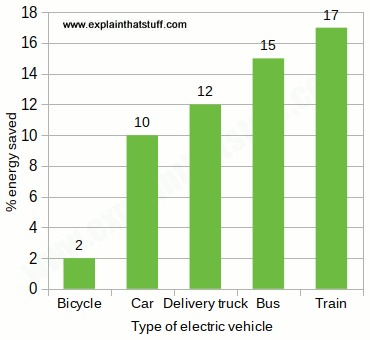
How much energy do regenerative brakes save? It depends on the vehicle. Large and heavy vehicles that move quickly (such as electric trains) build up lots of kinetic energy, so they get the best savings. Although they weigh less and go more slowly, delivery trucks that stop and start a lot can also make big savings. Cars vary in what they can save from about 8–15 percent (depending on the car and whether it's driving in city traffic or the open highway). Electric bicycles are light and go fairly slowly, so regenerative brakes achieve little.
Artwork: Energy saved by regenerative braking in different vehicles.
Data: I've used typical mid-range figures from various sources for
trains,
buses,
trucks,
cars,
and bicycles—but
you might well find different values elsewhere.
Let's look in a bit more detail at how different vehicles use regenerative braking in different ways.
Electric cars and trains
In electric and hybrid cars, the regenerative
brakes charge the main battery pack, effectively extending the
vehicle's range between charges. Electric trains, which
are powered by overhead or trackside powerlines, work in a slightly
different way. Instead of sending braking energy into batteries, they
return it to the powerline. A typical modern electric train can save
around 15–20 percent of its energy using regenerative brakes in this
way. Some vehicles use banks of supercapacitors for
storing energy instead of batteries.
Electric buses
“...if regenerative braking can have a net benefit, it would be on a heavy vehicle such as a municipal bus because of the frequent stop and go requirements for both traffic light and passengers.”
Buses have been experimenting with mechanical forms of regenerative braking
(using flywheels or hydraulics)
since the 1940s, when the idea was first pioneered by the Swiss company Oerlikon Machine Works.
Gyrobuses or inertial energy buses (IEBs), as they were called, were further developed by M.A.N. and Mercedes-Benz
in Germany and the idea has popped up many times since.
In the mid-1970s, Popular Science described how flywheels were being fitted to New York subway cars.
About a decade later, New Scientist reported on attempts to revive the idea in Swedish buses, noting that flywheels could achieve about a 25 percent saving, while
hydraulic systems reached up to 35 percent.
The idea never really caught on because flywheels added substantial mass (sometimes several tons)
and complexity.
[1]
How do modern regenerative brakes compare? Figures vary. ABB quotes a 15 percent energy saving for trolleybuses (also known as trams or "light rail"), which
puts them between trucks and trains—more or less where you'd expect to find them.
London buses using modern, regenerative (KERS) flywheels (discussed below)
achieve 20 percent, according to
Wired.
Photo: Regenerative bus: This hydrogen-powered bus has a Ford Triton V10 engine, with the wheels driven
by two electric motors (in other words, it's a series hybrid), so it can take advantage of energy-saving regenerative braking. Photo by Leslie Eudy courtesy of US Department of Energy/NREL (image ref #47035).
Electric bicycles
“Regenerative braking hardware adds mass, complexity and cost, and the energy efficiency gains from it turn out to be surprisingly limited."”
Most electric bicycles do not have regenerative
braking and gain little or no benefit from using it. Why? A bicycle is a low-mass, low-speed vehicle, so it
wastes much less kinetic energy in stopping and starting than a car
or a train (a high-mass, high-speed vehicle). Not only that, but
cyclists quickly learn to be smarter in the way they stop and start.
Most cyclists use energy really efficiently by coasting or freewheeling to a standstill
instead of jamming hard on the brakes, whenever they can. Unless you're doing an
awful lot of stopping and starting and cycling at relatively high speeds (if you're a delivery worker, for
example), the energy you save with regenerative brakes on an electric
bicycle is going to be minimal.
Indeed, regenerative brakes on bicycles can actually end up using more
energy than they save. To work effectively, vehicles with
regenerative braking systems need to have their electric motors
(typically hub motors on electric bicycles)
permanently engaged and working as either motors or generators the whole time.
That's fine for an electric car, but an electric bicycle needs its
motor on only part of the time: some of the time you can happily coast along.
Having the motor engaged all the time means the bicycle can end up using much more energy
overall, so regenerative brakes can actually end up using more energy than they save!
Often, regenerative brakes are added to electric bicycles purely as a
marketing gimmick.
Elevators
You might not think of elevators as electric vehicles,
but they certainly are! Otis, a leading maker, introduced the first regenerative
elevator, ReGen™, in 2011, claiming to save up to
75 percent of the energy normally used. Where an ordinary elevator wastes
braking energy as heat, ReGen feeds it back into the building's power system.
Other types of energy-saving brakes
Flywheels
Regenerative brakes may seem very hi-tech, but the idea of having "energy-saving
reservoirs" in machines is nothing new. Engines have been using
energy-storing devices called flywheels virtually since they were
invented.
Photo: The heavy metal flywheel attached to this engine helps to
keep it running at a steady speed. Note that most of the heavy metal mass of the flywheel
is concentrated around its rim. That gives it what's called a high moment of inertia: it
takes a lot of energy both to make it spin fast and slow down. This machine is an exhibit in the
engine hall at Think Tank science museum in Birmingham, England.
The basic idea is that the rotating part of the engine
incorporates a wheel with a very heavy metal rim, and this drives whatever
machine or device the engine is connected to. It takes much more time
to get a flywheel-engine turning but, once it's up to speed, the
flywheel stores a huge amount of rotational energy. A heavy spinning flywheel
is a bit like a truck going at speed: it has huge momentum so it
takes a great deal of stopping and changing its speed takes a lot of effort.
That may sound like a drawback, but it's actually very useful. If an engine (maybe a
steam engine powered by cylinders) supplies power erratically, the
flywheel compensates, absorbing extra power and making up for
temporary lulls, so the machine or equipment it's connected
to is driven more smoothly.
It's easy to see how a flywheel could be used for regenerative braking. In
something like a bus or a truck, you could have a heavy flywheel that could
be engaged or disengaged from the transmission at different times.
You could engage the flywheel every time you want to brake so it soaked
up some of your kinetic energy and brought you to a halt. Next time
you started off, you'd use the flywheel to return the energy and get you moving again,
before disengaging it during normal driving.
The main drawback of using flywheels in moving vehicles is, of course, their extra weight.
They save you energy by storing power you'd otherwise squander in brakes, but
they also cost you energy because you have to carry
them around all the time.
Advanced transmissions that incorporate hi-tech flywheels are now being used as regenerative
systems in such things as formula-1 cars, where they're typically referred to as kinetic energy recovery systems (KERS).
Photo: A magnetic flywheel developed by NASA for space applications. Note, once again,
how most of the mass is concentrated around the rim to achieve a high moment of inertia. Photo by courtesy of NASA Glenn Research Center (NASA-GRC).
Hydraulic fluids and compressed gas
Other kinds of regenerative systems store energy by compressing a gas each time a
vehicle brakes—a bit like the way a gas spring in
an office chair stores energy when you sit on it. The energy can be released and
reused by letting the gas expand (in much the same way as an office
chair releases energy when you take your weight off it with the
seat-lift lever unlocked). Other systems (including Ford's Hydraulic
Power Assist or HPA) store braking energy by pumping hydraulic fluid
into a reservoir.
Who invented regenerative brakes?
Now it might sound incredibly cutting-edge for electric cars and trains
to have regenerative brakes, but a little bit of research proves otherwise. The oldest US patent
for a regenerative electric train I can find, US Patent 714,196: Regenerative system by Martin Kubierschky of Berlin, Germany, was granted in 1902,
and aimed to save a very optimistic 40 percent of the usual power consumption.
There may well have been earlier versions, but not that many: regenerative technology seems to date from
around the turn of the 20th century. The first regenerative brake on a car is believed to have been developed by Frenchman M.A. Darracq and demonstrated at the Salon du Cycle Show in Paris in 1897.
[2]
Just like a modern regenerative system, it fed braking energy back to the battery
to extend the car's driving range (which was a mere 48km or 30 miles), but claimed a very surprising 30 percent saving in energy (about three times as much as the modern equivalent).
What's the point?
However they work, all regenerative braking systems have one thing in common—they help us
use energy more wisely. In a world where fuel is becoming ever more
costly, and environmental concerns are mounting
by the day, that can only be a good thing. When it comes to electric cars, wasting energy through
frictional braking is particularly sinful. Electricity is a very high grade of energy
(one we can easily change into many other forms), while heat is energy of a low grade
(far harder to use in different ways). Squandering high-grade electrical energy (battery power) by changing
it into low-grade heat (through braking) is outrageously wasteful when it's so easy to capture that energy
and reuse it through regenerative braking.
About the author
Chris Woodford is the author and editor of dozens of science and technology books for adults and children, including DK's worldwide bestselling Cool Stuff series and Atoms Under the Floorboards, which won the American Institute of Physics Science Writing award in 2016. You can hire him to write books, articles, scripts, corporate copy, and more via his website chriswoodford.com.
Sponsored links
Don't want to read our articles? Try listening instead
Propulsion Systems for Hybrid Vehicles by John M. Miller, Institution of Electrical Engineers, 2010. Includes material on flywheel energy storage in electric vehicles.
Modern Electric Vehicle Technology by C. C. Chan and K. T. Chau. Oxford University Press, 2001. Covers all aspects of electric vehicle motors and batteries, with a short final chapter on regenerative braking.
The Regenerative Braking Story by Struan Jno. T. Robertson. Scottish Tramway & Transport Society, 2007. A fascinating historical account of regenerative brakes in the UK.
An Escalator That Feeds the Building by Matthew L. Wald, The New York Times, October 7, 2011. Some of the ways in which elevators can save braking energy (and not all of them power the elevator cars).
Smooth ride with Reading's new eco-friendly buses by Jenny Minard, BBC News, 10 December 2010. Hybrid North-American buses hit the streets of Britain, with eco-features (including regenerative braking) cutting fuel consumption by up to 40 percent.
Drivers on track for greener trains by Richard Scott, BBC News, 10 October 2009. British railroad train drivers are learning to start and stop smoothly so they can return electricity to the power system more efficiently with regenerative brakes.
Emerging technologies for the supercar by Dan McCosh. Popular Science, June 1994. A great article from Pop Sci that explains why (and how) conventional cars waste so much energy. There's a feature within the article devoted to flywheels.
Flywheel brakes store new train's energy by Alden P. Armagnac, Popular Science, February 1974. A fascinating historic article about mechanical ways of saving energy being tested in New York subway cars in the 1970s.
US Patent 714,196: Regenerative system by Martin T A Kubierschky, November 25, 1902. The earliest regenerative braking patent I've found covering electic trains.
↑ Wikipedia's article
gyrobus dates
the idea to the 1940s, but is short on reliable citations.
Popular Science
ran an article on Oerlikon's buses in March 1951. The flywheel was "about six
feet in diameter and weighs more than a ton."
My figure of "several tons" comes from
Urban transit systems and technology by Vukan R. Vuchic, Wiley, 2007, p.210.
Please do NOT copy our articles onto blogs and other websites
Articles from this website are registered at the US Copyright Office. Copying or otherwise using registered works without permission, removing this or other copyright notices, and/or infringing related rights could make you liable to severe civil or criminal penalties.