Hit the top button on the elevator and prepare yourself for a long ride: in just a few days you'll be waving back from space! Elevators that can zoom up beyond Earth have certainly captured people's imagination in the decade
or so since space scientists first proposed them—and it's no wonder.
But in their time ordinary office elevators probably seemed almost as radical. It wasn't just
brilliant building materials such as steel and concrete that allowed
modern skyscrapers to soar to the clouds: it was the invention, in
1861, of the safe, reliable elevator by a man named Elisha Graves
Otis of Yonkers, New York. Otis literally changed the face of the
Earth by developing a machine he humbly called an "improvement in
hoisting apparatus," which allowed cities to expand vertically as
well as horizontally. That's why his invention can rightly be
described as one of the most important machines of all time. Let's
take a closer look at elevators and find out how they work!
Photo: How far will the top button take you? All the way to space? NASA is already working
on an elevator that could carry materials from the surface of Earth up to geostationary Earth orbit, 35,786km (22,241 miles) up.
Illustration by artist Pat Rawling courtesy of NASA Marshall Space Flight Center (NASA-MSFC).
Artwork: With the exception of electronic control systems, the basic mechanism of traction elevators (ones that are pulled up and down by cables) hasn't changed all that much in over a century. This diagram comes from a historic Otis brochure
dated around 1900 courtesy of
the Internet Archive.
The annoying thing about elevators (if you're trying to understand them) is that their
working parts are usually covered up. From the viewpoint of someone
traveling from the lobby to the 18th floor, an elevator is simply a
metal box with doors that close on one floor and then open again on
another. For those of us who are more curious, the key parts of an elevator are:
One or more cars (metal boxes) that rise up and down.
Counterweights that balance the cars.
An electric motor that hoists the cars up and down, including a
braking system. (Some elevators use hydraulic mechanisms instead.)
A system of strong metal cables and pulleys running between the cars and the motors.
Various safety systems to protect the passengers if a cable breaks.
In large buildings, an electronic control system that directs the cars to the correct floors using a
so-called "elevator algorithm" (a sophisticated kind of mathematical
logic) to ensure large numbers of people are moved up and down in
the quickest, most efficient way (particularly important in huge,
busy skyscrapers at rush hour). Intelligent systems are programmed
to carry many more people upward than downward at the beginning of
the day and the reverse at the end of the day.
[1]
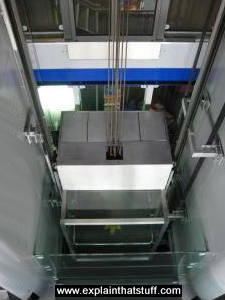
Photo: Every so often, you might stumble across an elevator that shows off its secrets. If you wait for the cars to move out of the way, you can often see some of the workings and figure out which bits do what. Photo courtesy of Carol M. Highsmith's America Project in the Carol M. Highsmith Archive,
Library of Congress, Prints & Photographs Division.
Sponsored links
How elevators use energy
Scientifically, elevators are all about energy. To get from the ground to the 18th
floor walking up stairs you have to move the weight of your body
against the downward-pulling force of gravity. The energy you expend
in the process is (mostly) converted into potential energy, so
climbing stairs gives an increase in your potential energy (going up)
or a decrease in your potential energy (going down).
This is an example of the law of conservation of energy in action.
You really do have more potential energy at the top of a building than at the bottom, even if it doesn't feel any different.
To a scientist, an elevator is simply a device that increases or decreases a person's
potential energy without them needing to supply that energy
themselves: the elevator gives you potential energy when you're going up
and it takes potential energy from you when you're coming down. In
theory, that sounds easy enough: the elevator won't need to use much
energy at all because it will always be getting back as much (when it
goes down) as it gives out (when it goes up). Unfortunately, it's not
quite that simple. If all the elevator had were a simple hoist with a
cage passing over a pulley, it would use considerable amounts of energy
lifting people up but it would have no way of getting that energy back: the energy would
simply be lost to friction in the cables and brakes (disappearing
into the air as waste heat) when the people came back down.
How much energy does an elevator use?
Photo: Elevators don't just hang from a single cable: there are several strong cables supporting the car in case one breaks. If the worst does happen, you'll find there's often an emergency intercom telephone you can use inside an elevator car to call for assistance.
If an elevator has to lift an elephant (weighing let's say 2500 kg) a distance of maybe 20m
into the air, it has to supply the elephant with 500,000 joules of
extra potential energy. If it does the lift in 10 seconds, it has to
work at a rate of 50,000 joules per second or 50,000 watts, which is
about 20 times as much power as a typical electric toaster uses.
Most elevators don't carry elephants; they carry people.
Suppose we have six average American males weighing about 80kg (180lb) each,
which makes roughly 500kg. Then our elevator would need only about a fifth
of the power or more like 10,000 watts—and that turns out to be a decent
estimate, because (from what I can glean from a quick online search) the power consumption of real
elevators is generally in the 5–15kW range, depending on the load.
[2]
Suppose the elevator is indeed carrying elephants, all day long (10 hours or 10 × 60 = 600
minutes or 10 × 60 × 60 = 36,000 seconds), and lifting for half that time
(18,000 seconds). It would need a grand total of 18,000 × 50,000 = 900
million joules (900 megajoules) of energy, which is the same as 250
kilowatt hours in more familiar terms.
In fact, the elevator wouldn't be 100 percent efficient: all the energy it took from the
electricity supply wouldn't be completely converted into potential energy in
rising elephants. Some would be lost to friction, sound, heat,
air resistance (drag), and other losses in the mechanism. So the real energy consumption would
be somewhat greater.
That sounds like a huge amount of energy—and it is. But much of it
can be saved by using a counterweight.
The counterweight
Photo: The counterweight rides up and down on wheels that follow guide tracks on the side of
the elevator shaft. The elevator car is at the top of this shaft (out of sight) so the counterweight is at the bottom. When the car moves down the shaft, the counterweight moves up—and vice versa. Each car has its own counterweight so the cars can operate independently of one another. On this picture, you can also see the doors on each floor that open and close only when the elevator car is aligned with them.
In practice, elevators work in a slightly different way from simple hoists. The elevator car
is balanced by a heavy counterweight that weighs roughly the same
amount as the car when it's loaded half-full (in other words, the weight
of the car itself plus 40–50 percent of the total weight it can carry).
[3]
When the elevator goes up, the counterweight goes down—and vice-versa, which helps us in
four ways:
The counterweight makes it easier for the motor to raise and lower the car—just
as sitting on a see-saw makes it much easier to lift someone's
weight compared to lifting them in your arms. Thanks to the
counterweight, the motor needs to use much less force to move the
car either up or down. Assuming the car and its contents weigh more than the counterweight, all
the motor has to lift is the difference in weight between the two and supply a bit of extra
force to overcome friction in the pulleys and so on.
Since less force is involved, there's less strain on the cables—which makes the elevator
a little bit safer.
The counterweight reduces the amount of energy the motor needs to use. This is
intuitively obvious to anyone who's ever sat on a see-saw: assuming
the see-saw is properly balanced, you can bob up and down any number
of times without ever really getting tired—quite different from
lifting someone in your arms, which tires you very quickly. This
point also follows from the first one: if the motor is using
less force to move the car the same distance, it's doing less work
against the force of gravity.
The counterweight reduces the amount of braking the elevator needs to use. Imagine if
there were no counterweight: a heavily loaded elevator car would be
really hard to pull upwards but, on the return journey, would tend
to race to the ground all by itself if there weren't some sort of
sturdy brake to stop it. The counterweight makes it much easier to control the
elevator car.
In a different design, known as a duplex counterweightless elevator, two cars are connected
to opposite ends of the same cable and effectively balance each
other, doing away with the need for a counterweight.
The safety brake
Everyone who's ever traveled in an elevator has had the same thought: what if the cable
holding this thing suddenly snaps? Rest assured, there's nothing to
worry about. If the cable snaps, a variety of safety systems prevent
an elevator car from crashing to the floor. This was the great
innovation that Elisha Graves Otis made back in the 1860s. His
elevators weren't simply supported by ropes: they also had a
ratchet system as a backup. Each car ran between two
vertical guide rails with sturdy metal teeth embedded all the way up
them. At the top of each car, there was a spring-loaded mechanism
with hooks attached. If the cable broke, the hooks sprung
outward and jammed into the metal teeth in the guide rails,
locking the car safely in position.
Sponsored links
How the original Otis elevator worked
Artwork: The Otis elevator. Thanks to the wonders of the Internet, it's really easy to look at original patent documents and find out exactly what inventors were thinking. Here, courtesy of the US Patent and Trademark
Office, is one of the drawings Elisha Graves Otis submitted with his "Hoisting Apparatus" patent dated January 15, 1861. I've colored it in a little bit so it's easier to understand.
Greatly simplified, here's how it works:
The elevator compartment (1, green) is raised and lowered by a hoist and pulley system (2) and a moving counterweight (not visible
in this picture). You can see how the elevator is moving smoothly between vertical guide bars: it doesn't just dangle stupidly from the rope.
The cable that does all the lifting (3, red) wraps around several pulleys and the main winding drum. Don't forget this elevator was invented before anyone was really using electricity: it was raised and lowered by hand.
At the top of the elevator car, there's a simple mechanism made up of spring-loaded arms and pivots (4). If the main cable (3) breaks, the springs push out two sturdy bars called "pawls" (5) so they lock into vertical racks of upward-pointing teeth (6) on either side. This ratchet-like device clamps the elevator safely in place.
Photo: A modern elevator has much in common with the original Otis design. Here you can see the little wheels at the edges of an elevator car that help it move smoothly up and down its guide bars.
According to Otis, the key part of the invention was: "having the pawls and the teeth of the racks hook formed, essentially as shown, so that the weight of the platform will, in case of the breaking of the rope, cause the pawls and teeth to lock together and prevent the contingency of a separation of the same."
If you'd like a more detailed explanation, take a look at the original Otis patent, US Patent #31,128: Improvement in Hoisting Apparatus. It explains more fully how the winch and pulleys work with the counterweight.
Did Otis invent the elevator?
No. He invented the safety elevator: he noted how ordinary elevators could fail and came up with a better
design that made them safer. The Otis elevator dates from the middle of the 19th century, but ordinary elevators date back
much further—as far as Greek and Roman times. We can trace them back to more general kinds of lifting equipment such as cranes,
windlasses, and capstans; ancient water-raising devices such as the shaduf (sometimes spelled shadoof), based on a kind of swinging see-saw design, may well have inspired the use of counterweights in early elevators and hoists.
[4]
Speed as well as safety
Safety wasn't the only attractive feature of the Otis elevator. One of his (somewhat
clunky) marketing lines was "by the power of ascension of the unassisted human leg":
thanks to Otis, people and buildings could swiftly and safely go places they'd never been before—high into the air.
[5]
Sponsored links
Speed governors
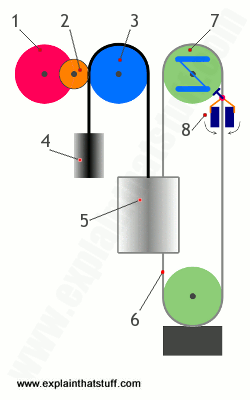
Most elevators have an entirely separate speed-regulating system called
a governor, which is a heavy
flywheel with
massive mechanical arms built inside it. Normally the arms are held inside
the flywheel by hefty springs, but if the lift moves too fast, they
fly outward, pushing a lever mechanism that trips one or more braking systems.
First, they might cut power to the lift motor. If that fails and the lift continues to accelerate,
the arms will fly out even further and trip a second mechanism, applying the brakes.
Some governors are entirely mechanical; others are electromagnetic;
still others use a mixture of mechanical and electronic components.
Artwork: How a governor works. The lift motor (1) drives gears (2) that turn the sheave (3)—a grooved wheel that guides the main cable. The cable supports both the counterweight (4) and lift car (5). A separate governor cable (6) is attached to the lift car and the governor mechanism on the right. The governor consists of a flywheel with centrifugal arms inside it (7). If the lift moves too quickly, the arms fly outward, tripping a safety mechanism that applies brakes to the governor cable (8) and slows it down. Because the governor cable is now moving slower than the main cable and the car itself, it activates another mechanism that causes friction brakes to shoot out from the elevator car onto its outer guide rails, bringing it smoothly and safely to a halt (in a similar way to the original Otis safety mechanism).
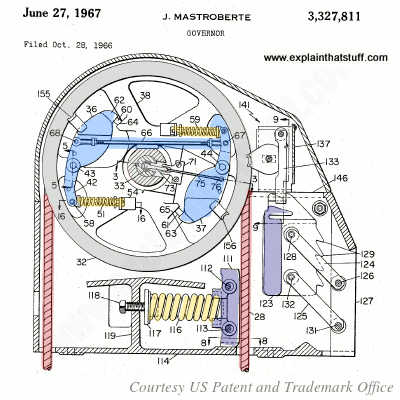
Artwork: An example of a fully mechanical governor mechanism designed by Otis engineers in the 1960s. You can see the flywheel (gray) with its centrifugal arms inside (light blue) and the springs that hold them in (yellow). When the wheel turns too fast, the arms fly outward, tripping a braking device that applies a pair of spring-loaded arms (darker blue) to the governor rope (brown). From US Patent 3,327,811: Governor by Joseph Mastroberte, Otis Elevator Company, patented June 27, 1967. Artwork courtesy of US Patent and Trademark Office (with colors added to make it easier to understand).
Photo: Older elevators sometimes used centrifugal governors, with two heavy little metal balls that moved up and out as they spun around, locking the car if they moved too fast and too far. This is the hoist motor and hoist (left) and centrifugal governor (right) on an old Otis elevator at the Grand Coulee Dam. Photograph by Jet Lowe, Library of Congress, Prints & Photographs Division, HAEL WASH,13-GRACO,1A--32.
Artwork: Here's a detail of an early Otis centrifugal governor from one of the company's promotional brochures, dated 1893. This is similar to the governor you can see in the photo above, but
in much enlarged view. You can see the two metal balls that spin around, connected to the central
wheel by a bevel gear. They rise upward if the car moves too fast, pulling on a brake lever that slows the car down safely. Source: Hydraulic, electric, steam and belt elevators by Otis Brothers. Peerless Press, 1893, courtesy of the Internet Archive.
Other safety systems
Modern elevators have multiple safety systems. Like the cables on a suspension
bridge, the cable in an elevator is made from many metal strands
of wire rope twisted together so a small failure of one part of the cable isn't, initially at
least, going to cause any problems. Most elevators also have
multiple, separate cables supporting each car, so the complete failure of one cable leaves
others functioning in its place. Even if all the cables break, this system will still hold the car in place.
In November 2018, it was widely reported in over-sensational media accounts that an elevator car
at 875 North Michigan Avenue in Chicago (the skyscraper formerly known as the John Hancock Cente)
had "plunged" down 84 floors after a cable failure.
In fact, as a detailed safety inspector's report later made clear, only one of seven hoist ropes had broken
and the other six intact cables had allowed a slow, controlled descent from the 20th floor to the 11th floor, where
passengers were eventually rescued. The elevator's safety systems worked exactly as designed
and it was "never out of control or unsafe."
Photo: One of the elevators at 875 North Michigan Avenue in Chicago.
Multiple safety systems ensure you return to the ground even when a cable fails.
Photo courtesy of Carol M. Highsmith's America Project in the Carol M. Highsmith Archive,
Library of Congress, Prints & Photographs Division.
Finally, if you've ever looked at a transparent glass elevator, you'll have noticed a giant
hydraulic or gas spring
buffer at the bottom to cushion against an impact
if the safety brake should somehow fail. Thanks to Elisha Graves Otis, and
the many talented engineers who've followed in his footsteps, you're
much safer inside an elevator than you are in a car.
How does a hydraulic elevator work?
Elevators that work with cables and wheels are sometimes called traction elevators, because they
involve a motor pulling on the car and counterweight. Not all elevators work this way, however.
In small buildings, it's quite common to find hydraulic elevators that raise and lower a
single car using a hydraulic ram (a fluid-filled piston similar to the ones that operate construction machines like bulldozers and cranes).
Hydraulic elevators are mechanically simpler and therefore cheaper to install, but since they typically don't use counterweights, they consume more power raising and lowering the car.
They're inherently safe and offer a super-smooth ride, but they do move slowly. Unlike
traction elevators, they're only used in relatively low buildings, partly because of
their speed but also because of the energy you'd needed to lift the car through greater
heights.
Sometimes the hydraulic ram is installed directly underneath the car and pushes it up and down (a design known as direct-acting). Alternatively, if there isn't room to do that, the ram can be mounted to the side of the lift shaft, operating the car using a system of ropes and sheaves (in a design known as indirect-acting). More complex elevators, like the one shown here, use multiple hydraulic cylinders and counterweights.
Artwork: A hydraulic elevator with an energy-saving counterweight. In this design, the passenger car (1) is supported by a direct-acting hydraulic ram (2), connected through a hydraulic pump (3) operated by a motor (4) connected to a second hydraulic ram (5) that operates a counterweight (6). As the elevator car falls, the pump transfers hydraulic fluid from one ram (2) to the other (5), so avoiding the need for a fluid reservoir. My drawing is based on a design by Otis described in US Patent 5,975,246: Hydraulically balanced elevator by Renzo Toschi, Otis Elevator Company, patented November 2, 1999.
Artwork: An early Otis direct-acting hydraulic freight elevator from one of the company's promotional brochures, dated September 1893. In this design, the moving hydraulic ram lifts the load; in indirect designs, the ram moves the load through a system of intermediate pulleys. Source: Hydraulic, electric, steam and belt elevators by Otis Brothers. Peerless Press, 1893, courtesy of the Internet Archive.
Photo: Here's a typical direct-acting hydraulic elevator in a small shopping mall. I've colored the hydraulic ram red so you can spot it more easily. Note the guide rails on the sides and the complete lack of a motor, winding gear, or other safety cables on top.
About the author
Chris Woodford is the author and editor of dozens of science and technology books for adults and children, including DK's worldwide bestselling Cool Stuff series and Atoms Under the Floorboards, which won the American Institute of Physics Science Writing award in 2016. You can hire him to write books, articles, scripts, corporate copy, and more via his website chriswoodford.com.
Sponsored links
Don't want to read our articles? Try listening instead
In New Proposed Subway Elevators, Some See a Terrorism Risk by Sarah Maslin Nirjan. The New York Times, January 22, 2018. Elevators that could make subways more accessible are being opposed by some Manhattan residents as potential security risks.
Riding a Time Capsule to Apartment 8G by Andy Newman. The New York Times, December 15, 2017. A celebration of old-fashioned, manually
operated elevators.
To the Elevators, and Then to the Pit by Julie Besonen. The New York Times. August 22, 2014. A fascinating introduction to The Elevator Historical Museum.
Fastest Elevator: Hyundai Elevator's Test Tower by Eliza Strickland. IEEE Spectrum. June 1, 2011. Cutting-edge skyscrapers need cutting-edge elevators capable of traveling at 64km/h (40mph).
On the up by Sean Couglan, BBC News, April 6, 2007. A short historical review of lift technology, from Otis to the Taipei 101.
Smart Elevators by Clive Thompson. The New York Times, December 10, 2006. The Miconic 10 gets people to their destination faster by directing passengers to different elevator cars in the lobby.
Elevator Traffic Handbook: Theory and Practice by Gina Barney and Lutfi Al-Sharif. Routledge, 2016. Explores the theory of designing elevators (and other transportation systems) for the most efficient movement of large numbers of people.
The Vertical Transportation Handbook by George R. Strakosch and Robert S. Caporale. John Wiley, 2010. An up-to-date reference about modern elevator systems produced with Elevator World magazine.
History
Lifted: A Cultural History of the Elevator by Andreas Bernard. NYU Press, 2014. Architecture, engineering, politics, and psychology are some of the topics covered in this wide-ranging study.
Otis Elevator Brochure c.1900 This archived brochure shows us that electric and hydraulic elevators were quite sophisticated in the early 20th century, though their maximum speed was only about 11mph (1000 ft/min).
A History of Engineering in Classical and Medieval Times by Donald R. Hill. Routledge, 1984. Although this book doesn't cover elevators (so far as I remember), it does go into excellent detail about ancient water-raising machines used for irrigation, which were among the earliest mechanical lifting devices.
Hydraulic, electric, steam and belt elevators by Otis Brothers. Peerless Press, 1893. This wonderful 54-page book contains some great early illustrations of elevators (including a few of the ones I've posted above).
For younger readers
Elevators by Tracy Maurer. Rourke Educational, 2017. A 48-page introduction for ages 8–11.
Be an Elevator Mechanic by Wil Mara. Cherry Lake, 2019. A 32-page overview for budding engineers.
↑ Estimates vary wildly according to the size of the elevator, the type of motor (electric, hydraulic, or whatever), and the height of the building served. Otis quotes a range of 3.3–17kW for its GeN2™ Flex+ elevators.
Small domestic pneumatic elevators made by PVE use about 5 kilowatts.
[PDF] Advancing Elevator Energy Efficiency by Harvey Sachs et al, American Council for an Energy-Efficient Economy, Jan 2015 quotes 90kW for a 14-story New York City elevator.
↑ Quoted in "Chapter 6: Counterweight " of Elevator Mechanical Design by By Lubomír Janovský, Elevator World, 1999, p.207.
↑ The earliest known elevator was built by Archimedes c.236 BCE using a capstan-powered hoist, according to Roman engineer Vitruvius (a story retold in The Elevator Constructor, 1967). For a great account of the elevator's more recent backstory, see Lee Gray's book in the list below.
Please do NOT copy our articles onto blogs and other websites
Articles from this website are registered at the US Copyright Office. Copying or otherwise using registered works without permission, removing this or other copyright notices, and/or infringing related rights could make you liable to severe civil or criminal penalties.