Simple, convenient, cheap, and
economical—bicycles are one of the
world's favorite forms of transportation. But they're not for
everyone. They can be hard to pedal up and down hills or with heavy
loads, and elderly or disabled people may find them impossible to
manage. In the last few years, a new generation of electric bicycles
has begun to revolutionize our idea of environmentally friendly
transportation. These new cycles have all the convenience of cars with
all the simple economy of ordinary cycles. Let's take a closer look at
how they work.
Photo: This typical electric bicycle, a Sanyo Eneloop (now discontinued), had a range of about 30–55 km (17–35 miles) and a top speed of around 24 km/h (15 mph). Note the 250-watt hub motor on the front wheel and the 5.7Ah lithium-ion
battery pack (black, marked "Sanyo," just in front of the back wheel). Picture by kind permission and courtesy of Richard Masoner, originally published on Flickr under a Creative Commons (CC BY-SA 2.0) licence.
If you have dynamo-powered bicycle lights, you already own an
electric-powered bicycle! Consider: as you pump your legs up and down
on the pedals, you make the wheels rotate. A small dynamo
(generator) mounted on
the rear wheel produces a tiny current of
electricity that keeps your
back safety lamp lit in the dark. Now suppose you could run this
process backward. What if you removed the lamp and replaced it with a
large battery. The battery would kick out
a steady electric current,
driving the dynamo in reverse so that it spun around like an
electric motor. As the dynamo/motor turned, it would rotate the tire and make
the bike go along without any help from your pedaling. Hey presto: an electric
bike! It may sound a bit far-fetched, but this is more or less exactly
how electric bikes work.
Key parts of an electric bike
There are four key parts to an electric bike: the batteries, the
motor, the sturdy frame and spokes, and the brakes.
Sponsored links
Batteries
Electric bicycles give themselves away with their large battery packs, usually mounted somewhere on the frame between the wheels. In the photo of the Sanyo Eneloop up above, the battery is mounted vertically next to the seat tube
(the vertical part of the frame in front of the back wheel); in the photo below, it's mounted on the down tube (the diagonal part of the frame behind the front wheel).
Photo: A battery pack built into the frame of a Yuba Boda typical electric cargo
bike. Photo by Dennis Schroeder courtesy of
NREL.
(NREL photo id#95899).
The batteries are the most important
parts of the bike, because (if you don't do any pedaling) they
contain all the power that will drive you along. Typical electric bike
batteries make about 350–500 W of power (that's about 35–50 volts and
10 amps), which is about a quarter as much as you need to drive an
electric toaster. In theory, you could use any kind of battery on a
bicycle. In practice, however, you want to use something that stores
lots of power without being too heavy—or you'll be using half your
power just moving the battery along! That tends to rule out heavy
lead-acid batteries like the ones that start cars, though some electric
bikes do use them. Lightweight
lithium-ion batteries,
similar to those used in laptop computers,
mobile (cellular) phones, and MP3
players, are now the most popular choice, though they're more
expensive
than older rechargeable battery technologies such as nickel-cadmium
("nicad"). Typical batteries will give your bicycle a range of 10–40
miles between charges (depending on the terrain) and a top speed of
10–20 mph (which is about the maximum most countries allow for these
vehicles by law). You can extend the range by pedaling or
free-wheeling some of the time.
Electric motor
In the theoretical electric bike we considered up above, we had the
dynamo/motor driving the back wheel directly, simply by pressing on the
tire. Most electric bikes work a different way. They have compact electric motors
built into the hub of the back or front wheel (or mounted in the center
of the bike and connected to the pedal sprocket). Take a look at
the hub of an electric bike and probably you'll see it's much fatter and bulkier
than on a normal bike. You can read more about how these motors work in our main article about hub motors.
Photo: Left: The hub motor of an electric bike. Right: If you took off the casing,
this is the kind of thing you'd see. It's a simple brushless motor from a PC cooling fan, but it works
in broadly the same way as a bike's hub motor. There's a static part made up of four electromagnet coils (left) and a rotating
part (right) made from a permanent magnet (the gray ring) that clips onto it. When the coils are energized in
sequence, they generate a magnetic field that makes the permanent magnet and fan spin around. At a glance, a hub motor looks much
like an ordinary bicycle hub, but look closer and you'll find it's a lot more bulky.
Hub motors aren't the only way to power electric bicycle wheels. If you've ever watched a mouse scampering around inside an exercise wheel, you might have wondered if you could drive a wheel electrically, in a similar way, with something that pushes against the inside of the rim.
A company called GeoOrbital has developed an ingenious mechanical equivalent that can be used to power conventional bikes—and here's a simplified illustration of how it works.
It has a motorized drive roller (red) that presses against the inner rim, powered by a battery pack (orange) that sits snugly inside the wheel. Two guide rollers (blue) mounted on a tensioned framework (green) take the place of the conventional arrangement of spokes. According to GeoOrbital, you can fit one of its wheels to a normal bike in just 60 seconds.
Artwork: GeoOrbital's radically different electric bicycle wheel.
Frame
The frame of an electric bike also has to be slightly different. The
main part of the frame (the bit that supports your weight) is usually
made from lightweight aluminumalloy: the lighter the frame, the
lighter the weight of the bike overall, and the further it can travel
before you need to recharge the batteries. The spokes on the wheel also
have to be stronger than the thin spokes on a traditional bicycle.
That's because the electric motor in the hub spins the wheel with a lot
of turning force (known as torque) and, if the spokes were ordinary
lightweight ones, they could bend or buckle.
Photo: The sturdy aluminum alloy frame of a RadRhino electric bike.
It's essentially a power-assist bike, driven by a 250-watt geared hub motor on the back wheel,
and has a range of up to 72 kilometers (45 miles) per charge.
Photo by Bryan Bechtold courtesy of NREL.
(NREL photo id#139967)
Brakes
Some electric bikes claim to use a neat trick called
regenerative braking. If
you start pedaling the bicycle or going downhill, the spinning wheels
turn the electric motor in the hub in reverse and start charging up the
batteries. In practice, regenerative braking is nowhere near as useful
on an electric bicycle as it is on an electric train or car.
An electric bike has much less mass and velocity than either a train or car, so it never gains (or loses) anything like
as much kinetic energy when it starts and stops.
You'd have to go down an awful lot of hills to charge up
the batteries completely and that's usually not practical. And what's
the point in pedaling the wheels simply to charge the battery? You
might as well have bought an ordinary bicycle to start with!
Sponsored links
Two types of electric bike motors
There are two main kinds of electric cycle, broadly known as full-power and power-assist, and
they differ in the way they're powered by the electric motor:
Full-power: These bikes are designed for minimal pedaling over relatively short distances. They have large batteries and powerful hub motors and they tend to be big, sturdy, and heavy. Bikes like this are for people who love cycling but hate pedaling! Since you're using power all the time, the range is limited (typically 16–30km or 10–20 miles).
Power-assist: Also known as pedal-assist bikes, these are the bicycle equivalents of hybrid cars: they're designed to be pedaled quite a lot of the time and electrically powered either when you're tired or when you feel like a bit of electric help (when you're going up hill, for example). Unlike full-power bikes, they don't
all have hub motors; instead, there's sometimes a separate electric motor mounted near the rear wheel and driving it either through the gear sprocket or simply by pressing against the rear tire.
Where a full-power type of hub motor is difficult or impossible to pedal without any power (because you're effectively turning it into a generator),
power-assist motors turn easily with little or no resistance when you pedal. That gives power-assist bikes much greater range than hub-motor ones (as much as 80–145km or 50–90 miles).
Photo: Zap Electric's power-assist kit turns a conventional bike into an electric one. There's a bolt-on DC electric motor (weighing just over 3kg or 7lb) just above the back wheel, behind the police officer's foot, pressing against the tire and driving it by simple friction. The motor's powered by a compact lead-acid battery (weighing about 5.5 kg or 12 lb) inside a protective nylon bag. This kit adds quite bit of weight to the bike, but gives extra range and speed when needed. Photo taken in Santa Rosa, California by Rick Tang courtesy of NREL.
Photo: Enzo's power-assist bike uses a hub motor on the rear wheel and can be powered, pedaled, or both for a maximum speed of 32 km/h (20 mph) over a range of 50–80 km (30–50 miles). Photo by Bryan Bechtold courtesy of NREL.
(NREL photo id#139687)
How environmentally friendly are electric bikes?
There's no question that electric bikes are far better for the
environment than petrol-powered car engines.
But that doesn't mean
they're completely perfect. Making and disposing of batteries can be
very polluting. Not only that, but an electric bicycle is still using
energy that has to come from somewhere. You
may think you're using clean green power, but the electricity you use for getting about might
have come from a filthy old, coal-fired power
plant or one driven by nuclear energy.
(If you're lucky, of course, it might have come from solar panels or
a wind turbine!)
Photo: Could solar power be the future of electric bicycles? The large solar panel mounted over the back wheel of this experimental bike powers an electric motor connected by a chain drive to the back wheel, helping the rider when he doesn't feel like pedaling. Using clean, green solar power would remove the problem of having to charge electric bikes with electricity generated from fossil fuels—and help to extend their range significantly. Photo by Warren Gretz courtesy of US DOE/NREL (NREL photo id#17807).
Electric bikes are nowhere near as environmentally friendly as ordinary push bikes, but
nothing is ever perfect—and, as people often say, "the perfect is the enemy of the good."
Electric bikes are certainly a step in the right direction. If everyone used them to get about instead of cars, global warming might be less of a problem, and the world would be a far cleaner and healthier place!
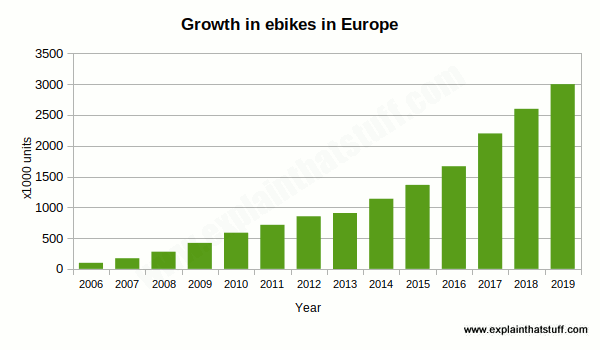
Chart: Electric bicycles are rapidly becoming popular. This chart shows the growth in sales of what the manufacturers refer to as "electric power-assisted cycles (EPACs)" in European countries over the last decade. Several million electric bikes are sold in Europe each year, which represents about 10 percent or so of total European bicycle sales. What this chart doesn't reveal is that the bikes are much more popular in some countries than others: four countries account for about 70 percent of all the sales (Germany, 36 percent; the Netherlands, 16 percent; Belgium, 10 percent; and France 8 percent). Data source: CONEBI (Confederation of the European Bicycle Industry).
Who invented electric bikes?
The oldest patent for an electric bike I've been able to find at the US Patent and Trademark Office is this
one, by Ogden Bolton, Jr. of Canton Ohio, which was filed in September 1895 and granted three months later.
Artwork: One of the first electric bicycles. Two artworks from
US Patent 552,271: Electrical Bicycle by Ogden Bolton, courtesy of US Patent and Trademark Office. Please note that I've colored
the original artwork and edited it slightly to improve clarity.
You can see from these original diagrams that it bears an amazingly close resemblance to modern electric bikes. In
the general picture on the left, you can see there's a hub motor on the rear wheel (blue), a battery suspended from the frame (red), and a simple handlebar control to make the thing stop and go. In the more detailed cutaway of the hub motor on the right, you can
see there's a six-pole magnet in the center (orange) bolted to the frame and an armature (made from coiled wire, yellow) that rotates
around it when the current is switched on. It's quite a hefty motor even by modern standards; Ogdon mentions
"a heavy current at low voltage—for instance, to carry one hundred amperes at ten volts." So that's
1000 watts, which is about twice the power of a typical modern bike hub motor.
The E-Bike Book by Hannes Neupert et al, teNeues Verlag, 2013. Quite a lot of detail and many photos and illustrations make this a book for browsing as well as learning.
Build Your Own Electric Bicycle by Matthew Slinn. TAB Green Guru Guides/McGraw-Hill, 2010. Introduces electric bikes and their benefits, discusses safety and legal issues, then goes on to explain how to build a bike with a hub motor kit. Also covers repair, maintenance, and more advanced projects.
Electric Bicycles by David Henshaw and Richard Peace. Excellent Books, 2010. Introduces electric bikes, describes their history, and explains how to choose and use a bike of your own.
How an E-Bike Changed My Life by Jennifer Finney Boylan, The New York Times, August 20, 2019. How an e-bike gave a cyclist a new lease of life.
Why I’m proud to ride an e-bike by Philippa Perry, The Guardian, August 27, 2017. A typical member of the "e-bike target audience" puts power-assisted cycles to the test.
The Surprising Health Benefits of an Electric Bike by Gretchen Reynolds. The New York Times, July 6, 2016. Electric bikes can encourage motorists back onto two wheels, with real benefits to their health.
E-Bike Sales Are Surging in Europe by Danny Hakim. The New York Times, August 8, 2014. Europe appears to be embracing electric bikes but, on closer inspection, some countries are buying into them much faster than others.
An Electric Boost for Bicyclists by J. David Goodman. The New York Times, January 31, 2010. There are over 120 million electric bicycles in China, and now Chinese makers have got behind the technology, they are driving growth in other world markets.
The Hybrid E-Bike by David Schneider, IEEE Spectrum, August 31, 2009. Explores ways to make your own pedal-assist bike.
Please do NOT copy our articles onto blogs and other websites
Articles from this website are registered at the US Copyright Office. Copying or otherwise using registered works without permission, removing this or other copyright notices, and/or infringing related rights could make you liable to severe civil or criminal penalties.