

The science of bicycles
by Chris Woodford. Last updated: November 16, 2023.
If you had to pick the greatest machine of all time, what would you say? If we were talking about machines that helped spread knowledge and educate people, you'd probably opt for the printing press. If we meant inventions that let people farm the land and feed their families, you might plump for the plow or the tractor. If you think transportation is really important, you could go for the car engine, the steam engine, or the airplane jet engine. But for its sheer simplicity, I think I would pick the bicycle. It's a perfect example of how pure, scientific ideas can be harnessed in a very practical piece of technology. Let's take a look at the science of cycles—and just what makes them so great!
Photo: The bicycle—a brilliantly simple form of transportation, wherever in the world you happen to be. Something like 130 million new bicycles are produced, worldwide, each year [1] and over 90 percent of them are now manufactured in China. Photo by Roger S. Duncan courtesy of US Navy and Wikimedia Commons.
Sponsored links

Contents
What's so good about bicycles?
What's so good is that they get you places quickly without gobbling up fossil fuels like gasoline, diesel, and coal or creating pollution. They do that because they very efficiently convert the power our bodies produce into kinetic energy (energy of movement). In fact, as you can see from the chart below, they're the most efficient transportation machines humans have developed so far. Harnessing the power from your muscles in an amazingly effective way, a bicycle can convert around 90 percent of the energy you supply at the pedals into kinetic energy that powers you along. Compare that to a car engine, which converts only about a quarter of the energy in the gasoline into useful power—and makes all kinds of pollution in the process.

Chart: Efficiencies of everyday machines compared (rough, guideline figures expressed as percentages). With the exception of the bicycle, newer technologies (such as diesel engines) are generally more efficient than older technologies (such as steam engines).
“A human and a bicycle are the perfect synthesis of body and machine.”
Richard Ballantine
Look at it this way: If you drive a car, you're dragging a lump of metal that probably weighs 10–20 times as much as you do wherever you go (a typical compact car weighs well over 1000kg or 2000lb). What a waste of energy! Go by bike and the metal you have to move around with you is more like 6–9kg (14–20lb) for a lightweight racing bike or 11–20kg (25–45lb) for a mountain bike or tourer, which is a fraction of your own weight.
Better efficiency means you can go further on the same amount of fuel, which is another great advantage of bikes, although a little hard to quantify. According to the classic Bicycling Science book by David Gordon Wilson et al: "A racing bicyclist at 32km/h (20mph) could travel more than 574 kilometers per liter (1,350 miles per US gallon) if there were a liquid food with the energy content of gasoline." Whichever way you look at it, bikes are pretty amazing!
Where does your energy go?
We've described a bicycle as a machine and, in scientific terms, that's exactly what it is: a device that can magnify force (making it easier to go uphill) or speed. It's also a machine in the sense that it converts energy from one form (whatever you had to eat) into another (the kinetic energy your body and bicycle have as they speed along). Now you've probably heard of a law of physics called the conservation of energy, which says that you can't create energy out of thin air or make it vanish without trace: all you can do is convert it from one from to another. So where does the energy you use in cycling actually go? It scientific terms, we say it goes into "doing work"— but what does that mean in practice?
Cycling can sometimes feel like hard work, especially if you're going uphill. In the science of cycling, "hard work" means that you sometimes have to use quite a lot of force to pedal any distance. If you're going uphill, you need to work against the force of gravity. If you're going fast, you're working against the force of air resistance (drag) pushing against your body. Sometimes there are bumps in the road you have to ride over; that takes more force and uses energy too (bumps reduce your kinetic energy by reducing your speed).

Photo: Bicycles work so well with the human body because they harness power from our large and very powerful leg muscles. Recumbent bicycles (ones you ride lying down) might look ultra-modern and a bit weird, but they date back at least 100 years. They're faster than conventional bicycles because their riders adopt a much more aerodynamic, tube-like posture that minimizes drag. Since the pedals are higher off the ground, the cranks can be longer, so you get more leverage, your muscles can make high power for longer, and do so more efficiently. Photo by Robin Hillyer-Miles courtesy of US Navy and Wikimedia Commons.
But whether you're going uphill or downhill, fast or slow, on a smooth road or a bumpy one, there's another kind of work you always have to do simply to make your wheels go around. When a wheel rests on the ground, supporting a load such as a rider on a bike, the tire wrapped around it is squashed up in some places and bulging out in others. As you cycle along, different parts of the tire squash and bulge in turn and the rubber they're made from is pulled and pushed in all directions. Repeatedly squashing a tire in this way is a bit like kneading bread: it takes energy—and that energy is what we know as rolling resistance. The more load you put on the tire (the heavier you are or the more you're carrying), the higher the rolling resistance. Around 80–90 percent of rolling resistance is caused by deformation of the tire itself, with the remainder coming from the air resistance of the tire and the way it slips against the ground.
For a racing bike traveling fast, about 80 percent of the work the cyclist does will go in overcoming air resistance, while the remainder will be used to battle rolling resistance; for a mountain biker going much more slowly over rough terrain, 80 percent of their energy goes in rolling resistance and only 20 percent is lost to drag. There are also small frictional losses in things like the chain and gears, but, however and whatever you're riding, as long as it's reasonably well maintained, the energy lost this way is usually not worth worrying about.

Chart: Slow mountain bikes waste most energy through rolling resistance; faster racing bikes waste more through air resistance.
How much energy are we actually talking about here? In the Tour de France, according to a fascinating analysis by Training Peaks, top riders average about 300–400 watts of power, which is as much as 3–4 old-fashioned 100-watt lamps or about 15 percent of the power you'd need to drive an electric kettle. For comparison, you can generate about 10 watts with a hand-cranked electricity generator, though you can't use one of those for very long without getting tired. What does this tell us? It's much easier to generate large amounts of power for long periods of time by using your big leg muscles than by using your hands and arms. That's why bikes are so clever: they make good use of the most powerful muscles in our body.
How a bicycle frame works
Assuming an adult weights 60–80kg (130–180lb), the frame of a bicycle has to be fairly tough if it's not going to snap or buckle the moment the rider climbs on board. Ordinary bicycles have frames made from strong, inexpensive, tubular steel (literally, hollow steel tubes containing nothing but air) or lighter alloys based on steel or aluminum. Racing bicycles are more likely to be made from carbon-fiber composites, which are more expensive but stronger, lighter, and rustproof.
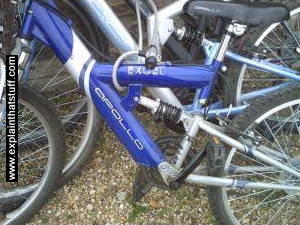
Photo: The bicycle's inverted A-frame is an incredibly strong structure that helps to distribute your weight between the front and back wheels. It helps to lean forward or even stand up when you're going uphill so you can apply maximum force to the pedals and keep your balance.
You might think that a bike frame made out of aluminum tubing would be much weaker than one made from steel—but only if the tubes are similar in dimensions. In practice, every bike needs to be strong enough to support the rider's weight and the loads it's likely to experience during different kinds of handling. So an aluminum bike would use tubing with a larger diameter and/or thicker walls than a bike made from steel tubing.
The frame doesn't simply support you: its triangular shape (often two triangles joined together to make a diamond) is carefully designed to distribute your weight. Although the saddle is positioned much nearer to the back wheel, you lean forward to hold the handlebars. The angled bars in the frame are designed to share your weight more or less evenly between the front and back wheels. If you think about it, that's really important. If all your weight acted over the back wheel, and you tried to pedal uphill, you'd tip backwards; similarly, if there were too much weight on the front wheel, you'd go head over heels every time you went downhill!
No material is 100 percent rigid and bicycles are made of multiple components, not just the basic frame, so they do flex and give a little as they're subjected to different kinds of force, at different times, by different shapes and sizes of riders. Some frames flex more than others, some are stiffer than others. Some will feel harsher, others will feel more comfortable. There's no golden scientific rule determining which frame material is "best": what matters is what works best for you in the conditions you're riding under at any given moment. And that's a general lesson of materials science: whether you're building a bike or a bridge, the "best" material depends on what you're doing, where, how, and under what conditions.
How bicycle wheels work

Photo: Like a car wheel, a bicycle wheel is a speed multiplier. The pedals and gears turn the axle at the center. The axle turns only a short distance, but the leverage of the wheel means the outer rim turns much further in the same time. That's how a wheel helps you go faster.
If you've read our article on how wheels work, you'll know that a wheel and the axle it turns around is an example of what scientists call a simple machine: it will multiply force or speed depending on how you turn it. Bicycle wheels are typically over 50cm (20 inches) in diameter, which is taller than most car wheels. The taller the wheels, the more they multiply your speed when you turn them at the axle. That's why racing bicycles have the tallest wheels (typically about 70cm or 27.5 inches in diameter).
The wheels ultimately support your entire weight, but in a very interesting way. If the wheels were solid, they'd be squashed down (compressed) as you sat on the seat, and pushing back up to support you. However, the wheels of most bikes are actually formed of a strong hub, a thin rim, and about 24 highly tensioned spokes. Bicycles have spoked wheels, rather than solid metal wheels, to make them both strong and lightweight, and to reduce drag (some riders use flat "bladed" spokes or ones with an oval shape, instead of traditional rounded ones, in an attempt to cut drag even more).
It's not just the number of spokes that's important but the way they're connected between the rim and its hub. Like the strands of a spider's web, or the dangling ropes of a suspension bridge, a bike wheel is in tension—the spokes are pulled tight. Since the hub is wider than the rim and the spokes angle outward, the wheel isn't as flat and flimsy as it appears, but actually an amazingly strong, three-dimensional structure. When you sit on a bike, your weight pushes down on the hubs, which stretch some of the spokes a bit more and others a bit less. If you weigh 60kg (130lb), there's about 30kg (130lb) pushing down on each wheel (not including the bicycle's own weight), and the spokes are what stops the wheels from buckling.

Photo: Despite appearances, a bicycle wheel is neither flat nor weak. The hub is much wider than the tire, the spokes are in tension, and they criss-cross, joining the hub at a tangent. All this makes a rigid three-dimensional structure that can resist twisting, buckling, and bending. Photo by David Danals courtesy of US Navy.
Since each wheel has a couple of dozen spokes, you might think each spoke has to support only a fraction of the total weight—maybe as little as 1–2kg (2.2–4.4lb), if there are 30 spokes, which it can do easily. In reality, the spokes bear the weight unevenly: the few spokes that are near the vertical bear much more load than the others. (There's still quite a bit of debate among bike scientists about how the load is actually borne, and whether it's better to think of a bike hanging from the spokes at the top or pushing down on the ones at the bottom.) As the wheel rotates, other spokes move closer to the vertical and begin to take more share of the strain. The load on each spoke rises and falls dramatically during each rotation of the wheel so, eventually, after many thousands of cycles of repeated stress and strain, during which each spoke stretches and relaxes in rapid alternation, one of the spokes (or its connection to the wheel or hub) is likely to fail through metal fatigue. That instantly and dramatically increases the load on the remaining spokes, making them more likely to fail too, and causing a kind of "domino" effect that makes the wheel buckle.
How bicycle gears work
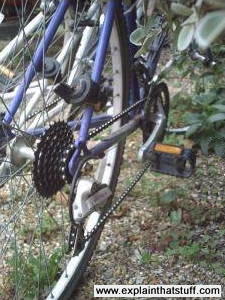
Photo: A gear is a pair of wheels with teeth that interlock to increase power or speed. In a bicycle, the pair of gears is not driven directly but linked by a chain. At one end, the chain is permanently looped around the main gear wheel (between the pedals). At its other end, it shifts between a series of bigger or smaller toothed wheels when you change gear.
A typical bicycle has anything from three to thirty different gears—wheels with teeth, linked by the chain, which make the machine faster (going along the straight) or easier to pedal (going uphill). Bigger wheels also help you go faster on the straight, but they're a big drawback when it comes to hills. That's one of the reasons why mountain bikes and BMX bikes have smaller wheels than racing bicycles. It's not just the gears on a bicycle that help to magnify your pedaling power when you go uphill: the pedals are fastened to the main gear wheel by a pair of cranks: two short levers that also magnify the force you can exert with your legs.
Gears can make an incredible difference to your speed. On a typical racing bike, for example, the gear ratio (the number of teeth on the pedal wheel divided by the number of teeth on the back wheel) might be as much as 5:1, so a single spin of the pedals will power you about 10m (35ft) down the street. Assuming you can only move your legs so fast, you can see that gears effectively make you go more quickly by helping you go further for each turn of the pedals.
Read more in our main article on gears.

Artwork: Bicycles before gears: Early bicycles like these (known as "Penny Farthings" or "High Wheels") had a huge front wheel, effectively multiplying your speed and making it possible to go very fast on the straight. There were no gears: the front wheel turned around once each time your legs pushed up and down on the cranks (pedals). Going downhill was pretty tricky (unless you took your feet off the cranks) and going uphill was pretty much impossible! Detail of an original painting, c.1887, by Henry "Hy" Sandham, courtesy of US Library of Congress.
Sponsored links
How bicycle brakes work

Photo: Rim brakes: The rubber shoes (blocks) of this bicycle's brakes clamp the metal rim of the wheel to slow you down. As you lose speed, you lose energy. Where does the energy go? It turns into heat: the brake blocks can get incredibly hot!
No matter how fast you go, there comes a time when you need to stop. Brakes on a bicycle work using friction (the rubbing force between two things that slide past one another while they're touching). Although some bikes now have disc brakes (similar to the ones cars use), with separate brake discs attached to the wheels, many still use traditional caliper-operated rim brakes with shoes.
When you press the brake levers, a pair of rubber shoes (sometimes called blocks) clamps onto the metal inner rim of the front and back wheels. As the brake shoes rub tightly against the wheels, they turn your kinetic energy (the energy you have because you're going along) into heat—which has the effect of slowing you down. There's more about this in our main article on brakes.Rim brakes versus disc brakes
Caliper-operated rim brakes push on the outside edge of the wheel where it's spinning fastest but with least force. That means they need relatively little braking force to slow the wheels (so they can be small and light), though you still have to press hard, and you have to apply that force for longer to bring yourself and your bike to a halt. One big drawback of rim brakes is that they're fully exposed to rain from above and the side and spray from the wheels; if the brake shoes and wheels are wet and muddy, there's considerable lubrication, the friction between the brakes and the wheels could be up to ten times less than in dry conditions (according to David Gordon Wilson's Bicycling Science), and your stopping distance will be much greater.
Disc brakes work closer to the hub, so they need to apply greater braking force, which can stress the forks and spokes, and they're both heavier (which can affect a bike's handling) and mechanically more complex, but they do tend to be more effective in wet weather and muddy conditions.
Browse through online bike forums and you'll find very different opinions about which type of brakes are best for different types of bikes, terrain, and weather conditions. Some people like disc brakes because they make a bike look better; others like rim brakes because they're so simple and straightforward.

Artwork: Disc brakes (simplified). When you pull on the brake lever, a wire cable or hydraulic line (yellow) operates the calipers (blue) that push brake pads against a disc called the rotor (red) attached to the wheel. Because the calipers are attached to one of the forks (gray), and the braking force has to pass through the spokes (black) to stop the wheel, disc brakes put much more stress on the forks and spokes than rim brakes.
How bicycle tires work
Friction is also working to your advantage between the rubber tires and the road you ride on: it gives you grip that makes your bike easier to control, especially on wet days.
Like car tires, bicycle tires are not made of solid rubber: they have an inner tube filled with compressed (squeezed) air. That means they're lighter and more springy, which gives you a much more comfortable ride. Pneumatic tires, as they're known, were patented in 1888 by Scottish inventor John Boyd Dunlop.
Different kinds of bicycles have different kinds of tires. Racing bicycles have narrow, smooth tires designed for maximum speed (though their "thin" profile gives them higher rolling resistance), while mountain bicycles have fatter, more robust tires with deeper treads, more rubber in contact with the road, and better grip (though being wider they create more air resistance).
Why clothing matters
Friction is a great thing in brakes and tires—but it's less welcome in another form: as air resistance that slows you down. The faster you go, the more drag becomes a problem. At high speeds, racing a bicycle can feel like swimming through water: you can really feel the air pushing against you and (as we've already seen) you use around 80 percent of your energy overcoming drag. Now a bicycle is pretty thin and streamlined, but a cyclist's body is much fatter and wider. In practice, a cyclist's body creates twice as much drag as their bicycle. That's why cyclists wear tight neoprene clothing and pointed helmets to streamline themselves and minimize energy losses.

Photo: Racing bicycles have two sets of handlebars. Inner handlebars let riders reduce air resistance by keeping their elbows closer together. Photo by Ben A. Gonzales courtesy of US Navy and Wikimedia Commons.
You might not have noticed, but the handlebars of a bicycle are levers too: longer handlebars provide leverage that makes it easier to swivel the front wheel. But the wider you space your arms, the more air resistance you create. That's why racing bicycles have two sets of handlebars to help the cyclist adopt the best, most streamlined position. There are conventional, outer handlebars for steering and inner ones for holding onto on the straight. Using these inner handlebars forces the cyclist's arms into a much tighter, more streamlined position. Most cyclists now wear helmets, both for safety reasons and improved aerodynamics.
Bicycles are physics in action
Let's briefly summarize with a simple diagram that shows all these different bits of cycle science in action:


