

Electronics
by Chris Woodford. Last updated: December 5, 2022.
They store your money. They monitor your heartbeat. They carry the sound of your voice into other people's homes. They bring airplanes into land and guide cars safely to their destination—they even fire off the airbags if we get into trouble. It's amazing to think just how many things "they" actually do. "They" are electrons: tiny particles within atoms that march around defined paths known as circuits carrying electrical energy. One of the greatest things people learned to do in the 20th century was to use electrons to control machines and process information. The electronics revolution, as this is known, accelerated the computer revolution and both these things have transformed many areas of our lives. But how exactly do nanoscopically small particles, far too small to see, achieve things that are so big and dramatic? Let's take a closer look and find out!
Photo: The compact, electronic circuit board from a webcam. This board contains several dozen separate electronic components, mostly small resistors and capacitors, plus the large black microchip (bottom left) that does much of the work.
Sponsored links

Contents
What's the difference between electricity and electronics?
If you've read our article about electricity, you'll know it's a kind of energy—a very versatile kind of energy that we can make in all sorts of ways and use in many more. Electricity is all about making electromagnetic energy flow around a circuit so that it will drive something like an electric motor or a heating element, powering appliances such as electric cars, kettles, toasters, and lamps. Generally, electrical appliances need a great deal of energy to make them work so they use quite large (and often quite dangerous) electric currents. The 2500-watt heating element inside an electric kettle operates on a current of about 10 amps. By contrast, electronic components use currents likely to be measured in fractions of milliamps (which are thousandths of amps). In other words, a typical electric appliance is likely to be using currents tens, hundreds, or thousands of times bigger than a typical electronic one.
Electronics is a much more subtle kind of electricity in which tiny electric currents (and, in theory, single electrons) are carefully directed around much more complex circuits to process signals (such as those that carry radio and television programs) or store and process information. Think of something like a microwave oven and it's easy to see the difference between ordinary electricity and electronics. In a microwave, electricity provides the power that generates high-energy waves that cook your food; electronics controls the electrical circuit that does the cooking.

Artwork: Microwave ovens are powered by electric cables (gray) that plug into the wall. The cables supply electricity that powers high-current electrical circuits and low-current electronic ones. The high-current electrical circuits power the magnetron (blue), the device that makes the waves that cook your food, and rotate the turntable. The low-current electronic circuits (red) control these high-powered circuits, and things like the numeric display unit.
Analog and digital electronics
There are two very different ways of storing information—known as analog and digital. It sounds like quite an abstract idea, but it's really very simple. Suppose you take an old-fashioned photograph of someone with a film camera. The camera captures light streaming in through the shutter at the front as a pattern of light and dark areas on chemically treated plastic. The scene you're photographing is converted into a kind of instant, chemical painting—an "analogy" of what you're looking at. That's why we say this is an analog way of storing information. But if you take a photograph of exactly the same scene with a digital camera, the camera stores a very different record. Instead of saving a recognizable pattern of light and dark, it converts the light and dark areas into numbers and stores those instead. Storing a numerical, coded version of something is known as digital.

Photo: Analog and digital electronics. The radio (back) is analog: it "soaks" up radio waves and turns them back into sound with electronic components like transistors and capacitors. The camera (front) is digital: it stores and processes photos as numbers.
Electronic equipment generally works on information in either analog or digital format. In an old-fashioned transistor radio, broadcast signals enter the radio's circuitry via the antenna sticking out of the case. These are analog signals: they are radio waves, traveling through the air from a distant radio transmitter, that vibrate up and down in a pattern that corresponds exactly to the words and music they carry. So loud rock music means bigger signals than quiet classical music. The radio keeps the signals in analog form as it receives them, boosts them, and turns them back into sounds you can hear. But in a modern digital radio, things happen in a different way. First, the signals travel in digital format—as coded numbers. When they arrive at your radio, the numbers are converted back into sound signals. It's a very different way of processing information and it has both advantages and disadvantages. Generally, most modern forms of electronic equipment (including computers, cell phones, digital cameras, digital radios, hearing aids, and televisions) use digital electronics.
Electronic components
If you've ever looked down on a city from a skyscraper window, you'll have marveled at all the tiny little buildings beneath you and the streets linking them together in all sorts of intricate ways. Every building has a function and the streets, which allow people to travel from one part of a city to another or visit different buildings in turn, make all the buildings work together. The collection of buildings, the way they're arranged, and the many connections between them is what makes a vibrant city so much more than the sum of its individual parts.
The circuits inside pieces of electronic equipment are a bit like cities too: they're packed with components (similar to buildings) that do different jobs and the components are linked together by cables or printed metal connections (similar to streets). Unlike in a city, where virtually every building is unique and even two supposedly identical homes or office blocks may be subtly different, electronic circuits are built up from a small number of standard components. But, just like LEGO®, you can put these components together in an infinite number of different places so they do an infinite number of different jobs.
These are some of the most important components you'll encounter:
Resistors
These are the simplest components in any circuit. Their job is to restrict the flow of electrons and reduce the current or voltage flowing by converting electrical energy into heat. Resistors come in many different shapes and sizes. Variable resistors (also known as potentiometers) have a dial control on them so they change the amount of resistance when you turn them. Volume controls in audio equipment use variable resistors like these.
Read more in our main article about resistors.
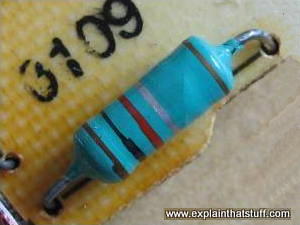
Photo: A typical resistor on the circuit board from a radio.
Diodes
The electronic equivalents of one-way streets, diodes allow an electric current to flow through them in only one direction. They are also known as rectifiers. Diodes can be used to change alternating currents (ones flowing back and forth round a circuit, constantly swapping direction) into direct currents (ones that always flow in the same direction).
Read more in our main article about diodes.
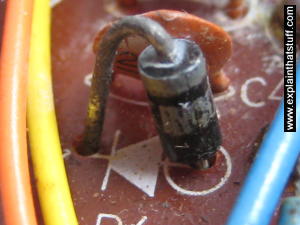
Photo: Diodes look similar to resistors but work in a different way and do a completely different job. Unlike a resistor, which can be inserted into a circuit either way around, a diode has to be wired in the right direction (corresponding to the arrow on this circuit board).
Capacitors
These relatively simple components consist of two pieces of conducting material (such as metal) separated by a non-conducting (insulating) material called a dielectric. They are often used as timing devices, but they can transform electrical currents in other ways too. In a radio, one of the most important jobs, tuning into the station you want to listen to, is done by a capacitor.
Read more in our main article about capacitors.
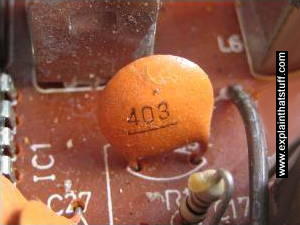
Photo: A small capacitor in a transistor radio circuit.
Transistors
Easily the most important components in computers, transistors can switch tiny electric currents on and off or amplify them (transform small electric currents into much larger ones). Transistors that work as switches act as the memories in computers, while transistors working as amplifiers boost the volume of sounds in hearing aids. When transistors are connected together, they make devices called logic gates that can carry out very basic forms of decision making. (Thyristors are a little bit like transistors, but work in a different way.)
Read more in our main article about transistors.
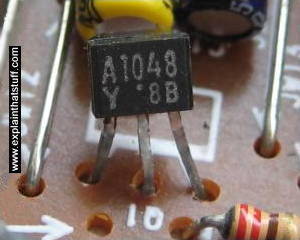
Photo: A typical field-effect transistor (FET) on an electronic circuit board.
Opto-electronic (optical electronic) components
There are various components that can turn light into electricity or vice-versa. Photocells (also known as photoelectric cells) generate tiny electric currents when light falls on them and they're used as "magic eye" beams in various types of sensing equipment, including some kinds of smoke detector. Light-emitting diodes (LEDs) work in the opposite way, converting small electric currents into light. LEDs are typically used on the instrument panels of stereo equipment. Liquid crystal displays (LCDs), such as those used in flatscreen LCD televisions and laptop computers, are more sophisticated examples of opto-electronics.
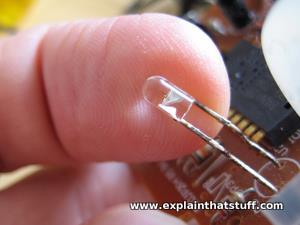
Photo: An LED mounted in an electronic circuit. This is one of the LEDs that makes red light inside an optical computer mouse.
Electronic components have something very important in common. Whatever job they do, they work by controlling the flow of electrons through their structure in a very precise way. Most of these components are made of solid pieces of partly conducting, partly insulating materials called semiconductors (described in more detail in our article about transistors). Because electronics involves understanding the precise mechanisms of how solids let electrons pass through them, it's sometimes known as solid-state physics. That's why you'll often see pieces of electronic equipment described as "solid-state."
Sponsored links
Electronic circuits and circuit boards
The key to an electronic device is not just the components it contains, but the way they are arranged in circuits. The simplest possible circuit is a continuous loop connecting two components, like two beads fastened on the same necklace. Analog electronic appliances tend to have far simpler circuits than digital ones. A basic transistor radio might have a few dozen different components and a circuit board probably no bigger than the cover of a paperback book. But in something like a computer, which uses digital technology, circuits are much more dense and complex and include hundreds, thousands, or even millions of separate pathways. Generally speaking, the more complex the circuit, the more intricate the operations it can perform.

Photo: The electronic circuit board from inside a computer printer. Which electronic components can you see here? I can make out some capacitors, diodes, and integrated circuits (the large black things, which are explained below).
If you've experimented with simple electronics, you'll know that the
easiest way to build a circuit is simply to connect components together
with short lengths of copper cable. But the more components you have to
connect, the harder this becomes. That's why electronics designers
usually opt for a more systematic way of arranging components on what's
called a circuit board. A basic circuit
board is simply a
rectangle of plastic with copper connecting tracks on one side and lots
of holes drilled through it. You can easily connect components together
by poking them through the holes and using the copper to link them
together, removing bits of copper as necessary, and adding extra wires
to make additional connections. This type of circuit board is often
called "breadboard".
Electronic equipment that you buy in stores takes this idea a step further using circuit boards that are made automatically in factories. The exact layout of the circuit is printed chemically onto a plastic board, with all the copper tracks created automatically during the manufacturing process. Components are then simply pushed through pre-drilled holes and fastened into place with a kind of electrically conducting adhesive known as solder. A circuit manufactured in this way is known as a printed circuit board (PCB).
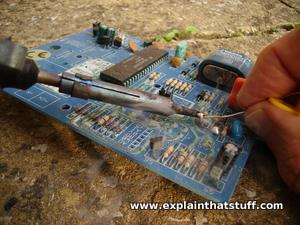
Photo: Soldering components into an electronic circuit. The smoke you can see comes from the solder melting and turning to a vapor. The blue plastic rectangle I'm soldering onto here is a typical printed circuit board—and you see various components sticking up from it, including a bunch of resistors at the front and a large integrated circuit at the top.
Although PCBs are a great advance on hand-wired circuit boards, they're still quite difficult to use when you need to connect hundreds, thousands, or even millions of components together. The reason early computers were so big, power hungry, slow, expensive, and unreliable is because their components were wired together manually in this old-fashioned way. In the late 1950s, however, engineers Jack Kilby and Robert Noyce independently developed a way of creating electronic components in miniature form on the surface of pieces of silicon. Using these integrated circuits, it rapidly became possible to squeeze hundreds, thousands, millions, and then hundreds of millions of miniaturized components onto chips of silicon about the size of a finger nail. That's how computers became smaller, cheaper, and much more reliable from the 1960s onward.
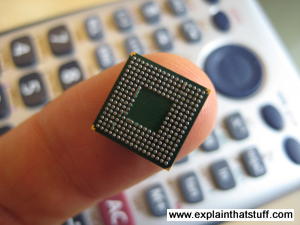
Photo: Miniaturization. There's more computing power in the processing chip resting on my finger here than you would have found in a room-sized computer from the 1940s!
Sponsored links
What is electronics used for?
Electronics is now so pervasive that it's almost easier to think of things that don't use it than of things that do.
Entertainment was one of the first areas to benefit, with radio (and later television) both critically dependent on the arrival of electronic components. Although the telephone was invented before electronics was properly developed, modern telephone systems, cellphone networks, and the computers networks at the heart of the Internet all benefit from sophisticated, digital electronics.
Try to think of something you do that doesn't involve electronics and you may struggle. Your car engine probably has electronic circuits in it—and what about the GPS satellite navigation device that tells you where to go? Even the airbag in your steering wheel is triggered by an electronic circuit that detects when you need some extra protection.
Electronic equipment saves our lives in other ways too. Hospitals are packed with all kinds of electronic gadgets, from heart-rate monitors and ultrasound scanners to complex brain scanners and X-ray machines. Hearing aids were among the first gadgets to benefit from the development of tiny transistors in the mid-20th century, and ever-smaller integrated circuits have allowed hearing aids to become smaller and more powerful in the decades ever since.
Who'd have thought that electrons—just about the smallest things you could ever imagine—would change people's lives in so many important ways?
A brief history of electronics

Photo: Sir J. J. Thomson, who discovered that electrons were negatively charged particles, at Cambridge University, in 1897. Thomson won the Nobel Prize in Physics in 1906 for his work. Photo by Bain News Service courtesy of US Library of Congress.
- 1874: Irish scientist George Johnstone Stoney (1826–1911) suggests electricity must be "built" out of tiny electrical charges. He coins the name "electron" about 20 years later.
- 1875: American scientist George R. Carey builds a photoelectric cell that makes electricity when light shines on it.
- 1879: Englishman Sir William Crookes (1832–1919) develops his cathode-ray tube (similar to an old-style, "tube"-based television) to study electrons (which were then known as "cathode rays").
- 1883: Prolific American inventor Thomas Edison (1847–1931) discovers thermionic emission (also known as the Edison effect), where electrons are given off by a heated filament.
- 1887: German physicist Heinrich Hertz (1857–1894) finds out more about the photoelectric effect, the connection between light and electricity that Carey had stumbled on the previous decade.
- 1897: British physicist J.J. Thomson (1856–1940) shows that cathode rays are negatively charged particles. Thomson calls them "corpuscles," but they are soon renamed electrons.
- 1904: John Ambrose Fleming (1849–1945), an English scientist, produces the Fleming valve (later renamed the diode). It becomes an indispensable component in radios.
- 1906: American inventor Lee De Forest (1873–1961), goes one better and develops an improved valve known as the triode (or audion), greatly improving the design of radios. De Forest is often credited as a father of modern radio.
- 1947: Americans John Bardeen (1908–1991), Walter Brattain (1902–1987), and William Shockley (1910–1989) develop the transistor at Bell Laboratories. It revolutionizes electronics and digital computers in the second half of the 20th century.
- 1958: Working independently, American engineers Jack Kilby (1923–2005) of Texas Instruments and Robert Noyce (1927–1990) of Fairchild Semiconductor (and later of Intel) develop integrated circuits.
- 1971: Marcian Edward (Ted) Hoff (1937–) and Federico Faggin (1941–) manage to squeeze all the key components of a computer onto a single chip, producing the world's first general-purpose microprocessor, the Intel 4004.
- 1987: American scientists Theodore Fulton and Gerald Dolan of Bell Laboratories develop the first single-electron transistor.
- 2008: Hewlett-Packard researcher Stanley Williams builds the first working memristor, a new kind of magnetic circuit component that works like a resistor with a memory, first imagined by American physicist Leon Chua almost four decades earlier (in 1971).
About the author
Chris Woodford is the author and editor of dozens of science and technology books for adults and children, including DK's worldwide bestselling Cool Stuff series and Atoms Under the Floorboards, which won the American Institute of Physics Science Writing award in 2016. You can hire him to write books, articles, scripts, corporate copy, and more via his website chriswoodford.com.
