Power to go—that's the promise batteries deliver. They give us
all the convenience of electricity in a handy, portable form. The
only trouble is, most batteries run flat very quickly and, unless you
use a specialized charger, you then have to throw them away. It's
hard on your pocket and bad for the environment as well: worldwide, we throw
away billions of disposable batteries every single year.
Rechargeable batteries help to solve this problem and the best kind
use a technology called lithium ion. Your cellphone,
laptop computer,
and MP3 player probably all use lithium-ion batteries. They've been
in widespread use since about 1991, but the basic chemistry was first
discovered by American chemist Gilbert Lewis (1875–1946) way back in
1912. Let's take a closer look at how they work!
Photo: Lithium-ion batteries power all kinds of "mobile" technology, from electric toothbrushes and tablet computers to electric cars and trucks.
Photo by Dennis Schroeder courtesy of NREL (photo id#119047).
If you've read our main article on batteries, you'll know a
battery is essentially a chemical experiment happening in a small
metal canister. Connect the two ends of a battery to something like a
flashlight and chemical reactions begin: chemicals inside the
battery slowly but systematically break apart and join
themselves together to make other chemicals, producing a stream of positively
charged particles called ions and negatively charged electrons. The
ions move through the battery; the electrons go through the circuit
to which the battery's connected, providing electrical energy that drives the
flashlight. The only trouble is, this chemical reaction can
happen only once and in only one direction: that's why ordinary batteries usually
can't be recharged.
Rechargeable batteries = reversible reactions
Artwork: Ordinary batteries, such as zinc-carbon and alkaline ones, cannot be recharged because the chemical reactions that generate the power are not reversible. Once they're empty of electrical energy, there's no easy way to refill them.
Different chemicals are used in rechargeable batteries and they
split apart through entirely different reactions. The big difference is
that the chemical reactions in a rechargeable battery are reversible:
when the battery is discharging the reactions go one way and the
battery gives out power; when the battery is charging, the reactions
go in the opposite direction and the battery absorbs power. These
chemical reactions can happen hundreds of times in both directions,
so a rechargeable battery will typically give you anything from two
or three to as much as 10 years of useful life (depending on how
often you use it and how well you look after it).
Sponsored links
How lithium-ion batteries work
Like any other battery, a rechargeable lithium-ion battery is made
of one or more power-generating compartments called cells. Each cell
has essentially three components: a positive electrode (connected to
the battery's positive or + terminal), a negative electrode
(connected to the negative or − terminal), and a chemical called an
electrolyte in between them. The positive electrode is typically made
from a chemical compound called lithium-cobalt oxide (LiCoO2—often pronounced "lyco O2") or, in newer batteries, from lithium iron phosphate (LiFePO4).
The negative electrode is generally made from carbon (graphite) and
the electrolyte varies from one type of battery to another—but isn't
too important in understanding the basic idea of how the battery works.
Photo: A lithium-ion battery, such as this one from a smartphone, is made from a number
of power-producing units called cells. Each cell produces about 3–4 volts, so this battery (rated at 3.85 volts) has just one cell, whereas a laptop battery that produces 10–16 volts typically needs three to four cells.
All lithium-ion batteries work in broadly the same way. When the
battery is charging up, the lithium-cobalt oxide, positive electrode gives up
some of its lithium ions, which move through the electrolyte to the
negative, graphite electrode and remain there. The battery takes in and stores
energy during this process. When the battery is discharging, the
lithium ions move back across the electrolyte to the positive
electrode, producing the energy that powers the battery. In both
cases, electrons flow in the opposite direction to the ions around
the outer circuit. Electrons do not flow through the electrolyte:
it's effectively an insulating barrier, so far as electrons are concerned.
The movement of ions (through the electrolyte) and electrons (around the external circuit, in the opposite
direction) are interconnected processes, and if either stops so does the other. If ions stop moving through the
electrolyte because the battery completely discharges, electrons can't move through the outer
circuit either—so you lose your power. Similarly, if you switch off
whatever the battery is powering, the flow of electrons stops and so does the flow of ions.
The battery essentially stops discharging at a high rate (but it does
keep on discharging, at a very slow rate, even with the appliance disconnected).
Unlike simpler batteries, lithium-ion ones have built in
electronic controllers that regulate
how they charge and discharge. They prevent the overcharging and overheating that
can cause lithium-ion batteries to explode in some circumstances.
Photo: Lithium-ion batteries are less toxic than
batteries containing heavy metals such as lead, cadmium, and mercury, but recycling them is still far
preferable to incinerating them or sending them to landfill.
This photo shows a chemical reclamation process called relithiation,
which restores spent battery chemicals to a form good enough to reuse
with minimal investment of energy. Photo by Werner Slocum courtesy of NREL (US National Renewable Energy Laboratory). NREL photo id#140317.
How a lithium-ion battery charges and discharges
Animation: Charging and discharging a lithium-ion battery.
As their name suggests, lithium-ion batteries are all about the movement of lithium ions:
the ions move one way when the battery charges (when it's absorbing power); they move the opposite way when the battery
discharges (when it's supplying power):
During charging, lithium ions (yellow circles) flow from the positive electrode (red) to the negative electrode (blue) through the electrolyte (gray). Electrons also flow from the positive electrode to the negative electrode, but take the longer path around the outer circuit. The electrons and ions combine at the negative electrode and deposit lithium there.
When no more ions will flow, the battery is fully charged and ready to use.
During discharging, the ions flow back through the electrolyte from the negative electrode to the positive electrode. Electrons flow from the negative electrode to the positive electrode through the outer circuit, powering your laptop. When the ions and electrons combine at the positive electrode, lithium is deposited there.
When all the ions have moved back, the battery is fully discharged and needs charging up again.
How are the lithium ions stored?
This second animation shows what's going on in the battery in a bit more detail. Again, the negative graphite electrode (blue)
is shown on the left, the positive cobalt-oxide electrode (red) on the right, and the lithium ions are represented by yellow circles.
Animation: How lithium ions are stored in the negative graphite electrode (left) and positive cobalt-oxide electrode (right).
When the battery is fully charged, all the lithium ions are stored between layers of graphene (sheets of carbon one atom thick) in the graphite electrode (they have all moved over to the left). In this charged-up state, the battery is effectively a multi-layer sandwich: graphene layers alternate with lithium ion layers. As the battery discharges, the ions migrate from the graphite electrode to the cobalt-oxide electrode (from left to right). When it's fully discharged, all the lithium ions have moved over to the cobalt-oxide electrode on the right. Once again, the lithium ions sit in layers, in between layers of cobalt ions (red) and oxide ions (blue). As the battery charges and discharges, the lithium ions shunt back and forth from one electrode to the other.
Sponsored links
Advantages of lithium-ion batteries
Generally, lithium ion batteries are more reliable than older technologies
such as nickel-cadmium (NiCd, pronounced
"nicad") and don't suffer from a problem known as the "memory
effect" (where nicad batteries appear to become harder to charge
unless they're discharged fully first). Since lithium-ion batteries
don't contain cadmium (a toxic, heavy metal), they are also (in
theory, at least) better for the environment—although dumping
any batteries (full of metals, plastics,
and other assorted chemicals) into landfills is never a good thing. Compared to
heavy-duty rechargeable batteries (such as the lead-acid ones used to
start cars), lithium-ion batteries are relatively light for the amount of energy they
store.
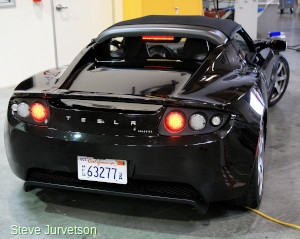
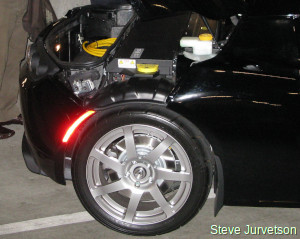
Lithium-ion batteries are getting better all the time, as electric cars
clearly demonstrate. Lightweight lithium-ion batteries were first properly
used in electric cars in the pioneering Tesla Roadster, manufactured
from 2008 to 2012. It took roughly 3.5 hours to charge its 6831 lithium-ion cells,
which together weighed a whopping one half a tonne (1100 lb) and held 53kWh of energy.
[1]
Fully charged, they gave the car a range of over 350km (220 miles).
Newer Teslas have far better cells and much greater range.
A typical Tesla Model 3 has a 75kWh battery (half as much energy again as a Roadster)
with just 4,416 cells—so they clearly have much higher energy density—and
a range of 602km (374 miles).
[2]
Photo: The pioneering Tesla Roadster. Left: You can see the yellow power lead charging the batteries.
Right: The batteries are in the large compartment you can see directly above the back wheel.
First photo: Tesla Inside;
Second photo Shiny New Tesla.
Both by courtesy of Steve Jurvetson, published on Flickr in 2007 under a
Creative Commons licence.
Disadvantages of lithium-ion batteries
Energy density
If we're interested in the drawbacks of lithium-ion batteries, it's important to bear in mind what we're comparing them with. As a power source for automobiles, we really need to compare them not with other types of batteries but
with gasoline. Despite considerable advances over the years, kilo for kilo, rechargeable batteries still store only a fraction as much energy as ordinary gas; in more scientific words, they have a much lower energy density (they store less energy per unit of weight). That also explains why you can fully "recharge" (refuel) a gas-powered automobile in a couple of minutes, whereas it'll generally take you hours to recharge the batteries in an electric car. Then again, you have to bear in mind that these disadvantages are balanced by other advantages, such as the greater fuel economy of electric cars and their relative lack of air pollution (zero tailpipe/exhaust emissions from the vehicle itself).
Safety
Leaving aside vehicles and considering lithium-ion batteries more generally, what are the problems? The biggest issue is
safety: Li-ion batteries will catch fire if they're overcharged or if an internal malfunction causes a short circuit; in both cases, the batteries heat up in what's called a "thermal runaway," eventually catching fire or exploding. That problem is solved with a built-in circuit breaker, known as a current interrupt device or CID, which kills the charging current when the voltage reaches a maximum, if the batteries get too hot, or their internal pressure rises too high.
Photo: Lithium-ion batteries can inflate like little cushions if they don't have a means of venting any gases produced during charging (mainly carbon monoxide, carbon dioxide, and hydrogen, though smaller amounts of other organic gases may also be present). Here are two identical batteries from a cellphone, the top one of which has almost doubled in width due to the trapped gases inside.
But there remain concerns and, in 2016, the International Civil Aviation Organization officially prohibited shipments of lithium-ion batteries on passenger planes because of the potential danger. Now the safety risks of lithium batteries have attracted lots of media attention—especially when they've caused fires to break out in electric cars or on airplanes—but it's worth bearing in mind how few incidents there have been given how common the technology is (you'll find lithium-ion batteries in every modern cellphone, laptop, tablet, and most other rechargeable gadgets). And, once again, it's important to bear in mind the risks of the alternatives: yes, lithium-ion batteries in electric cars can catch fire—but gasoline-powered automobiles catch fire much more often... and cause actual explosions! Other types of batteries can also catch fire and explode if they overheat, so fire isn't a problem that's unique to lithium-ion technology.
Photo: What happens when a lithium-ion battery fails completely. Top: An intact battery. Bottom: An identical battery that failed after being punctured in a lab safety test. Photo by Dennis Schroeder courtesy of NREL (US National Renewable Energy Laboratory). NREL photo id#119819.
What's the solution? One promising option, currently being pioneered by a company called Ionic Materials, is to use flame-resistant polymers (solid plastics) in place of the flammable liquid electrolytes that are normally used in lithium-ion batteries. Another option, favored by John Goodenough, the chemist behind lithium-ion batteries,
is to use "doped" glass (treated to make it electrically conductive) for the electrolyte instead. Time will tell whether one of these options—or something else entirely—will topple lithium-ion batteries from their place as the world's
favorite rechargeable technology.
Artwork: A lithium-ion battery has a current interrupt device (CID) inside to stop it overheating. Here's one example of how it can work. The two battery electrodes (green, 12 and 14) sit inside a case (light blue, 22) with a lid on top (dark blue, 24). One of the electrodes (14) is connected to its top terminal (42) through the CID (28), which is made of three parts. There are two metal conducting discs (red, 30 and 32) with an insulator (purple, 34) in between them. Normally the discs are touching and allow current to flow from the electrode to its terminal. But if the battery overheats and pressure builds up inside, the discs are pushed apart and stop any more current flowing. Any excess gas vents through small slits (yellow, 56) in the sides of the case. Artwork from US Patent 4,423,125: Integrated current-interrupt device for lithium-ion cells by Phillip Partin et al, Boston-Power, Inc., courtesy of US Patent and Trademark Office.
Who invented lithium-ion batteries?
Handy, helpful lithium-ion power packs were pioneered at Oxford University in the 1970s by chemist
John Goodenough and his colleagues Phil Wiseman, Koichi Mizushima, and Phil Jones. Their research was published in 1980 and turned into a commercial technology by Sony, who produced the first lithium ion batteries in the early 1990s. Since then, they've become commonplace: around 5 billion are manufactured every year (according to a Bloomberg news report from 2013), most of them in China.
Three pioneers of lithium-ion battery technology—John Goodenough, M. Stanley Whittingham, and Akira Yoshino—shared the 2019 Nobel Prize in Chemistry for their groundbreaking work.
Like all scientists, their research can trace back to earlier discoveries; in this case,
it's worth mentioning American chemist Gilbert Lewis and his research into the electrochemistry of lithium, in the early 20th century.
Phone: A typical lithium-ion cellphone battery. This one is rated 3Wh, so you'd need
about 25,000 of these to store as much electrical energy as you'd pack into a 75kWh (75,000Wh) Tesla Model 3 car battery!
What does the future hold?
Today's lithium-ion rechargeables have many advantages over yesterday's "nicads,"
but they're far from the end of the story. As we've already seen, there are pesky problems
like "thermal runaway" still seeking effective solutions. Meanwhile, the hurtling pace
of climate change is accelerating the need for cheaper, safer, more energy-dense and environmentally friendly batteries that charge more quickly and pack ever more energy into ever smaller space. Lots of exciting research is going on as you read these words.
Ultra-fast-charging graphene batteries, ones made from other cutting-edge
nanomaterials such as carbon nanotubes,
and even ones based on genetically engineered viruses and vitamins such as flavin could be powering your computer or smartphone in the very near future!
Photo: Lithium-ion batteries can also work at scale to store power produced by renewable sources like wind turbines and
solar cells. Here's an experimental 1MWh battery storage unit under test at NREL. Photo by Dennis Schroeder courtesy of NREL (US National Renewable Energy Laboratory). NREL photo id#113307.
Lithium Batteries: Science and Technology by Christian Julien, Alain Mauger, Ashok Vijh, and Karim Zaghib. Springer, 2016. Covers all types of primary (single-use) and secondary (rechargeable) lithium batteries, including lithium-ion.
Lithium-ion Batteries: Science and Technologies by Masaki Yoshio, R. J. Brodd, and Akiya Kozawa (eds). Springer, 2009. Cutting-edge lithium-ion technology reviewed by academics and leading engineers.
Battery that 'charges in seconds': BBC News, 11 March 2009. How a new method of producing lithium-ion batteries speeds up ion movement, allowing them to be charged in a fraction of the usual time.
Lithium-ion battery's place of origin awarded plaque: BBC News, 30 November 2010. The scientists who developed lithium-battery ion technology are recognized with a plaque at Oxford University's Inorganic Chemistry Laboratory.
Building a better battery by John Hockenberry, Wired 14.11, November 2006. An interesting look at the problems of lithium-ion batteries (things like thermal runaway) and the sorts of things engineers are trying to solve them.
Patents
If you're looking for much more detailed technical descriptions of lithium-ion batteries and their chemistry, try these:
Please do NOT copy our articles onto blogs and other websites
Articles from this website are registered at the US Copyright Office. Copying or otherwise using registered works without permission, removing this or other copyright notices, and/or infringing related rights could make you liable to severe civil or criminal penalties.