Is the air
conditioner costing you a fortune? What about that
electric fire... or the washing machine...
or the dishwasher? And how can you find out?
Step forward the energy monitor!
Simply place it near a power cable coming from an appliance and you
get an instant measurement of how much you're paying for electricity
per hour. What a brilliant idea for saving your pocket and the
planet! If you've seen one of these things in action
(popular brands include the wattson and the Owl), you might have
wondered just how they work their magic. Let's take a closer look and
see!
Photo: A smart meter for checking home energy consumption.
Unlike older meters, this one automatically sends its readings to the utility company.
You can see from the LCD display that it's currently reading 1446 kWh (kilowatt hours)—in other words, about 1.5 megawatt hours of energy (5400 megajoules) has been used
since the meter was installed.
Electricity is having a difficult
time—or, rather, making it has
never been more tricky. Oil and gas are slowly running out, coal's
dirty, wind power and solar panels still aren't completely competitive, nuclear worries people. Add
to that the difficult problem of global
warming (the way Earth is
slowly heating because of carbon dioxide produced when we consume
energy) and you can see we're in a bit of
bother. If you're troubled
by the high cost of energy, or by the effect people are having on the
planet, why not start using energy more wisely?
You can drive more efficiently, for example, switch off your air-con, or turn down your
room thermostat a degree or two.
Another good thing you can do is try
to use energy-efficient
lamps. But if you want to make a really big difference
to your home energy consumption, you need to tackle your power-hungry appliances:
your cooker, refrigerator, freezer, dishwasher, washing machine, and electric kettle.
If you've no idea how much electricity you're
using, that's where electrical energy monitors can help!
Sponsored links
How can you measure electricity consumption?
Photo: An ordinary electricity meter tells you the total amount of electricity you've
used for all time. It's not very helpful for cutting your consumption.
If you use electricity, you have a meter somewhere in your
building that keeps a record of how much you're consuming so your
utility company can bill you for it. The only trouble is, the meter
measures your total electricity
consumption for every
appliance you're using for all time.
That makes it hard to know how much you're paying to run any one of the dozens of appliances you may be using
and to discover which ones are wasting energy.
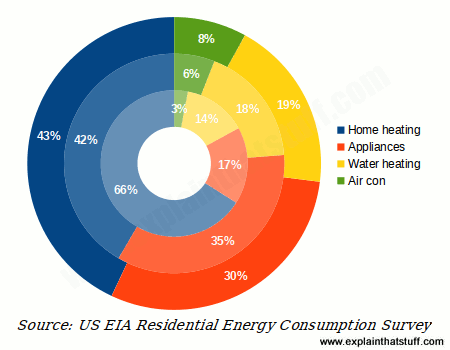
Charts: More and more of the energy we use at home is going to power gadgets and appliances. Look
at the rings of this donut chart, which compares US home energy use from 1978 (inner ring), 2009 (middle ring), and 2015 (outer ring).
Blue = home heating, Orange = appliances and electronics, Yellow = water heating, Green = air conditioning. You can see that while we're using much less energy to heat our homes, the share of energy use for appliances (the orange segments) has grown enormously,
and air conditioning is a real cause for concern. Data from Residential Energy Consumption Surveys (RECS), US Energy Information Administration (EIA), and is the newest available as of October 2021.
Nevertheless, an analysis published by the EIA in
2015 shows that efficiency gains of various kinds still led to an overall reduction in energy use per household in the three decades between 1980 and 2009.
Now, in theory, it should be easy enough to unplug any
electrical appliance, plug it into a meter of some kind, and plug the meter
into your electricity outlet (that's "mains socket" to you
Brits)—and there are quite a few energy monitors that work
in exactly this way (including one amusingly called the Kill-a-Watt).
But some appliances, especially the really power-hungry ones
(refrigerators, deep freezers, and
electric cookers among them) are
difficult to unplug. Isn't there another way? The new electricity
consumption meters that have started appearing over the last few
years work totally differently—using the electricity you consume to
make magnetism, turning the magnetism into electricity, and then
measuring that electricity. Let me explain...
How we can measure electricity using magnetism
As you might know already, electricity and magnetism are like an old
married couple: you never
get one without the other. That's how all kinds of electric
appliances work, from motors and
generators to transformers and
headphones. If you send a fluctuating electric current
down a cable, it creates an invisible
magnetic field all around the cable at the same time. This surprising
effect was first discovered by a Danish physicist named
Hans-Christian Ørsted (1777–1851) when he placed an
electricity cable over a compass and switched on the power.
French physicist André-Marie Ampère (1775–1836) took
Ørsted's finding a step further by showing that the strength
of the magnetic field is directly related to the size of the electric
current: put a bigger current through the wire and you get a stronger
magnetic field around it.
Let's say we have an electric
toaster plugged in and we're cooking some bread. How can
Ørsted
and Ampère help us figure out how much our toast is costing?
Consider the cable that's connecting the toaster to the power outlet.
As electricity's charging down it, a magnetic field is being created
all around it. So, all we have to do is measure the strength of the
magnetic field: the bigger the field, the more electricity we're
using.
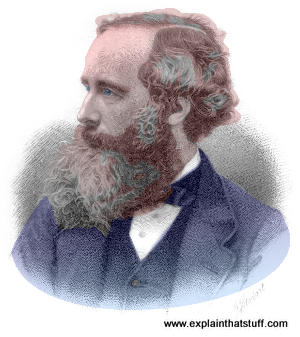
Photo: Scottish physicist James Clerk Maxwell (1831–1879)
wrapped up the work of Ampère, Ørsted, Faraday, and others to make a
comprehensive theory of electricity and magnetism. Maxwell's theory of electromagnetism is
summed up in four amazingly elegant mathematical equations.
Public domain photo by courtesy of Wikimedia Commons.
Now this is the clever part. Just
as an electric current can create a magnetic field, so a magnetic
field can create an electric current. It's called electromagnetic induction. Suppose you have a magnet and
you move it around near a length of electric cable. If you hook up
the cable to a voltmeter, you'll find that electricity flows through
the cable every time you move the magnet. A changing magnetic field
makes electricity flow through a conductor that's inside the field.
English physicist Michael Faraday (1791–1867) found this out about 10
years after Ørsted's original discovery and that led him to
invent the generator—the device that makes virtually all the electricity we
use in our homes.
Now we can cut to the chase: to measure how much electricity an
appliance is using, you simply place
a coil of wire around (or very near to) the main cable through which
the power is flowing. Let's call this coil the probe. As the
electricity flows, it'll generate a magnetic field around the main
cable. The magnetic field constantly fluctuates because the
electricity flows rapidly back and forth in what's known as an
alternating current (AC). The fluctuating
magnetic field
generates an electric field in the coil of wire that makes up our
probe. All we need to do is wire the probe up to a meter that
measures electric current. The more electricity our appliance uses,
the bigger the current that will flow in our probe.
How energy monitors work
You switch on your appliance.
Alternating current (AC) carries electrical energy into it.
The AC current flows back and forth along the power cable between the power outlet and your appliance.
As the current changes, it creates a magnetic field all around the cable.
Put your energy monitor's probe near the cable and the magnetic field causes a secondary alternating current to flow inside it.
(The magnetic field from an ordinary household cable is weak so the probe will need to be very close to the cable.
With some energy monitors, such as the wattson, the sensor/probe clamps tightly around one of the power cables near your fusebox.)
Your energy monitor measures the size of this secondary current and either converts it into a measurement in watts (W) or calculates the running cost per hour.
Sponsored links
Figuring out which home appliances cost most to run
Even though most of us can't manage without things like
vacuum cleaners and clothes washing
machines, there's still scope for saving energy by buying the most
efficient appliances we can find. Many countries now have
eco-labelling
schemes that compel manufacturers to show how efficient
(or otherwise) their products are; by encouraging healthy
competition, schemes like this lead to a gradual improvement in the
efficiency of appliances in the long term. In Europe, appliances
are now widely rated on a scale from A to G, with A being most
efficient and G most wasteful.
Photo: The packaging for an energy-saving fluorescent lamp shows it has an energy rating of A—it's currently one of the most efficient lamps you can get. Look out for energy ratings like this on all the major appliances you buy, especially on energy guzzlers like
clothes dryers, clothes washing machines, and dishwashers.
To make the biggest possible difference to your energy bills, it's important to focus
on appliances that use the most energy, such as clothes tumble
dryers. Get into the habit of drying your clothes outdoors (often
possible even on cold days in winter, providing the humidity is low) and you'll make big savings.
If you can get your clothes 50 percent dry outdoors and just finish
them off in your dryer, you're still going to save half your drying
costs. Dishwashers and clothes washers also use a lot of energy so
look into whether you can run them on shorter cycles or
lower-temperature programs. Can you run them with bigger loads
without sacrificing their cleaning performance? Can you run them
safely overnight when electricity is often cheaper? (Make sure you have
smoke alarms fitted if you do this.)
Which appliances cost most
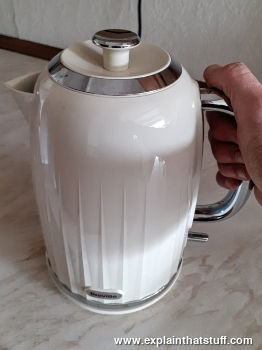
Photo: Kettles are among the biggest energy hogs because they draw a lot of power and we use them very often. They're also very efficient at converting electricity into heat, so the only real way to economize is to avoid boiling more water than you need.
Some electricity monitors simply tell you the instantaneous cost
per hour of whatever appliance you're "probing". Others, like
wattson, are more sophisticated: you hook them up to your computer
and run a sophisticated statistical program to discover how much
energy you're using (and saving) over hours, days, or even weeks.
Using a computer program called holmes, wattson can monitor your
energy consumption for a 28-day period and claims it could help cut
5–20 percent from your electricity bill. With savings like that,
energy monitors can pay for themselves in no time!
To understand how much a particular appliance costs to run, you need to know
both how much power it consumes and how long it's working for, which will tell you
how much energy it uses in total. Things that use a lot of power only cost a lot of money if they run for long
enough to use a significant amount of energy. At 4000 watts (4 kW), a clothes dryer uses energy 360 times more quickly
than an 11-watt (11 W) compact fluorescent lamp (CFL). Lights are usually
on for much longer, but even if you use a lamp for 10 hours and a clothes dryer for only an hour,
the dryer still uses 36 times more energy!
Photo: Power hungry? This chart shows the power consumption (in watts, red) and
energy used per week (in kilowatt hours, green) for a variety of everyday appliances. You can see that a tumble dryer uses
lots of power and energy because it runs for a long time. Things like refrigerators and
TVs don't use much power but they consume plenty of energy because they run for a long
time each week. Vacuum cleaners use high power but relatively little energy because they run for
only a few minutes at a time. Kettles cost more to run than you might think because you use
them so often. Energy-saving lights use trivial amounts of power and energy, but you might have
10 of them burning away at a time, so the cost quickly mounts up.
Analyzing the data
Artwork: A typical smartphone energy tracking app. This one is Efergy Engage, which I downloaded from the iPhone App Store.
Most energy monitors let you track, analyze, and chart your consumption over a period of time using
PC programs or (often more conveniently) smartphone and tablet apps. If you go into your favorite app store and search for "energy monitor," you'll find quite a few to choose from. Most require you to have bought a bit of energy-monitoring kit in the first place, though there are a few apps that work purely from meter readings (helping to monitor your overall consumption rather
than focusing on specific appliances).
Even without an energy monitor, you can make quite a big difference to your electricity and gas consumption simply
by getting into the habit of taking regular meter readings, entering them into a spreadsheet, and automatically plotting a chart;
the very act of measuring and monitoring has an amazing way of encouraging efficiency—and it doesn't cost you a penny!
Artwork: Making regular measurements of electricity or natural gas meter readings will encourage you to be more efficient, even if you don't use an energy monitor. This is how I cut my gas consumption significantly, over a period of five years, after I started making quarterly meter readings and entering them in a spreadsheet. It's best to make your own readings on consistent dates rather than rely on utility company data, which might be taken on different dates (making it harder to compare the figures from one year to the next).
Calculating your energy use the old-fashioned way
You don't necessarily need to buy yourself an energy-monitor to figure out how much energy your appliances use: simply look at the power consumption figure in watts (marked on virtually every appliance somewhere or noted in its
instruction booklet), estimate how long you're using the appliance for, and
that should give you a reasonably good guide.
Doing it roughly
Broadly speaking, anything that has a heating element (something that turns electrical energy into heat energy) uses a great deal of electricity (so tumble dryers,
electric showers, clothes washers,
dishwashers, irons, and electric
fires are all things to focus on) and anything that uses over about
1000 watts (1 kilowatt or 1kW) for more than a few minutes will be
costing you lots of money to run. Small electronic appliances (CD
players, stereos, cellphones, battery chargers, and so on) may be operating for much longer but have relatively trivial power (and therefore energy) consumption; they're still worth switching off and unplugging when you're not using them. Computers use more energy than you might
think; laptops are very much more energy efficient than desktops, especially if you have an older desktop
with a cathode-ray tube monitor.
More mathematically...
If you want to crunch the numbers, it's fairly easy. Look for a label on the appliance
itself (or the instruction book that came with it) to find out its power rating (it'll be
labeled as so many watts or W—about 100 watts for a bright,
old-fashioned lamp or maybe 1000–1500 watts for a vacuum cleaner).
This is a measurement of how much energy the appliance uses on
average each second, so a 100 watt lamp uses 100 joules of energy
each second.
To find out how much that costs, you need to figure out
how much energy you'd use if you left the appliance on for an hour.
That gives you a measurement in kilowatt hours.
(A kilowatt is 1000 watts.) A 100 watt lamp running for 1
hour = 0.1 kilowatts for one hour = 0.1 kilowatt hours. A 1000 watt
vacuum operating for 1 hour = 1 kilowatt hour. If you know how much
your electricity company charges you per kilowatt hour, in cents (or
pence or whatever your currency happens to be), you can find out the
cost per hour by multiplying the number of kilowatt hours it uses in
one hour by the hourly cost. I pay about 20 cents per kilowatt hour,
so a 100-watt lamp costs me 2 cents per hour to run and a 1000 watt
vacuum costs me 20 cents per hour.
The trouble with everything I've said so far is that energy consumption is often a "done deal": there's not
much you can do about a fairly new refrigerator that uses lots of energy if you've bought it only very
recently and don't plan to replace it. (You might be able to turn down the thermostat, but that's
about it). You can (and should) factor power consumption into your decision
when you buy new things: more efficient appliances (and things like energy-saving lamps)
may well pay for themselves within their lifetime. Having said that, it helps to know how things work so
you're not compromising on performance, if that's important. Modern vacuum cleaners, for example, often
use much more power than older ones because they have more elaborate filtration and it takes more energy
to pull air through them. If air purity is really important to you (perhaps because you have asthma),
compromising on a lower-power, more energy-efficient cleaner may not be something you want to do
if household dust then becomes a problem.
But maybe you could investigate making other appliances more energy efficient instead?
Sponsored links
Find out more
On this website
You might like these other articles on our site covering related topics:
Real-Time Data to Reduce Electric Use by Jim Witkin. The New York Times. April 10, 2012. Examples of how consumers and utilities are benefiting from energy monitors.
Digital Tools Help Users Save Energy, Study Finds by Steve Lohr. The New York Times. January 10, 2008. A study by Pacific Northwest National Lab suggests that energy monitoring could save tens of billions and avoid the need to build several dozen large power plants.
Homes to get free energy monitors by Mark Kinver. BBC News, April 16, 2007. The British government plans to introduce free monitoring to the UK.
Energy-saving advice from governments and nonprofits
Some of the best energy-saving sites are produced by governments, but don't assume they apply only to the country where they're published; except for tax and financial advice, most of the advice applies universally.
Energy Savers: Tips on saving energy and money from the US Department of Energy.
Energy Star: Positive, practical action to save money and protect the environment from the U.S. Environmental Protection Agency and the U.S. Department of Energy.
Energy Saving Trust: A UK nonprofit that provides practical advice and information on saving energy and money.
Energy saving and generation: An introduction to saving energy, generating your own green energy, and grants from the British government's direct.gov site.
Energy Wise: This great site from the New Zealand government explains how to save energy in your home, on the road, and elsewhere. It covers ratings and labels and helps you choose efficient appliances.
Energy Efficiency Programs: Energy efficiency measures for households, communities, and businesses from the Australian government.
Alliance to Save Energy: A well-established nonprofit coalition of business, government, environmental and community groups.
Manufacturers and suppliers of energy monitors
If you're looking for an energy monitor, there are lots of different ones on the market. Not all of them are available worldwide, so you'll need to do some research before you buy:
Belkin Conserve
Bye Bye Standby®
Current Cost
Efergy
Kill A Watt®
Neurio
TED (The Energy Detective)
The Owl
wattson
Please do NOT copy our articles onto blogs and other websites
Articles from this website are registered at the US Copyright Office. Copying or otherwise using registered works without permission, removing this or other copyright notices, and/or infringing related rights could make you liable to severe civil or criminal penalties.