What's the best way to cool down your kitchen on a hot summer's
day? If your immediate answer is "Open the refrigerator door," you're way off target.
Every bit of heat a refrigerator sucks in
through its cool box is pumped straight out of
the metal fins at the back. If anything, because of the sheer
inefficiency of the machine, you'll make the room even hotter.
But using a refrigerator to cool a home isn't such a crazy idea as
it might seem: with a few slight modifications, it's almost exactly
how an air conditioner works. Let's take a closer look!
Photo: A typical air conditioner unit mounted on a wall outside a building. These are the fans that
blow away the hot air. There's another fan you can't see, circulating cool air inside the building. Most
air conditioners are permanently fixed in one place, but you can get small portable air-conditioning units too.
A basic law of physics called the conservation of energy
says you can't make or destroy energy:
if you have some energy you don't want (such as heat in your kitchen),
you can't get rid of it completely. All you can do is change it into another form or move it to another place. If you
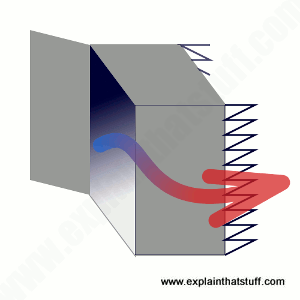
open your refrigerator door in the hope that you'll cool the kitchen,
all the heat that gets drawn in has to go somewhere else. The only
place it can go is out of the back of the machine. You may have
noticed that the grid of fins on the back of a refrigerator gets
pretty hot—and that's why: they're giving off all the heat that
would normally be inside. You can find out more in our article on
how refrigerators work.
Artwork: Physics tells us you can't cool your kitchen by leaving the refrigerator door open, because the heat energy "sucked" into the chiller cabinet is simply pumped out again through the cooling fins at the back.
How to build an air conditioner
Photo: Another typical wall-mounted air conditioner.
But all's not lost! Instead of letting the power of science defeat us,
we just have to use it the right way.
Suppose you take a refrigerator and build your house around it, so
half the machine (the chiller cabinet) is inside your home and the
other half (the grid of hot fins at the back) is outside. Now if you
leave the door open, what you have in effect is a fully fledged air
conditioner. It draws in heat from inside your home and belches it
out again outside, gradually cooling your home in the process.
The simplest air conditioner units work in almost exactly this way, except they have
fans on both sides to circulate air more rapidly. They also have a
heating element in them so they can warm the air in a room on cold
days as well as cool it down on warm days. Machines like this are
sometimes called HVACs (heating and ventilation air
conditioning units). More elaborate air conditioners use long ducts to pipe
the warmed or cooled air throughout an entire building, but they
still work in essentially the same way.
How an HVAC air conditioner works
Warm air from the room is sucked in through a grille at the base of the machine
The air flows over some chiller pipes through which a coolant fluid is circulating. This part of the machine works just like the chiller cabinet in a refrigerator. It cools down the incoming air and a dehumidifier removes any excess moisture.
The air then flows over a heating element (similar to the one in a fan heater). On a cold day, this part of the unit may be turned right up so the HVAC works as a heater.
A fan at the top blasts the air back through another grille into the room. If the heating element is turned down, the air re-entering the room is much cooler, so the room gradually cools down.
Meanwhile, coolant (a volatile liquid that evaporates easily) flows through the chiller pipes. As it does so, it picks up heat from the air blowing past the pipes and evaporates, turning from a cool liquid into a hotter gas. It carries this heat from inside the room to the outside of the building, where it gives up its heat to the outside air. How? Just like in a refrigerator, the coolant flows through a compressor unit and some condensing pipes, which turn it back into a cool liquid ready to cycle round the loop again.
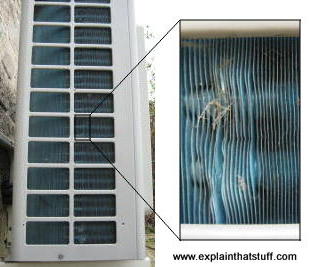
What happens to the heat? In the unit outside the building, there are lots of metal plates that dissipate the heat to the atmosphere. An electric fan blows air past them to accelerate the process.
Over time, the heat inside the building gradually pumps away into the outside air.
Photos: Where does the heat go? Look around the side of an air conditioner like this and you'll see it's jam-packed with metal, heat-dissipating plates. You may even feel some heat being given off as the fan sucks or blows air past them. The image on the right is a close-up of the black area outlined in the middle photo.
Sponsored links
Air conditioners in cars
Car air conditioners work much the same way as home and office ones, only they're a lot smaller. The chiller
part (which incorporates an expansion valve and an evaporator) is mounted behind the car's dashboard, the heat dissipater (incorporating a compressor unit and a condenser) is fitted near the car's radiator grille (where air blows past as you drive along), and the two things are connected by a circuit of pipes through which coolant flows when the air conditioning is switched on. Unlike with a static unit in a building, which is completely powered by electricity, the compressor unit in a car is powered by the crankshaft (driven by the engine, in other words). Usually there's a heater (so the temperature of the passenger compartment can be adjusted) and a dehumidifer (sometimes called a receiver/dryer unit) as well. Just like in normal air conditioning, the coolant cycles between gas and liquid, high and low pressure, and high and low temperature.
How car aircon works
Ever wondered how your car's aircon keeps you cool? It goes a bit like this...
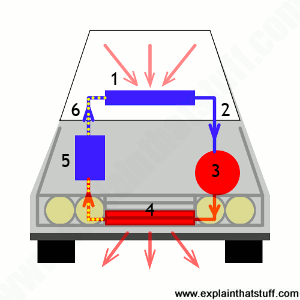
Artwork: How car aircon works (simplified).
The evaporator absorbs heat from the passenger compartment, which makes the coolant inside it boil and turn from a low-pressure liquid into a low-pressure gas.
The coolant flows out of the compartment into the compressor taking the heat with it. It enters the compressor as a low-pressure, relatively low-temperature gas.
The compressor squeezes the coolant so it becomes a high-pressure, high-temperature gas.
The coolant flows into the condenser and (surprise, surprise) condenses: it gives up its heat to the atmosphere, so it turns back into a high-pressure, low-temperature liquid and flows (via the receiver/dryer, not shown) into the expansion valve.
The expansion valve allows the coolant to expand into a low-pressure liquid.
The low-pressure liquid coolant enters the evaporator and the whole cycle repeats. Over time, heat is sucked from inside the passenger compartment to the air outside, cooling the car down.
In practice, there's a second, heating loop attached to this one that can take heat from the car's exhaust system and dump it in the passenger compartment. A couple of valves on both loops ensure the system is
working either as a cooler or a heater, but not both. So, very simplified, we have something like
this, where the front of the car is on the left and the exhaust tailpipe on the right:
Animation: A car's cooling system (blue) effectively takes heat from the passenger compartment (center) and dumps it at the radiator (left). The heating system (red) takes heat from the waste exhaust (right) and dumps it in the passenger compartment. The two systems are typically (but not always)
connected. The orange circles are valves that open and close so that either the heating or cooling circuit is working, but not both at the same time.
How air conditioners can harm the environment
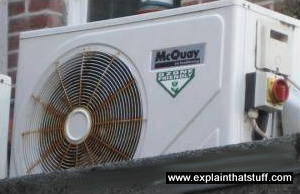
Photo: An "ozone friendly" air conditioner mounted outside a restaurant.
You probably love the feel of freshly chilled air on a hot day, but don't forget
that law called the conservation of energy! There's always a price to pay for getting something good in our universe. In this case, the price is the energy you have to use to run the air conditioning unit; using energy means there's an impact on your pocket and on the planet too in the shape of environmental problems like global warming.
Environmentalists say we should use less air-conditioning, which sounds easier than it is in a really hot climate. It's important to remember that air-conditioning isn't just about luxury or comfort: an air-conditioned room can make you much more productive at work and it can have important health benefits too; some
public-health doctors have suggested that the greater use of air conditioning in the United States is one reason why there are fewer heat-related deaths there than in Europe, where air conditioning is used less. It's sometimes argued that if people don't have air conditioning, they're more likely to use things like electric fans, which work very inefficiently (rearranging hot air instead of removing it and generating heat with their own electric motors). But the biggest electric desk fans (typically rated 25–50 watts) use a fraction as much power as the smallest air conditioners (typically rated at 750–1000 watts); you could use about 20–30 fans and consume the same or less power than a compact AC unit!
[1]
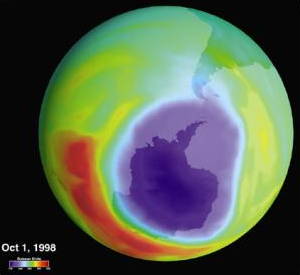
Photo: The ozone hole over Antarctica that was caused by CFC pollution, mostly from air conditioners,
refrigerators, and aerosols. Picture courtesy of NASA on the Commons.
So what's the environmental damage? Let's consider the energy first. Every time you switch on the air conditioner in your car, you add an extra 10–20 percent to your fuel consumption (and an extra 10–20 percent to the price you pay at the gas station).
Your vehicle will produce correspondingly more carbon dioxide emissions and
air pollution.
[2]
At low speeds, opening a window instead is often a better option, though at higher speeds you create air resistance (drag) and waste more energy than you save. At home, using the air conditioner will add plenty to your electricity bill; when
physicist Tom Murphy tested his air conditioning scientifically, he found he used "more electrical energy in two days than we normally expend in a month." You could try other strategies like opening your windows all night but shutting them tight first thing in the morning and throughout the daytime to keep hot air out of your home. In really hot climates, you might find you simply cannot do without the AC; even so, you can dramatically reduce how much it's costing you (and how much energy you're using) simply by turning the thermostat to a slightly higher setting.
Air conditioning units used to have another very harmful effect on the environment as well. Until the late 20th century, most used coolant chemicals known as chlorofluorocarbons (CFCs) (so called because they are made from
the chemicals chlorine, fluorine, and carbon), which were also used widely in refrigerators.
When old air conditioners and refrigerators were broken apart for scrap at the end of their lives, the coolant chemicals escaped into the atmosphere. Floating up into the stratosphere (the upper atmosphere), they rapidly damaged Earth's ozone layer: the natural sunscreen that helps to protect us from the Sun's harmful ultra-violet rays. Most modern air conditioners avoid CFCs (now banned in many countries under a global agreement called the Montreal Protocol) and use alternative coolant chemicals instead (typically halogenated chlorofluorocarbons or HCFCs). If you look closely at our top photo, you can see that the fan has a green "Ozone friendly" label on it, which means there are no CFC coolants inside.
Here to stay?
Love them or loathe them, we won't be getting rid of our air conditioners anytime soon;
in the United States, for example, all the trends are pointing the other way.
According to a 2009 survey by the US Energy Information Administration (EIA), 87 percent of US households now have air conditioning, with a dramatic increase in every region of the country since 1980. Changing expectations have helped to drive that trend:
the same survey revealed that around 90 percent of new homes are now fitted with AC.
Affluent homes are more likely to use centralized air conditioning systems that cool the entire building; poorer homes rely on smaller, room-based air conditioning units fitted to windows or
walls. Although centralized systems are overwhelmingly the most popular in the South, Midwest, and West of the country, room-based units are still significantly more popular in the colder Northeast. According to the EIA, residential air conditioning consumes
16 percent of US household electricity (2022 figure), accounts for
12 percent of total home energy costs (2018 figure), and causes a dramatic increase in consumption during the summer months. In 2020, the EIA calculated that heating and air conditioning combined account for about
half (52 percent) of a typical household's total energy consumption.
Chart: Space cooling, including air conditioning, uses more energy in homes than anything else (albeit only 16 percent of the total).
Source: US Energy Information Administration (EIA), 2022.
Sponsored links
Who invented air conditioners?
If you couldn't live without your air-con, thank Willis Carrier (1876–1950). He was the man who pioneered this "cool stuff" in the early decades of the 20th century. Here's one of his early designs—and note how closely it resembles my quick sketch up above. How does it work? Warm air is pulled in from a room (1), mixed with fresh air (2), conditioned, and blown back into the room by a fan (3). Heat is removed by the refrigerator chiller pipes in the center of the duct (4), which are fed and controlled by a system of pumps, compressors, valves, and thermostats (5).
Photo: One of Willis Carrier's air conditioner designs. This diagram is part of Carrier's US patent #675,144, filed in 1933 and reissued in 1941, which you'll find among the references below. Picture courtesy of US Patent and Trademark Office.
Evaporative air coolers
If you're turned off air conditioning by the thought of expensive
electric bills and harming the planet, air coolers that work by
evaporation are another option to consider.
Evaporative cooling might sound complex, but it's pretty familiar
to all of us. Dogs keep cool without air conditioners just by
sticking their tongues out and panting; hot runners use a similar
trick, sweating profusely to shed heat from their bodies. When liquid
water evaporates and turns to water vapor, it absorbs heat, known as
the latent heat of evaporation, which it has to remove from something
nearby (a panting dog or a sweating athlete, perhaps). Putting this
science to practical use, we can use evaporation to remove the heat
from a room providing we have a handy supply of water nearby.
Portable air coolers (sometimes known as evaporative air coolers
or "swamp coolers") look a bit like air conditioners on wheels
but work in a very different way. Where an air conditioner works
like a fridge, expanding and then compressing a coolant chemical to
shift heat from inside a building to outside, an air cooler sucks in
hot air, passes it through or near to water to cool it down, and then
blows it back out into the room. There are two subtly different types
of air cooler:
One of them passes the air through a kind of
water-filled "sponge," evaporating droplets of water into the
air, cooling it down, and making it more humid at the same time. This
is called direct evaporation because the air and water
meet—they exchange heat by coming into direct contact.
In a slightly different setup, the incoming air blows through a heat
exchanger with cool water circulating in the opposite direction.
Here, the water and air don't come into contact, which is why this is
called indirect evaporation. Indirect evaporation involves
moving two streams of fluid instead of one, which needs an extra fan/pump,
so it tends to use more energy (electricity).
Artwork: How an evaporative cooler works. 1) Hot, dry air is sucked in through a grille.
2) The air passes through a pad soaked with cool water. 3) Some of the water evaporates, cooling the air and making
it more humid. A fan blows the cooled, humid air back into the room. 4) More water is added to the pad by an internal tank
that periodically needs refilling.
Air coolers can be much cheaper to run than air conditioners, but
they don't cool as dramatically. On the plus side, they are much more
portable; on the minus, they have internal tanks that need
periodically refilling with water (and ice, if you wish, to improve
performance) or permanently hooking up to a water supply with a
length of garden hose. They generally work best in hot, dry climates
where the humidity is fairly low (less than about 60 percent),
because lower humidity means more effective evaporation and cooling.
Unlike with air conditioners, which work best when you keep the doors
and windows closed, air coolers need to be placed in a good air flow
near an open window (where dry fresh air comes in) and with an open door
(for moist exhaust air to flow out). That makes sense if you think about it:
the water you're adding to the airflow is "soaking" up heat from the room, and if you constantly expel moist air while allowing dry air to enter in its place, you're continually
removing heat. Air coolers that work by direct evaporation (adding water) can also be used as humidifiers though, in that case, the doors and windows do need to be kept closed to allow the humidity to increase.
Charlatans, Cranks, and Cooling by Paul Krugman. The New York Times, 23 March 23, 2015. Should we credit air conditioning for our economic successes?
Rocking the AC by Tom Murphy, Do the Math Blog, 4 September 2012. A physicist experiments with air conditioning to find out how much energy it really uses.
The Cost of Cool by Elizabeth Rosenthal, The New York Times, 18 August 2012. Does air conditioning pose a threat to the environment and, if so, what can we do about it?
Method for Conditioning Air by Willis Carrier. US Patent #675,144 filed June 10, 1933 and reissued November 18, 1941. This is one of the original air-conditioner patents granted to Willis Carrier, the man who pioneered air conditioning.
Window room air conditioner by Nestor Hernandez, et al, Carrier Corporation. US Patent #6182460B1, granted February 6, 2001. A typical modern room air conditioner with indoor and outdoor units linked by a cooling circuit.
↑ Fans versus air conditioners: I looked at specs for a few desk fans and typical power consumption is about 35 watts, though smaller ones use as little as 25 watts and really big ones come in at 100–200 watts. As a general and fairly obvious rule of thumb, the bigger the fan, the more energy it uses. To give one very specific example, the Honeywell HT900EV1 Turbo uses 40 watts. What about air conditioners?
Even the small DeLonghi Pinguinos come in at 700–1300 watts and bigger units can use
several times more.
↑ Exactly how much aircon adds to your fuel consumption depends on how powerful it is, how much you use it, how old it is, how efficient it is, what the temperature and humidity is like, how much weight it adds to the car, and various other factors.
At one extreme, a 2000 report by NREL found: "Current air-conditioning systems can reduce the fuel economy of high fuel-economy vehicles by about 50% and reduce the fuel economy of today's mid-sized vehicles by more than 20% while increasing NOx [nitrogen oxides] by nearly 80% and CO [carbon monoxide] by 70%". See [PDF] Impact of Vehicle Air-Conditioning on Fuel Economy, Tailpipe Emissions, and Electric Vehicle Range by R. Farrington and J. Rugh, NREL, NREL/CP-540-28960, September 2000.
Another study (of a 2009 Ford Explorer and a 2009 Toyota Corolla), by scientists from Oak Ridge National Laboratory, found typical fuel increases of about 8–22.5 percent.
See Effects of Air Conditioner Use on Real-World Fuel Economy by Shean Huff et al, 2013.
Please do NOT copy our articles onto blogs and other websites
Articles from this website are registered at the US Copyright Office. Copying or otherwise using registered works without permission, removing this or other copyright notices, and/or infringing related rights could make you liable to severe civil or criminal penalties.