When Bob Dylan sang "like a rolling stone... with no direction home," he obviously
wasn't carrying his compass. Armed with a simple bit of magnetized
metal, you can almost always find your "direction home" in
an instant. People have been navigating with magnetic compasses for the best part of 900 years, so there must
be something in it! What are compasses and how do they work? And what
about the compasses people use in ships and airplanes where Earth's
magnetism isn't always a reliable method of navigation? Let's take a closer look!
Artwork: Most compasses are marked with the four main points North (N), South (S), West (W),
and East (E). The four (lighter blue) points in between these are (running clockwise) NE, SE, SW, and NW.
In between those points, we have NNE, ENE, ESE, SSE, SSW, WSW, WNW, and NNW, so the
compass needle here is pointing roughly to East North East (ENE). There's
a further level of division if you want to give even more precise directions. For example, in between NNE and NE, we have "North East by North". In between SSE and S, we have "South by East."
Photo: A magnetic compass points north because it aligns itself
with the magnetic field produced inside Earth. Photo by Jeremy T. Lock courtesy of US Air Force and
Wikimedia Commons.
"... iron, a rich ore of which, placed in a vessel upon water, by an innate property of its own directs itself, just like the loadstone, North and South, at which points it rests, and to which, if it be turned aside, it reverts by its own inherent vigour."
De Magnete (1600), William Gilbert
The simplest compass is a magnetized metal needle mounted in such a way that it can spin freely. (You can make one yourself by magnetizing an ordinary
needle, placing it carefully on a slice of cork, and letting the cork
float in a tray of water.) Left to its own devices, the needle turns
until one end points north and the other south. You can usually
figure out which end is which from the position of the Sun in the
sky, remembering that the Sun rises in the east and sets in the west.
So if you're looking down on the floating needle at about noon,
with the eye on the left and the point on the right,
and the Sun is somewhere in front of you, you know the point is indicating north.
How do you use a compass?
Compasses you buy are a bit more sophisticated than floating needles but work essentially the same way.
They have a lightweight, magnetized pointer mounted on a very
low-friction pivot that is sealed inside a small plastic cylinder filled with liquid.
The pointer is built into a rectangle of plastic called a compass
card, printed with the cardinal points of the
compass (north, south, east, and west), and the intercardinal
points (north-east, north-west, south-east, south-west).
To use a compass like this, you first figure out which direction is north. You let the
needle settle then rotate the compass card so the needle lines up
with the north-south axis and the end of the needle colored red,
marked with an arrow, or printed 'N' points north. You can then
instantly see which direction is south, east, or west and (with the
help of a map) set off in the direction you need to go.
Photo: Modern magnetic compasses are marked with cardinal points (N, S, E, W) and have a 360° scale as well for "taking your bearing," which is how far away from north you should be heading (according to your map). Photo by Nathanael Callon courtesy of US Air Force and
Wikimedia Commons.
How do compasses work?
Magnetism is one of the first bits of science we learn in school and just about the first
thing we discover is that "like poles repel, unlike poles attract."
In other words, if you hold two bar magnets so their north poles
are almost touching, they'll push away from one another; if you
turn one of the magnets around so one magnet's north pole is near
the other magnet's south pole, the magnets will pull toward one another.
That's all there is to a compass: the red pointer in a compass (or
the magnetized needle on your home-made compass) is a magnet and it's
being attracted by Earth's own magnetism (sometimes called the
geomagnetic field—"geo" simply means Earth). As English
scientist William Gilbert explained about 400 years ago, Earth
behaves like a giant bar magnet with one pole up in the Arctic (near the north pole) and another pole down in Antarctica (near the
south pole). Now if the needle in your compass is pointing north, that means it's being
attracted (pulled toward) something near Earth's north pole.
Since unlike poles attract, the thing your compass is being attracted
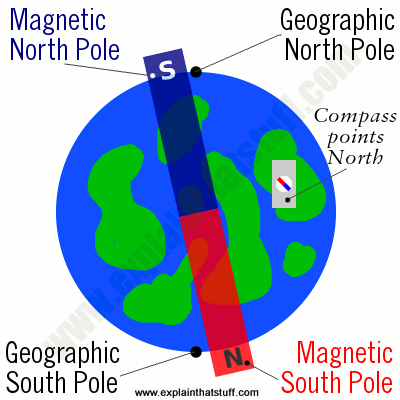
to must be a magnetic south pole. In other words, the thing we
call Earth's magnetic north pole is actually the south pole of the magnet
inside Earth. That's quite a confusing idea, but it'll make sense if you always remember
that unlike poles attract.
Artwork: Earth behaves as though it has a giant bar magnet built inside it. But the magnet is the opposite way around to how you might think, with its south pole up near Earth's actual (geographic) north pole and vice-versa. A compass needle points north because the north pole of the magnet inside it is attracted to the south pole of Earth's built-in magnet. Confusing, eh? Also note that the magnetic north pole and the real north pole don't exactly coincide.
Earth's magnetic field is actually quite weak compared to the "macho" forces like
gravity and friction that really dominate our lives. For a compass to
be able to show up the relatively tiny effects of Earth's magnetism,
we have to minimize the effects of these other forces. That's why
compass needles are lightweight (so gravity has less effect on them)
and mounted on frictionless bearings (so there's less frictional
resistance for the magnetic force to overcome).
Photo: In the 1960s, astronauts were equipped with little compasses like this
as part of their survival gear so they'd know where they were when they came back to Earth.
Photo courtesy of NASA Johnson Space Center (NASA-JSC).
Sponsored links
Why compasses can be inaccurate
Compasses are brilliantly useful but they can sometimes lead us astray, because of two
quite different problems called declination (or variation) and
deviation. Here's why.
Declination (variation)
Artwork: A full map of the compass points. N, S, E, and W are obviously North, South, East, and West, and B means "by", so "NBE" is "North by East" and "SWBS is "South West by South".
Historic 1766 artwork from Andrew Mariner's book The Mariner's Compass Rectified
courtesy of Internet Archive.
Earth spins about an axis (a kind of invisible rod) running through the north pole
(sometimes called the geographic north pole, at the "top" of the
planet) and the south pole (or geographic south pole, at the "bottom"
of the planet). But Earth's magnetic field is a bit wonky and doesn't
quite line up with its axis of rotation. So the magnetic north pole
(the place your compass points toward) doesn't precisely coincide
with the real north pole (it's several hundred km/miles) away
and the same goes for the magnetic south pole.
In practice, the difference between "true north" and "magnetic north" is small and generally (when you're out and about with a
compass and map) you can treat the north a compass shows you as
though it were pointing to the real, geographic north pole.
If we're being more accurate, the difference between "magnetic north" and "true north" is an
angle that varies slightly from place to place (and from year to
year, because the position of Earth's magnetic north is constantly
changing) and it's called the declination or variation.
When really accurate navigation is important (for example, on ships),
you have to take the declination into account and correct for it.
Deviation
A compass is designed to react to the magnetic field generated by the swirling hot mass of
rock thousands of kilometers/miles deep inside Earth, but there are
lots of other things going on, much nearer to your compass, that can
throw it well and truly out of whack. If you're inside an iron ship
or a car, for example, all that metal can make a big difference. The
accuracy of a compass measurement in a certain situation is called
the deviation, and it's the angle between where the compass
would point if it were perfectly accurate (magnetic north) and where
it actually points. If there's a magnet nearby, or you're near a
particularly magnetic bit of Earth's crust, or there are fluctuating
electric currents generating magnetic fields, your compass needle is
going to be affected and its accuracy is going to be
reduced. The most sophisticated compasses have compensating magnets
or pieces of iron built into them that you can adjust to cancel out any local magnetic
effects.
Photo: Good compasses have flip-up "sights" on them (top) so you can take your bearings accurately using distant landmarks. Photo by Shauntae Hinkle-Lymas courtesy of US Air Force and
Wikimedia Commons.
Ship's compasses
Declination and deviation don't matter so much if you're on foot with a map or in a
car; generally, there are other things you can use to help you find
your way and it's hardly catastrophic if you take a wrong turn or
two. On a ship, far from land and in bad weather (so you can't
navigate by the sky), it's a whole different matter. Before
technological advances like GPS and
radar came along, people's lives
depended on navigating accurately by compass alone. That's why ship's
compasses (sometimes called mariner's compasses) were much more
sophisticated than the ones people typically used on
land. In a modern ship's compass, the compass card is attached to a float with a number of
magnetic needles underneath it and spins freely inside a large glass
bowl filled with a mixture of alcohol and water (to minimize friction
and absorb vibrations from the moving ship). The whole thing is
mounted on gimbals (pivots) in a stand called a binnacle
so it stays horizontal even when the ship is pitching (moving up and
down) and rolling (rocking from side to side) in the waves.
Photo: A mariner's (ship's) compass from the sailing ship Blossom. Note the gimbal-mounting that keeps it
steady as the ship pitches and rolls. Photo courtesy of Tim Evanson, published on Wikimedia Commons
under a Creative Commons (CC BY-SA 2.0) licence.
Sponsored links
Other kinds of compasses
Gyrocompasses
If magnetic compasses can be tricky to use in ships, imagine how much worse they are
in fast-moving aircraft. That's why airplanes (plus large ships
and some land vehicles) rely on gyrocompasses. Unlike a magnetic
compass, which points the same way because of magnetic attraction, a
gyrocompass uses a gyroscope—a fast-spinning wheel, mounted on
gimbals, that keeps rotating in the same direction whichever way you
turn it. Gyrocompasses are better able to cope with the more "dynamic
environment" onboard ships and planes and another advantage is that
they can be set to indicate true north (the north pole) rather than
magnetic north.
Artwork: How a gyrocompass works: a heavy rotating gyroscope (yellow, center) powered by an electric motor (purple, bottom) spins inside two perpendicular mounting rings called gimbals (red and green). These are fixed by springs to an outer casing (blue), itself firmly attached to the body of a ship or an airplane. The basic idea is that the spinning gyroscope keeps an indicator pointing in the same direction, no matter how the ship or plane veers and drifts. The model shown here was developed by Hans Usener of Kiel Germany, from his US Patent 1,136,566: Gyrocompass, patented April 20, 1915, courtesy of US Patent and Trademark Office.
The gyrocompass was successfully developed in the early 20th century by American engineer Elmer Sperry (1860–1930), patented in 1908, and first demonstrated on a ship in 1911. However, Sperry's gyrocompass was actually based on an earlier (1906) invention by German scientist
Hermann Anschütz-Kaempfe (1872–1931), who successfully sued Sperry for patent infringement in Germany with the help of Albert Einstein (1879–1955). Later patent infringement cases in the UK and the USA found in favor of Sperry, however, which is why he's largely credited with the invention today.
Astrocompasses
While magnetic compasses and gyrocompasses are set according to the Earth,
astrocompasses are aligned with the position of celestial bodies
(fixed points in the sky, such as the Sun or stars) and then indicate
the position of true north. They're more complex and harder to use
than magnetic compasses, but offer a good alternative in places like
the polar regions where magnetic compasses and gyrocompasses are
unreliable.
Photo: Gyrocompass and navigational equipment on a truck. Photo courtesy of
US Geological Survey.
Radio compasses
Also called radio direction finders (RDF), these pick up directional signals beamed out
from radiotransmitters.
The basic idea is that a receiving antenna (onboard something like a ship or airplane) picks up a
stronger or weaker signal according to how it points toward the transmitting antenna.
With original RDF equipment, you had to turn the receiving antenna one way or the other to maximize or minimize the signal,
which allowed you to figure out where the transmitter was. With signals from more than one transmitter, you could
figure out your own position. Automatic direction finders (ADF) on modern aircraft are radio compasses that automatically figure out and display directions using a pointer and dial similar to a traditional, magnetic compass.
Who invented the compass?
Photo: A fateful compass: This is the compass that actor John Wilkes Booth used to
navigate the Potomac River, as he made his escape after shooting US President Abraham Lincoln in 1865. Photo courtesy of Carol M. Highsmith's America, Library of Congress,
Prints and Photographs Division.
No-one knows when or where compasses were invented, but this is what we do know:
~300–200BCE: Primitive magnetic direction finders are believed to have been invented in China.
12th century CE: More sophisticated compasses are invented independently in China, the Arabic world, and Europe and feature compass needles mounted on pins for the first time.
13th century: Compasses incorporate compass cards marked with the now-familiar cardinal points and subdivisions.
15th century: Navigators realize that compasses point to Earth's magnetic north pole rather than its true (geographical) north pole.
16th century: Marine compasses are mounted in gimbals to reduce problems caused by the motion of ships.
17th century: Englishman William Gilbert publishes a comprehensive scientific account of Earth's magnetism and uses it to explain why compasses point north.
1880s: Scottish physicist William Thompson (Lord Kelvin) develops compasses that can be adjusted to work inside iron-hulled ships.
1880s: Dutchman Marinus Gerardus van den Bos patents a gyrocompass. Others develop and refine the invention over the next few decades.
1900s: Radio direction finding (RDF) is developed by Italian engineers Ettore Bellini and Alessandro Tosi.
1906: Hermann Anschütz-Kaempfe (1872–1931) invents the modern gyrocompass.
1911: Elmer Sperry's improved gyrocompass is successfully tested on a ship for the first time.
1900–1920: Radio compasses (radio direction finders, RDFs) are developed.
1973: The United States GPS satellite navigation project marks the beginning of a steady shift away from traditional navigation to more automated, easier-to-use methods of finding your way.
Sponsored links
Don't want to read our articles? Try listening instead
A History of the Magnetic Compass by John Vardalas. BHP History, 2013/2019. A brief history of compass technology, from ancient times to the 19th century.
[PDF] The Radio Direction Finder and its Application to Navigation by Frederick A. Kolster and Francis W. Dunmore. An old but fascinating article by two of the pioneers of radio compass technology, explaining early, 20th-century RDF equipment developed by the Bureau of Standards and Bureau of Lighthouses.
Be Expert with Map and Compass by Björn Kjellström and Carina Kjellstrom Elgin. Wiley, 2009. A practical guide to navigating with a compass for people who love the outdoors and don't want to rely on GPS!
Mapping Skills with Google Earth by Paul Bramley. Classroom Complete Press, 2015. Mainly for teachers, this is a curriculum-linked, activity-based introduction that offers ways of teaching students how to read and draw maps that cover increasingly large areas, from a small classroom to the entire world. Includes a teacher guide and student handouts. Separate books cover grades PK (prekindergarten) to 2, 3–5, and 6–8.
Please do NOT copy our articles onto blogs and other websites
Articles from this website are registered at the US Copyright Office. Copying or otherwise using registered works without permission, removing this or other copyright notices, and/or infringing related rights could make you liable to severe civil or criminal penalties.