Bang! We think of explosions as
terrible, dangerous things—but that's not always the case. Every
day, explosions are helping to save people's lives. If you're unlucky
enough to be involved in a car accident, a carefully controlled
explosion will (hopefully) fire an airbag out from the dashboard,
cushioning the impact and helping to reduce the damage to your body.
Airbags are very simple but also amazingly clever, because they have
to open up at over 300 km/h (200mph)—faster than a car can crash!
Let's take a closer look at how they work.
Artwork: Airbags save lives thanks to the selfless dedication of crash-test dummies, which have been a feature of car design since the very first dummy, Sierra Sam, made his original test drive in 1949. If we couldn't test new safety innovations with dummies, we'd never be able to deploy them in our cars for real.
Photo by Alex Durbin courtesy of US Air Force and
DVIDS.
Like everything else in the world,
car crashes are controlled by the laws of physics—and, more specifically, the
laws of motion.
Anything that moves has mass (very loosely speaking, this means how much
"stuff" an object contains and it's closely related to how heavy it
feels) and velocity
(loosely, this is the same thing as speed, but strictly it means
speed in a certain direction). Anything that has mass and velocity has
kinetic energy, and the heavier your car and
the faster you're going, the more kinetic energy it has. That's fine until you suddenly want
to stop—or until you crash into something. Then all the energy has
to go somewhere. Even though cars are designed to crumple up and
absorb impacts, their energy still poses a major risk to the
driver and passengers.
Chart: The faster you go, the harder it is to stop. That's because your kinetic energy increases
with the square of your speed (your speed × your speed). The more kinetic energy you have, the more you need
to lose before you come to a stop. If a collision brings your car to a halt in a certain time, the more energy you have, the more
violent the collision, and the greater the chance you'll be injured or killed. Airbags help your body stop more slowly,
reducing the risk of injury and death. [Chart based on a vehicle of total mass 1500kg.]
The trouble is, people inside a
moving car have mass and velocity too and, even if the car stops,
they'll tend to keep on going. It's a basic law of physics (known as
Newton's first law of motion, after brilliant English physicist Sir Isaac
Newton who first stated it) that things that are moving tend to keep
on moving until something (a force of some kind) stops them. Cars
have had seatbelts for decades, but they're a fairly crude form of
protection. The biggest problem is that they restrain only your body.
Your head weighs a surprising 3–6kg (6–12lb)—as much as several bags of
sugar— and isn't restrained at all. So even if your body is fastened
tight, the same basic law of
physics says your head will keep on going and smash into the
steering wheel or the glass windshield (windscreen).
That's where airbags come in.
Sponsored links
How airbags help
An airbag is more correctly known
as a supplementary restraint system (SRS) or supplementary
inflatable restraint (SIR). The word "supplementary" here means that the
airbag is designed to help the seatbelts protect you rather than
replace them (relying on an airbag to protect you without fastening
your seatbelt is extremely dangerous).
The basic idea is that the airbag inflates as soon as the car starts to slow down in an accident and
deflates as your head presses against it. That's important: if the bag didn't deflate, your head would just bounce back off it and you'd be no better off.
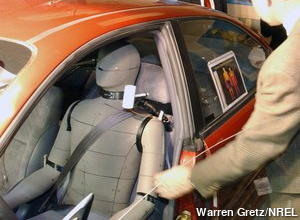
Photo: A typical crash-test dummy has over 130 different sensors packed inside. This dummy, whose name is "Adam," doesn't test crash responses: he's designed to sweat like a real person so researchers can test the climate conditions inside a car! Photo by Warren Gretz courtesy of US Department of Energy/National Renewable Energy Laboratory (DOE/ NREL).
How effective are airbags?
Airbags sound like they must be a good idea, but scientists like hard evidence: is
there any proof that they reduce fatalities?
In 1995, Adrian Lund and Susan Ferguson published a
major study of road traffic accidents over eight years from 1985 to 1993. They found that airbags reduced fatalities by 23–24 percent in head-on crashes and by 16 percent in crashes of all kinds, compared to cars fitted only with manual safety belts.
That's obviously a huge improvement, but it's important to note that airbags are violently explosive things that present dangers of their own. The biggest risk is to young children, though adults also face a small risk of
eye injury and hearing loss.
If an airbag saves your life, you probably consider a slight risk of injury a price well worth paying. Even so, it's clearly important to study the potential dangers of airbags so we can make them as safe and effective as possible.
Modern airbags (installed since the late 1990s) fire with less force than older designs,
and there's compelling evidence that this has reduced accidental deaths, especially among children, without compromising passenger safety.
How airbags work
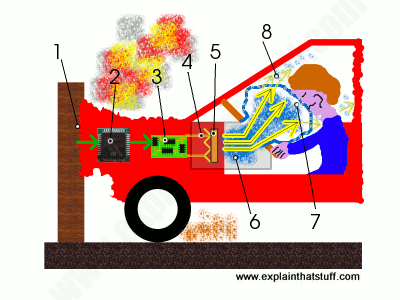
When a car hits something, it starts to decelerate (lose speed) very rapidly.
An accelerometer (electronic chip that measures acceleration or force) detects the change of speed.
If the deceleration is great enough, the accelerometer triggers the airbag circuit. Normal braking doesn't generate enough force to do this.
The airbag circuit passes an electric current through a heating element (a bit like one of the wires in a toaster).
The heating element ignites a chemical explosive. Older airbags used sodium azide as their explosive; newer ones use different chemicals.
As the explosive burns, it generates a massive amount of harmless gas (typically either nitrogen or argon) that floods into a nylon bag packed behind the steering wheel.
As the bag expands, it blows the plastic cover off the steering wheel and inflates in front of the driver. The bag is coated with a chalky substance such as talcum powder to help it unwrap smoothly.
The driver (moving forward because of the impact) pushes against the bag. This makes the bag deflate as the gas it contains escapes through small holes around its edges. By the time the car stops, the bag should have completely deflated.
Who invented airbags?
If you search around online, you'll find quite a few different people are credited with inventing airbags.
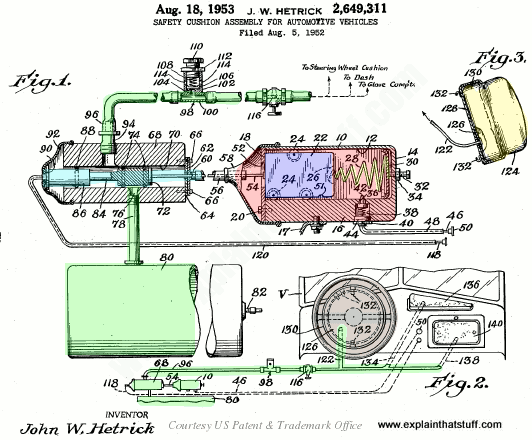
Who thought of them first? In the United States, it appears to have been John W. Hetrick of Newport, Pennsylvania, who came up with the idea after an accident in which he swerved his car off the road into a ditch to avoid hitting a rock, almost throwing his daughter through the windshield. Hetrick filed his patent for a Safety cushion assembly for automotive vehicles on August 5, 1952 (it was granted as US Patent #2,649,311 on August 18, 1953).
Meanwhile over in Europe, a German inventor named Walter Linderer had filed an airbag patent
(DE896312C: Device to protect people in vehicles against injuries in the event of a collision) in October 1951, some 10 months before Hetrick, although it was officially granted three months after Hetrick's patent in November 1953.
As often happens in the history of invention, it seems likely that the two men came up with the same idea independently at more or less the same time.
Artwork: John Hetrick's original airbag design from 1953, which I've colored to make it easier to follow. There are three separate drawings here, showing the main mechanism (occupying most of the picture), a driver's perspective view of the steering wheel (bottom right), and a view of the inflated bag from the side (top right). The bag is triggered by a heavy weight (blue) restrained by a spring (yellow) inside the red cylinder on the right. After an impact, the weight pushes the spring to the right, opening a valve inside a pipe (turquoise) that allows compressed air to flow out from a cylinder (green) and inflate the airbag cushion. Artwork courtesy of US Patent and Trademark Office. Read a full description in Safety cushion assembly for automotive vehicles (via Google Patents).
Many other inventors have built on the idea since then, notably Allen K. Breed (1927–2000), who developed a variety of different ways of triggering the explosion of gas inside an airbag just before the impact of a crash. According to
Breed's New York Times obituary, he made his first airbag design in 1968, and filed numerous patents for improvements, helping to turn Breed Corporation into one of the world's largest suppliers of car safety systems.
People's airbag 'prevents injury': BBC News, 24 September 2008. How a personal airbag could protect you from injuries when you fall over.
External airbag protects pedestrians by Ben Mack, Wired, 5 April 2009. Engineers at Cranfield University have developed an airbag that inflates on the outside of a car.
Car airbags can cause deafness? by Tim Radford, The Guardian, 19 February 1999. Low-speed airbag deployments could cause brief, high-intensity pressure waves that damage your hearing, one expert argues.
Mobility Without Mayhem: Safety, Cars, and Citizenship by Jeremy Packer. Duke University Press, 2008. How do we square ideas like safety and caution with a car culture that thrives on freedom and speed? Packer explores contradictions like this in a fascinating historical account.
Crash by Nicholas Faith. Channel 4 TV/Boxtree Books, 1998. Why do we resist improvements in car safety so strenuously?
Risk by John Adams. Routledge, 1995/2000. A fascinating study of how our perception of risk makes us act more safely or dangerously. There's no specific coverage of airbags, but the effectiveness of seat belts, cycle helmets, and similar safety measures is discussed at length.
For younger readers
Car Science by Richard Hammond. Dorling Kindersley, 2007. A cunning book about science heavily disguised as a book about cars! A great way to learn about the science that makes cars work. If you're interested, I worked as a consultant and contributor on this book. Ages 9–12.
Eyewitness Car by Richard Sutton. Dorling Kindersley, 2005. One of the many excellent DK Eyewitness books, this one teaches you about the history and technology of cars from early days to the present. Again, most suitable for ages 9–12 though older readers (and even adults) will probably enjoy it too.
Videos
Airbag Deployment in Slow Motion: A side-on view of what happens when an airbag inflates, by Biodynamics Engineering, Inc. Note how the bag automatically deflates at the end, albeit more slowly than it would with a person pressing against it.
Please do NOT copy our articles onto blogs and other websites
Articles from this website are registered at the US Copyright Office. Copying or otherwise using registered works without permission, removing this or other copyright notices, and/or infringing related rights could make you liable to severe civil or criminal penalties.