Lasers are amazing light beams powerful
enough to zoom miles into the sky or cut through lumps of metal.
Although they seem pretty recent inventions, they've actually
been with us over half a century: the theory was figured out in 1958; the first
practical laser was built in 1960. At that time, lasers were
thrilling examples of cutting-edge science: secret agent 007,
James Bond, was almost chopped in half by a laser beam in the 1964
film Goldfinger. But apart from Bond villains, no-one
else had any idea what to do with lasers; famously,
they were described as "a solution looking for a problem."
[1]
Today, we all have lasers in our homes (in CD and DVD players), in our offices (in
laser printers), and in the stores where we shop (in
barcode scanners). Our clothes are cut with lasers, we fix our eyesight with
them, and we send and receive emails over the Internet with signals
that lasers fire down fiber-optic cables. Whether we realize it or
not, all of us use lasers all day long, but how many of us really
understand what they are or how they work?
The basic idea of a laser is simple. It's a tube that concentrates light over and over again until it
emerges in a really powerful beam. But how does this happen, exactly? What's going on inside a laser? Let's take a closer look!
Photo: A scientific experiment to check the alignment of optical equipment
using laser beams, carried out at the US Navy's Naval Surface Warfare Center (NSWC).
Photo by Greg Vojtko courtesy of US Navy and
Wikimedia Commons.
The difference between ordinary light and laser light is like the difference between
ripples in your bathtub and huge waves on the sea. You've probably noticed that if you move your hands back and forth in
the bathtub you can make quite strong waves. If you keep moving your hands in step with the waves you make, the
waves get bigger and bigger. Imagine doing this a few million times in the open ocean.
Before long, you'd have mountainous waves towering over your head! A laser does something similar with light waves. It starts off with weak light and keeps adding more and more energy so the light waves become ever more concentrated.
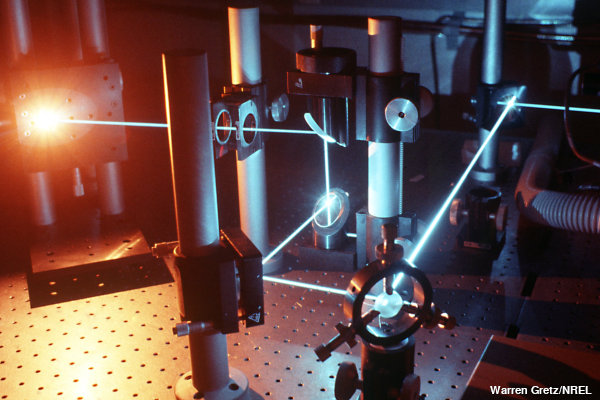
Photo: It's much easier to make laser beams follow precise paths than ordinary light beams,
as in this experiment to develop better solar cells. Picture by Warren Gretz courtesy of US DOE/NREL
(Department of Energy/National Renewable Energy Laboratory).
If you've even seen a laser in a science lab, you'll have noticed
two very important differences straightaway:
Where a flashlight produces "white" light (a mixture of all different
colors, made by light waves of all different frequencies), a laser
makes what's called monochromatic light (of a single, very
precise frequency and color—often bright red or green or an
invisible "color" such as infrared or ultraviolet).
Where a flashlight beam spreads out through a lens into a short and fairly
fuzzy cone, a laser shoots a much tighter, narrower beam over a much
longer distance (we say it's highly collimated).
There's a third important difference you won't have noticed:
Where the light waves in a flashlight beam are all jumbled up (with the crests
of some beams mixed with the troughs of others), the waves in laser
light are exactly in step: the crest of every wave is lined up with
the crest of every other wave. We say laser light is coherent. Think of a flashlight beam as a crowd
of commuters, pushing and shoving, jostling their way down the
platform of a railroad station; by comparison, a laser beam is like a
parade of soldiers all marching precisely in step.
These three things make lasers precise, powerful, and amazingly useful beams of energy.
How lasers work
Before you can understand how a laser works, you need to know how an
atom can give off light.
If you're not sure how this happens, take a look at the box
how atoms make light
in our introductory article about light.
A laser is effectively a machine that makes billions of atoms pump out trillions of
photons (light particles) all at once so they line up to form a really concentrated light beam.
What do you need to make a laser?
We need two basic parts:
A load of atoms (a solid, liquid, or gas) with electrons in them that we can stimulate. This is
known as the medium or, sometimes, the amplifying or "gain" medium (because gain is another word for amplification).
Something to stimulate the atoms with, such as a flash
tube (like the xenon flash lamp in a camera) or another laser.
A typical red laser would contain a long crystal made of ruby (the medium, shown in the artwork below as a red bar) with a flash tube (yellow zig-zag lines) wrapped around it. The flash tube looks a bit like a fluorescent strip light, only it's
coiled around the ruby crystal and it flashes every so often like a camera's flash lamp.
How do the flash tube and the crystal make a laser beam?
A high-voltage electric supply makes the tube flash on and off.
Every time the tube flashes, it "pumps" energy into the ruby crystal. The flashes it makes inject energy into the crystal in the form of
photons.
Atoms in the ruby crystal (large green blobs) soak up this energy in a process called absorption.
Atoms absorb energy when their electrons jump to a higher energy level.
After a few milliseconds, the electrons return to their original energy level (ground state) by giving off a photon of light
(small blue blobs). This is called spontaneous emission.
The photons that atoms give off zoom up and down inside the ruby crystal, traveling at the speed of light.
Every so often, one of these photons stimulates an already excited atom. When this happens, the excited atom gives off a photon and we get our original photon back as well. This is called stimulated emission. Now one photon of light has produced two, so the light has been amplified (increased in strength). In other words, "light amplification"(an increase in the amount of light) has been caused by "stimulated emission of radiation" (hence the name "laser", because that's exactly how a laser works!)
A mirror at one end of the laser tube keeps the photons bouncing back and forth inside the crystal.
A partial mirror at the other end of the tube bounces some photons back into the crystal but lets some escape.
The escaping photons form a very concentrated beam of powerful laser light.
Sponsored links
How do lasers make light?
If that's as much detail as you want to know about lasers, you can stop reading now
or skip further down the page to types of lasers.
This section goes over the same points from the box above in a bit more detail,
and a little bit more "theoretically."
You'll often read in books that "laser" stands
for Light Amplification by Stimulated Emission of Radiation. That's
a complex and confusing mouthful but, if you pull it apart slowly, it's
actually a very clear explanation of how lasers make their
super-powerful beams of light.
Spontaneous emission
Let's start with the "R" of laser: radiation.
The radiation lasers make has nothing to do with dangerous
radioactivity, the stuff that
makes Geiger counters click, which
atoms spew out when they smash
together or fall apart. Lasers make electromagnetic radiation,
just like ordinary light, radio waves,
X rays, and infrared. Although
it's still produced by atoms, they make ("emit") it in a totally
different way, when electrons jump up and down inside them. We can
think of electrons in atoms sitting on energy levels, which are a bit
like rungs on a ladder. Normally, electrons sit at the lowest
possible level, which is called the atom's ground state. If you fire
in just the right amount of energy, you can shift an electron up a
level, onto the next rung of the "ladder." That's called
absorption and, in its new state, we say
the atom's excited—but it's also unstable. It very quickly returns to the ground state
by giving off the energy it absorbed as a photon (a particle
of light). We call this process spontaneous emission of
radiation: the atom is giving off light (emitting radiation) all by
itself (spontaneously).
Photo: Spontaneous emission—by candlelight.
From candles to light bulbs and fireflies to flashlights, all conventional forms of light work through the process of spontaneous emission. In a candle, combustion (the chemical reaction between oxygen and fuel, in this case, wax) excites atoms and makes them unstable. They give off light when they return to their original (ground) states. Every photon produced by spontaneous emission inside this candle flame is different from every other photon, which is why there's a mixture of different wavelengths (and colors), making "white" light. The photons emerge in random directions, with waves that are out of step with one another ("out of phase"), which is why candlelight is much weaker than laser light.
Stimulated emission
Normally, a typical bunch of atoms would have more
electrons in their ground states than their excited states,
which is one reason why atoms don't spontaneously give off light.
But what if we excited those atoms—pumped them full of energy—so
their electrons were in excited states. In that case, the
"population" of excited electrons would be bigger than the
"population" in their ground states, so there would be plenty of
electrons ready and willing to make photons of light. We call this
situation a population inversion, because the usual state of
affairs in the atoms is swapped around (inverted).
Now suppose also that we could maintain our atoms in this state for a little
while so they didn't automatically jump back down to their ground
state (a temporarily excited condition known as a meta-stable
state). Then we'd find something really interesting. If we fired
a photon with just the right energy through our bunch of
atoms, we'd cause one of the excited electrons to jump back down to its
ground state, giving off both the photon we fired in and the photon
produced by the electron's change of state. Because we're
stimulating atoms to get radiation out of them, this process is
called stimulated emission. We get two photons out after
putting one photon in, effectively doubling our light and amplifying
it (increasing it). These two photons can stimulate other atoms to
give off more photons, so, pretty soon, we get a cascade of photons—a
chain reaction—throwing out a brilliant beam of pure, coherent
laser light. What we've done here is amplify light using stimulated
emission of radiation—and that's how a laser gets its name.
Artwork: How lasers work in theory: Left: Absorption: Fire energy (green) into an atom and you can shift an electron (blue) from its ground state to an excited state, which usually means pushing it further from the nucleus (gray). Middle: Spontaneous emission: An excited electron will naturally jump back to its ground state, giving out a quantum (packet of energy) as a photon (green wiggle). Right: Stimulated emission: Fire a photon near a bunch of excited atoms and you can trigger a cascade of identical photons. One photon of light triggers many, so what we've got here is light amplification (making more light) by stimulated emission of (electromagnetic) radiation—LASER!.
What makes laser light so different?
If that's how lasers make light, why do
they make a single color and a coherent beam? It boils down to the
idea that energy can only exist in fixed packets, each of which is
called a quantum. It's a bit like money. You can only have
money in multiples of the most basic unit of your currency, which
might be a cent, penny, rupee, or whatever. You can't have a tenth of
a cent or a twentieth of a rupee, but you can have 10 cents or 20
rupees. The same is true of energy, and it's particularly
noticeable inside atoms.
Like the rungs on a ladder, the energy levels in atoms are in fixed places, with gaps in between them. You
can't put your foot anywhere on a ladder, only on the rungs; and in
exactly the same way, you can only move electrons in atoms between
the fixed energy levels. To make an electron jump from a lower to a
higher level, you have to feed in a precise amount (quantum) of
energy, equal to the difference between the two energy levels. When
electrons flip back down from their excited to their ground state,
they give out the same, precise amount of energy, which takes the
form of a photon of light of a particular color. Stimulated emission
in lasers makes electrons produce a cascade of identical
photons—identical in energy, frequency, wavelength—and that's
why laser light is monochromatic. The photons produced are equivalent
to waves of light whose crests and troughs line up (in other words,
they are "in phase")—and that's what makes laser light coherent.
Sponsored links
Types of lasers
Since we can excite many different kinds of atoms
in many different ways, we can (theoretically) make many different kinds of lasers.
In practice, there are only a handful of common kinds, of which
the five best known are solid-state, gas, liquid dye, semiconductor, and
fiber.
Solids, liquids, and gases are the three main states of matter—and give us three different kinds of lasers. Solid-state lasers are
like the ones I illustrated up above. The medium is something like a
ruby rod or other solid crystalline material, and a flashtube wrapped
around it pumps its atoms full of energy. To work effectively, the
solid has to be doped, a process that replaces some of the
solid's atoms with ions of impurities, giving it just the right
energy levels to produce laser light of a certain, precise
frequency.
Solid-state lasers produce high-powered beams, typically
in very brief pulses. Gas lasers, by contrast, produce
continuous bright beams using compounds of noble gases (in
what are called excimer lasers) or carbon dioxide (CO2) as their medium,
pumped by electricity. CO2
lasers are powerful, efficient, and typically used in
industrial cutting and welding. Liquid dye lasers use a
solution of organic dye molecules as the medium, pumped by something
like an arc lamp, a flash lamp, or another laser. Their big advantage
is that they can be used to produce a broader band of
light frequencies than solid-state and gas lasers, and they can even
be "tuned" to produce different frequencies.
[2]
Photo: Dye laser: This dye laser (top layer) is used to separate different
isotopes (atomic forms) of uranium for nuclear power production. It absorbs green, copper-vapor laser light from optical fibers (bottom layer) and uses it to produce an intense red-orange light at a very specific frequency. Photo courtesy of US Department of Energy.
While solid, liquid, and gas lasers tend to be
large, powerful, and expensive, semiconductor lasers are
cheap, tiny, chip-like devices used in things like CD players,
laser printers,
and barcode scanners. They work like a cross between a conventional
Light-emitting diode (LED)
and a traditional laser. Like an LED, they make light when electrons and "holes" (effectively, "missing
electrons") hop about and join together; like a laser, they
generate coherent, monochromatic light. That's why they're sometimes
referred to as laser diodes (or diode lasers). You can read more
about them in our separate article about semiconductor
laser diodes.
Photo: Lasers—as most of us we know them: This is the laser and lens that scans discs inside a CD or DVD player. The small circle on the bottom right is a semiconductor laser diode, while the larger blue circle is the lens that reads the light from the laser after it's bounced off the shiny surface of the disc.
Finally, fiber lasers work their magic
inside optical fibers; in effect, a doped fiber-optic cable becomes
the amplifying medium. They're powerful, efficient, reliable, and
make it easy to pipe laser light to wherever it's needed.
Photo: Some lasers are designed to produce short, very intense beams. Femtolasers (like this one) can make beams lasting only a millionth of a billionth of a second (10−15s)!
Photo courtesy of US Department of Energy.
What are lasers used for?
“... none of us who worked on the first lasers imagined how many uses there might eventually be... The people involved, motivated mainly by curiosity, often have little ideas as to where their research will lead.”
Charles Townes, How the Laser Happened, 1999.
When Theodore ("Ted") Maiman developed the first practical
laser, few people realized how important these machines would
eventually become. Goldfinger, the 1964 James Bond movie,
offered a tantalizing glimpse of a future where industrial lasers
could slice like magic through anything in their path—even secret agents!
Later the same year, reporting on the award
of the Nobel Prize in Physics to the laser pioneer Charles Townes, The New York
Times suggested that "a laser beam could, for example, carry
all the radio and television programs in the world plus several
hundred thousand telephone calls simultaneously. It is used
extensively for range-finding and missile-tracking." Over half a
century later, applications like this—precision tools, digital
communication, and defense—remain among the most important uses of
lasers.
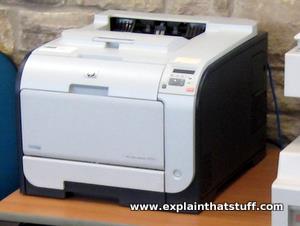
Photo: Every time it prints a document, the laser printer on your desk is busily
stimulating zillions of atoms! The laser inside it is used to draw a very precise image of the page you want to print onto a large drum, which picks up powered ink (toner), and transfers it onto paper.
Tools
Cutting tools based on CO2 lasers are widely used
in industry: they're precise, easy-to-automate, and, unlike knives,
never need sharpening. Where pieces of cloth were once cut by hand to
make things like denim jeans, now fabrics are chopped by
robot-guided lasers. They're faster and more accurate than humans and
can cut multiple thicknesses of fabric at once, which improves
efficiency and productivity. The same precision is equally important
in medicine: doctors routinely use lasers on their patients' bodies.
for everything from blasting cancer tumors and cauterizing blood vessels to
correcting problems with people's vision (laser-eye surgery, fixing
detached retinas, and cataract treatments all involve lasers).
Photo: An eye surgeon carries out LASIK surgery. Photo by Larry A. Simmons courtesy of US Air Force.
Communications
Lasers form the bedrock of all kinds of
21st-century digital technology. Every time you swipe your shopping
through a grocery store barcode scanner,
you're using a laser to convert a printed barcode into a number that the checkout computer can
understand. When you watch a DVD or listen to a CD, a semiconductor
laser beam bounces off the spinning disc to convert its printed
pattern of data into numbers; a computer chip converts these numbers
into movies, music, and sound. Along with fiber-optic cables, lasers
are widely used in a technology called photonics—using
photons of light to communicate, for example, to send vast streams of
data back and forth over the Internet.
Facebook is currently experimenting with using lasers (instead of radio waves) to make better connections to space
satellites, which could lead to higher data rates
and much-improved Internet access in developing countries.
Photo: Communicating with satellites (in this case, the Lunar Reconnaissance Orbiter) using lasers. Photo courtesy of NASA Goddard Space Flight Center.
Defense
The military has long been one of the biggest users
of this technology, mainly in laser-guided weapons and missiles.
Despite its popularization in movies and on TV, the sci-fi idea of
laser weapons that can cut, kill, or blind an enemy remained fanciful
until the mid-1980s. In 1981, The New York Times went so far as to
quote one
"military laser expert" saying: "It's just silly. It takes
more energy to kill a single man with a laser than to destroy a
missile." Two years later, long-range laser weapons
officially became the bedrock of US President Ronald Reagan's
controversial Strategic Defense Initiative (SDI), better known as the
"Star Wars program". The original idea was to use space-based,
X ray lasers (among other technologies) to destroy incoming enemy
missiles before they had time to do damage, though the plan gradually
fizzled out following the collapse of the Soviet Union and the end of
the Cold War.
Photo: Are laser weapons the future? This is the US Navy's Laser Weapon System (LaWS),
which was tested onboard the USS Ponce in 2014. There are no expensive bullets or missiles with a laser gun like this, just an endless supply of fiercely directed energy. Photo by John F. Williams courtesy of US Navy and
Wikimedia Commons.
Even so, defense scientists have continued to transform
laser-based missiles from science fiction into reality. The US Navy first began testing LaWS (Laser Weapon System) onboard the USS Ponce ship in the Persian Gulf in 2014. Using solid-state lasers pumped by
LEDs, it was designed to damage or destroy enemy equipment more
cheaply and precisely than conventional missiles. The tests proved successful,
and the Navy
announced contracts to build more LaWS systems in 2018.
Meanwhile, the development of space lasers continues, though none have so far been deployed.
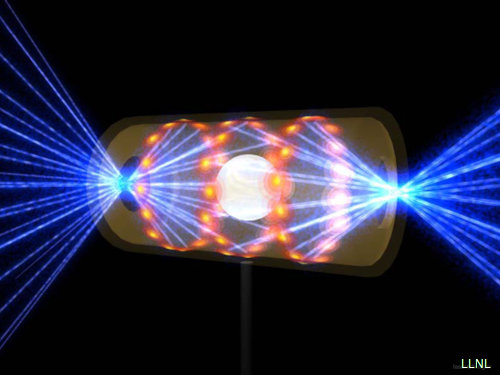
Photo: Scientists at Lawrence Livermore National Laboratory in California developed the
world's most powerful laser, National Ignition Facility (NIF), for nuclear research. Housed in a 10-story building occupying an area as big as three football fields, it uses 192 separate laser beams to deliver up to 500 trillion watts of power
(100 times more energy than any other laser), generating temperatures of up to 100 million degrees. NIF cost a total of $3.5 billion and is expected to power cutting-edge nuclear research for the next 30 years. Above: One of the twin laser bays at the National Ignition Facility. Below: How it works: Beams from the laser are concentrated on a small pellet of fuel in a chamber to produce intense temperatures (like those deep inside stars). The idea is to produce nuclear fusion (make atoms join together) and release a massive amount of energy. Photo credit: Lawrence Livermore National Laboratory.
Who invented lasers?
We can trace the birth of lasers right back to the
first two decades of the 20th century. That's when
Albert Einstein
figured out the quantum theory of light and photons (in 1905) and the
mechanism of stimulated emission (in 1917)—the two key components
of laser science. But it was another four decades before the first
practical laser actually appeared.
Lasers evolved from masers, which are similar but produce microwaves and radio waves instead of visible light. Masers
were invented in the 1950s by Charles Townes and Arthur Schawlow, both of whom went on to win the Nobel Prize in Physics for their work (Townes in 1964 and Schawlow in 1981).
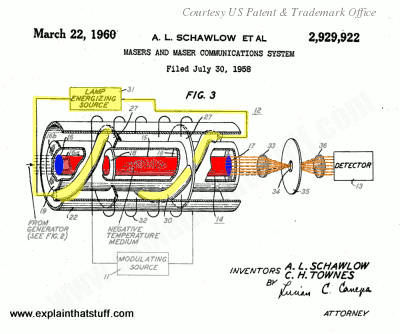
They applied to protect their invention on July 30, 1958 and were granted US Patent #2,929,922 (Masers and maser communication system) on March 22, 1960 (you can see one of the drawings from it here).
Artwork: The original maser designed in the late 1950s by Arthur Schawlow and Charles Townes, taken from their US Patent 2,929,922, which I've colored to highlight the main components. You can see how closely it resembles the laser in my artwork in the box up above. Artwork courtesy of US Patent and Trademark Office.
But did they invent the laser? In 1957, one of Townes' graduate students,
Gordon Gould, sketched in his lab notebook an idea for how a visible light version of the maser could work, coining the word "laser" that we've used ever since. Unfortunately, he didn't patent his idea at the time and had to devote the next 20 years of his life to legal battles, eventually gaining a patent for part of the laser invention
(Method of energizing a material) and substantial back royalties
in 1977.
[3]
Artwork: Gordon Gould's alternative laser is a very different design, but does essentially the same job: amplifying light. Artwork courtesy of US Patent and Trademark Office.
Although Townes and Schawlow are often credited with inventing lasers, the first person to build a working, visible light laser was actually Theodore Maiman, who has never really gained the recognition he deserved: his original writeup of his work was rejected by the journal Physical Review Letters and, despite twice being nominated for the Nobel Physics Prize, he never won the ultimate accolade. He was, however, inducted into the National Inventors Hall of Fame in 1984 and won many other worldwide honors for his groundbreaking work.
[4]
About the author
Chris Woodford is the author and editor of dozens of science and technology books for adults and children, including DK's worldwide bestselling Cool Stuff series and Atoms Under the Floorboards, which won the American Institute of Physics Science Writing award in 2016. You can hire him to write books, articles, scripts, corporate copy, and more via his website chriswoodford.com.
Sponsored links
Don't want to read our articles? Try listening instead
Laserfest: A superb website set up to mark the 50th anniversary of the laser's invention. Includes excellent videos by laser pioneers, including Charles Townes and Theodore Maiman, and many other useful articles and resources. [Archived via the Wayback Machine.]
Facebook's Plans for Space Lasers Revealed by Mark Harris. IEEE Spectrum, January 21, 2019. How Facebook is helping to pioneer laser connections to communications satellites to provide improved Internet access in developing countries.
Creating Lasers in the Sky by Alexander Hellemans. IEEE Spectrum, March 10, 2015. How can we create focused atmospheric laser beams?
Lasers scan future possibilities by Jonathan Amos, BBC News, 12 May 2010. Explains how lasers became an indispensable part of everyday life—and where the technology is heading next.
Lasers lift dirt of ages from artworks by Doreen Walton, BBC News, 26 February 2010. Lasers can be used to blast away dirt, restoring paintings to their former glory.
Lasers by James Bow. Gareth Stevens, 2016. A 48-page introduction for ages 9–12.
Lasers: The Technology and Uses of Crafted Light by Charlene Billings and John Tabak. Facts on File, 2006. A deeper, 208-page overview for ages 10+ (also a good as a non-mathematical backgrounder for adult readers).
Science Pathways: Light by Chris Woodford. Rosen, 2012. One of my own books, this is the broader story of how scientists unraveled the mysteries of light. Ages 9–12. (Previously published by Blackbirch, 2004.)
For older readers
Check out anything and everything by Jeff Hecht—for my money, the best science writer by far covering laser-related topics.
Jeff's own website contains lots of laser- and optics-related resources.
Beam: The Race to Make the Laser by Jeff Hecht. Oxford University Press, 2005. The early years of the laser, focusing on the work of Townes, Schawlow, and Maiman.
Lasers by Anthony E. Siegman. University Science Books, 1990. One of the best introductory books on lasers for college-level students, written by a Stanford Professor.
Principles of Lasers by Orazio Svelto. Springer, 1998. Another detailed student text for undergraduates.
Laser Pioneers by Jeff Hecht. Academic Press, 1992. The story of the laser, including interviews with 15 of the key pioneers.
Inventing the laser at Bell Labs: Charles Townes and Arthur Schawlow are interviewed in this great AT&T archive video from 1988, which explains why lasers were developed, how they work, and what they've done for us.
↑ "Solution looking for a problem" is a quote from Irnee D'Haenens, one of Ted Maiman's assistants, speaking to Maiman. Quoted in Beam: The Race to Make the Laser by Jeff Hecht. Oxford University Press, 2005, p.9.
Please do NOT copy our articles onto blogs and other websites
Articles from this website are registered at the US Copyright Office. Copying or otherwise using registered works without permission, removing this or other copyright notices, and/or infringing related rights could make you liable to severe civil or criminal penalties.