Imagine if there were no electricity
and you had to survive up to 12 hours of darkness each night by candlelight! It sounds wonderful in our age of
cold, sterile, fluorescent
light. But if you had to live that way all
the time you'd find it an awful lot of bother, especially if your
house had many candles, all burning at once. You'd not only have to
keep the wicks burning brightly, you'd also have to ensure they
weren't going to tip over and cause a fire. Drawbacks aside, candles
will always be a symbol of romance. Look more closely and you'll also
find they're classic examples of ingenious technology. Let's take a
closer look at how they work!
Photo: Calm candles are universal symbols of peace and devotion—and they're powered
by the science of chemistry. Photo from Carol M. Highsmith's America Project in the Carol M. Highsmith Archive,
courtesy of Library of Congress Prints and Photographs Division.
Candles make light by making heat, so they're crude examples of what
we call incandescent lamps (old-fashioned, electric filament lamps, pioneered in the late 19th century by Thomas Edison, are a much more
sophisticated version of the same idea). All the light a candle makes
comes from a chemical reaction known as combustion
in which the wax (made from carbon-based chemicals typically derived from
petroleum) reacts with oxygen in the air to make a colorless gas
called carbon dioxide. Water is also produced
in the form of steam. Since the wax never burns perfectly cleanly, there's also a little
smoke produced. The smoke is an aerosol (tiny particles of solid, unburned carbon from the wax mixed in with the steam) and it often leaves a black, carbon
deposit on nearby walls or the ceiling above where the candle's
burning. The steam is made in the blue part of a candle flame, where
the wax burns cleanly with lots of oxygen; the smoke is made in the bright, yellow part of the flame, where
there isn't enough oxygen for perfect combustion to take place.
Candles don't burn all by themselves. It takes energy to kick-start the chemical combustion reaction that makes the wax burn. The initial energy you need to start a chemical reaction is called activation energy. You can provide it using a burning match.
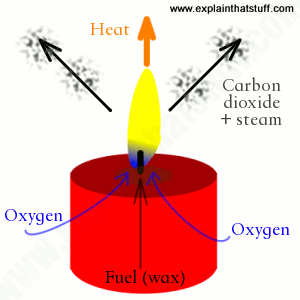
Artwork: How a candle works: A candle is a miniature chemical factory that converts the
hydrocarbons (molecules based on the atoms hydrogen and carbon) in wax into carbon dioxide and water (steam)
through the chemical reaction we call combustion. Oxygen is pulled in at the bottom, fuel is drawn up the
wick, and heat is given off at the top where the hot air rises.
What is candle wax?
You might think wax is just... well, wax, but it's actually quite a tricky thing to define.
The word "wax" is a bit like the word "plastic": it refers to a collection of different substances
with similar properties. Just as we should talk about "plastics" (because there are many different ones),
so we should talk about waxes.
Photo: Wax in action: Three everyday waxes. Top: A beeswax candle. Left: A tin of carnauba wax shoe polish. Right: Surfboard wax, typically made from beeswax, paraffin, or hard synthetic waxes.
Waxes are mainly defined by their physical properties, not their chemical properties.
For our purposes, we can think of a wax as a complex mixture of fatty organic chemicals that has waxlike properties:
It has a relatively low melting point above room temperature (50°–90°C) and melts without
decomposition above 40°C.
It has relatively low viscosity just above the melting point.
It has no viscoelasticity (deforms and gradually returns to shape after a force is applied).
It can be polished (buffed) and becomes plastic above 20°C with slight pressure.
It burns with a sooty flame (the characteristic property of a candle).
It's a poor conductor (of both heat and electricity).
Candles may look simple but they're remarkably ingenious. Set fire
to the wick (the little string poking up at the top) and heat travels
rapidly downward toward the wax body of the candle beneath. The wax has a
low melting point so it instantly turns into a hot liquid and
vaporizes, funneling straight up around the wick as though it's
rushing up an invisible smokestack (chimney). The wax vapor catches light
and burns, sending a flame high above the wick.
Heat from the flame
travels in three directions at once by processes called conduction,
convection, and radiation. Conduction carries heat down the wick to
melt more wax at the top of the candlestick (it also carries down
into the solid base of the candle, which gets noticeably warm to the touch).
Convection draws hot wax vapors out from the wick and sucks oxygen from the surrounding air
into the base of the flame. The flame also gives off invisible beams
of heat in all directions by radiation. The candle continues to "feed"
on the wax underneath it until it's all burned away—until all the
potential energy locked away in the wax is converted to heat,
light, and chemical waste products.
Which part of a candle flame is the hottest?
Here are some approximate temperatures for the different parts of a candle and its flame. Note that the exact temperatures
vary quite a bit depending on all kinds of different factors, notably the type of wax from which the candle is made but also the ambient (air) temperature, and how much oxygen is present. Please don't take these values as absolutely definitive ones that apply in all cases—they're just a rough guide.
Wick: 400°C (750°F).
Blue/white outer edge of the flame (and also the blue cone underneath flame where the oxygen enters): 1400°C (2550°F).
Yellow central region of the brightest part of the flame: 1200°C (2190°F).
Dark brown/red inner part of the flame: 1000°C (1830°F).
Red/orange inner part of the flame: 800°C (1470°F).
Body of the candle: 40–50°C (104–122°F).
Melted pool of wax on top of the candle: 60°C (140°F).
Perhaps surprisingly, the brightest part of the flame is not the
hottest. The
blazing part of the flame gives off three quarters of its energy as
light and only a quarter as heat (so you can see a candle is, at
best, around 75 percent efficient as a lamp). The hottest parts of a candle
flame are actually the blue, almost invisible area near the base,
where oxygen is drawn in, and the blue/white part around the edge, where the
flame meets the oxygen-rich air all around it. The flame
gets progressively cooler as you move in from the outside edge toward
the wick. Cooler areas are darker and colored orange, red, or brown.
Most of the flame's heat is delivered toward the tip, where a large
volume of gas is always burning and convection is sweeping hot gases
constantly upwards. If you want to heat something with a candle, hold it
near the tip.
Chart: There's a wide range of temperatures in the relatively small space that a burning candle occupies. What does that tells us? Apart from anything else, it suggests the wax from which a candle is made must be a relatively poor conductor of heat.
Sponsored links
Do candles burn in space?
The answer's no, yes, and maybe. "No", because there's no oxygen in space. "Yes", because you can burn candles in a spaceship where there's an artificial supply of air. The answer's "maybe" because candles don't burn in the microgravity of space exactly as they burn back here on Earth. There's no "up" and "down" in space, so there's no "top" or "bottom" of a candle flame either. Convection doesn't draw cooler oxygen in at the bottom and throw hot exhaust gases out at the top, as it does here on Earth, where hotter gases are less dense (weigh less per unit of volume) than cooler ones. In the microgravity of space, with plenty of oxygen, candle flames are more spherical, as this NASA photograph clearly shows:
Photo: Candles make only a fraction as much light as electric lamps.
A typical wax candle makes roughly one candela of light, which is also roughly one candlepower (a now-obsolete unit).
Modern light bulbs measure the amount of light they produce in units called lumens; an 8W CFL (equivalent to a 40-watt incandescent bulb) produces about 400 lumens.
Although there isn't a simple, direct conversion from candelas to lumens (because they measure different things), a decent rule of thumb is that a candle produces about 12 lumens. So you need several dozen candles to make as much light as a typical electric bulb—but clearly it depends on the size of the candle.
Do candles make pollution?
Photo: Candles give off potentially harmful particulates, particularly when the wick is smouldering like this.
Yes, but some make more than others. What you have in a candle is a flame burning a mixture of hydrocarbons in air (oxygen and nitrogen), so, apart from making steam and carbon dioxide, it will also make small amounts of carbon monoxide, nitrogen dioxide, and give off quite a lot of "particulates" (those sooty unburned carbon particles). In one anecdotal study reported by
The
Times newpaper, a scented candle rapidly produced twice the level of fine particulates (known as PM2.5s) recorded
at a bus stop in a busy street in central London.
When I carried out my own tests of candle smoke, I found a single candle quickly produced PM2.5 particulates
at levels of up to 50μg/m3, which is not far short of the levels you'd breathe in the streets
of Hyderabad, India. [1]
A recent (2020) scientific review of selected air pollutants in the home, by Professor Sotiris Vardoulakis and colleagues, identified
candles as a "major source" of indoor PM2.5s, alongside smoking, cooking, wood stoves, use of incense, and insecticides.
Air-quality researchers have also found that paraffin-based candles give off toxic chemicals such as benzene (a known carcinogen) and
toluene (which has
numerous adverse effects if you breathe enough of it); technically these are known as volatile organic compounds (VOCs), because they evaporate readily, and polyaromatic hydrocarbons (PAHs), because of their chemical structure. Scented candles can also produce
formaldehyde, another known carcinogen.
What matters with air pollution is generally your exposure (how much of a pollutant you breathe in, in total,
over a period of time). If you light candles individually and only once in a while, they're not likely to cause enough indoor pollution to worry about; other sources of air pollution, both in your home and outside it, are likely to be far more significant. But if you burn a lot of candles and sit in the smoke for long periods, you might want to think twice.
Candle pollution by James Randerson. New Scientist, June 22, 2002. Some candles have wicks stiffened with highly toxic lead
Patents
US Patent: 2697926: Paraffin Wax Candle by William T. Knox, Jr., Standard Oil Development Co., December 12, 1954. Describes a candle with less tendency to drip and the process by which it's made.
US Patent: 1959164: Candle by Alphonse O. Jaeger, Selden Co, August 27, 1931. This old patent describes a method of giving candles a hard, robust, outer coating
and goes into quite a lot of detail about the ideal chemical composition of candles.
Organizations
National Candle Association: Science Projects: This is the main trade body for candle-making companies. Its website includes quite an interesting "Elements of a candle" section that goes into detail about different types of waxes and wicks, and the various fragrances and dyes used. The link takes you directly to their science projects page.
Please do NOT copy our articles onto blogs and other websites
Articles from this website are registered at the US Copyright Office. Copying or otherwise using registered works without permission, removing this or other copyright notices, and/or infringing related rights could make you liable to severe civil or criminal penalties.