You might think the world is essentially what you can see in front of you, but think for a moment and you'll realize this isn't true. When you close your eyes, the world doesn't cease to exist just because there's no light to see by. If you were a rattlesnake or an owl, you could see perfectly well by night. Thinking more laterally, what if you were a radar set
mounted on an airplane? Then you could help pilots see in darkness or bad weather by detecting reflected radio waves. And if you were a camera sensitive to X rays, you could even see through bodies or buildings! The light we can see is only one part of all the electrical and magnetic energy buzzing around our world. Radio waves, X rays, gamma rays, and microwaves work in a very similar way. All together, this energy is called the electromagnetic spectrum. Let's take a closer look at what that means!
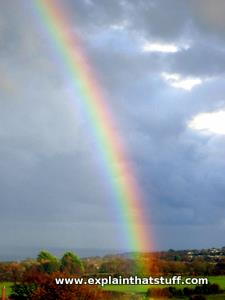
Photo: Water drops bend (or refract) short wavelength blue light more than long-wavelength red light, which is why rainbows arc across the sky when sunlight streams through rain, making a rainbow and revealing the spectrum "hidden" inside white light.
Photo: Even when there's little or no "visible" light around,
we're bathing in vast amounts of invisible electromagnetic energy.
When it comes to electromagnetic radiation, there's really no such thing as "dark."
Photo courtesy of NASA on the Commons.
Light waves and other types of energy that radiate (travel out) from where they're produced are
called electromagnetic radiation. Together, they make up what's known as the electromagnetic spectrum. Our eyes can see only a limited part of the electromagnetic spectrum—the colorful rainbow we see on sunny-rainy days, which is an incredibly tiny part of all the electromagnetic radiation that zaps through our world. We call the energy we can see visible light
(we discuss it in detail in our main article on light) and, like radio waves, microwaves, and all the rest, it's made
up of electromagnetic waves. These are up-and-down, wave-shaped patterns of
electricity and magnetism
that race along at right angles to one another, at the speed of light (300,000 km per second or 186,000 miles per second, which is fast enough to
go 400 times round the world in a minute!). The light we
can see stretches in a spectrum from red (the lowest frequency and
longest wavelength of light our eyes can register) through orange, yellow,
green, blue, and indigo to violet (the highest frequency and shortest
wavelength we can see).
Artwork: How an electromagnetic wave travels: If we could peer inside a light ray (or other electromagnetic wave), this is what we'd see: an electrical wave vibrating in one direction (blue in this case, and vibrating up-and-down) and a magnetic wave vibrating at right angles to it (red in this case, and vibrating from side to side). The two waves vibrate in perfect step, at right angles to the direction they're traveling in. This diagram shows us something scientists only really understood in the 19th century: electricity and magnetism are equal partners that work together closely at all times.
Sponsored links
What kinds of energy make up the electromagnetic spectrum?
What are the other kinds of electromagnetic radiation that objects give off? Here are a few of them, ranged in order
from the longest wavelength to the shortest. Note that these are not really definite bands with hard edges: they blur into one another with some overlap between them.
Radio waves: If our eyes could see radio waves, we could (in
theory) watch TV programs just by staring at the sky! Well not really, but it's a nice idea. Typical size: 30cm–500m (from the size of a school ruler to a little more than the unwrapped length of a 400m athletic track). Radio waves cover a huge band of frequencies, and their wavelengths vary from tens of centimeters for high-frequency waves to hundreds of meters (the length of an athletics track) for lower-frequency ones. That's simply because any electromagnetic wave longer than a microwave is called a radio wave.
Microwaves: Obviously used for cooking in microwave ovens, but also for transmitting information in radar equipment. Microwaves are like short-wavelength radio waves. Typical size: 15cm (the length of a pencil).
Infrared: Just beyond the reddest light we can see, with a
slightly shorter frequency, there's a kind of invisible "hot light" called
infrared. Although we can't see it, we can feel it warming our skin
when it hits our face—it's what we think of as radiated heat.
If, like rattlesnakes, we could see infrared radiation, it would
be a bit like having night-vision lenses built into our heads.
Typical size: 0.01mm (the length of a cell).
Visible light: The light we can actually see is just a tiny slice in the middle of the spectrum.
Typical size: 550 nanometers (the size of a small amoeba).
Ultraviolet: This is a kind of blue-ish light just beyond the
highest-frequency violet light our eyes can detect. The Sun transmits powerful ultraviolet radiation that
we can't see: that's why you can get sunburned even when you're swimming in the sea or on cloudy days—and why sunscreen is so important.
Typical size: 500 nanometers (the width of a typical bacteria).
X rays: A very useful type of high-energy wave widely used in medicine and security. Find out more in our main article on X rays.
Typical size: 0.1 nanometers (the width of an atom).
Gamma rays: These are the most energetic and dangerous form of electromagnetic
waves. Gamma rays are a type of harmful radiation.
Typical size: 0.000001 nanometers (the width of an atomic nucleus).
The electromagnetic spectrum—a closer look
Photo: Diagram of electromagnetic spectrum courtesy of NASA.
All the different kinds of electromagnetic radiation are essentially the same "stuff" as light:
they're forms of energy that travel in straight lines, at the speed of light (300,000 km or 186,000 miles per second), when
electrical and magnetic vibrations wiggle from side to side. Together,
we refer to these forms of energy as the electromagnetic spectrum. You can think of it as a kind of
super-big spectrum that stretches either side of the smaller spectrum we can actually see (the rainbow of light colors).
There are lots of images of the electromagnetic spectrum available online, so we won't bothering drawing
it out for you again. Click the small image on the right to see quite a nice diagram of
the spectrum from NASA.
Who discovered the electromagnetic spectrum?
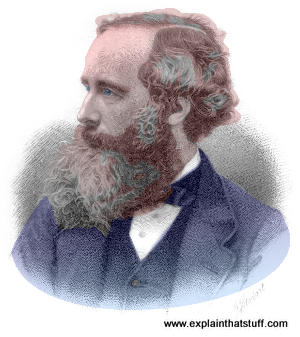
Photo: James Clerk Maxwell: the father of electromagnetism.
Photo courtesy of Wikimedia Commons.
Up until the 19th century, scientists thought electricity and magnetism were completely separate things.
Then, following a series of amazing experiments, it became clear that they were linked together
very closely. Electricity could cause magnetism and vice-versa! Around 1819/1820, a Danish physicist
called Hans Christian Oersted (1777–1851) showed that an electric wire would create a pattern of magnetism around it. About a decade later, English chemist Michael Faraday (1791–1867) proved that the opposite
could happen too—you could use magnetism to generate electricity—and that led him to
develop the electric motors and electricity generators
that now power our world.
Thanks to the pioneering work of people like this, another great scientist,
James Clerk Maxwell (1831–1879) was able to come up with a single theory that explained
both electricity and magnetism. Maxwell summed up everything people had discovered in four
simple equations to produce a superb theory of electromagnetism,
which he published in 1873. He realized that electromagnetism could travel in the form of waves, at the speed of light,
and concluded that light itself had to be a kind of electromagnetic wave. About a decade after
Maxwell's death, a brilliant German physicist named Heinrich Hertz (1857–1894) became the first person to
produce electromagnetic waves in a laboratory. That piece of work led to the development of
radio, television, and—much more
recently—things like wireless Internet.
Sponsored links
"Seeing" other parts of the spectrum with space telescopes
Our eyes pick up light from just one tiny slice of the spectrum,
but the Universe is buzzing with other kinds of radiation.
If we want to "see" beyond the electromagnetic limits of our own eyes,
we can use telescopes "tuned" to higher or lower wavelengths.
Astronomers use all kinds of telescopes—some on Earth,
some in space—to glean information about distant objects
from the electromagnetic radiation they give off.
Radio waves
Giant satellite-dish antennas pick up long-wavelength, high-frequency
radio waves. The biggest radio telescope on Earth is the
Five-hundred-meter Aperture Spherical Telescope (FAST) in China,
which is getting on for twice the size of the much better known
305m (1000ft) Arecibo Observatory in Puerto Rico, which was the world's largest for a half century, but is now being decommissioned. The dish pictured here is about seven times smaller than FAST and four times smaller than Arecibo. It's the 70m (230ft) Canberra deep dish satellite in Australia.
Because cosmic microwaves can't get through the whole of Earth's atmosphere, we have to study them from
space. Cosmic Background Explorer (COBE),
launched in 1989 and deactivated in 1993, was a space satellite designed to do this. These images of the night sky were taken by COBE using different wavelengths of infrared light.
Water in Earth's atmosphere absorbs infrared; studying that
kind of electromagnetic radiation is another job for a space-based satellite, such as the
Infrared Astronomical Satellite (IRAS),
which operated for 10 months during 1983. This is an image of the Andromeda Galaxy taken by IRAS.
Visible light shooting in from space is one thing we can easily study from Earth with any conventional, optical telescope. This one is the historic 66cm (26inch) refractor telescope at the U.S. Naval Observatory in Washington, D.C. However, Earth-bound telescopes like this can pick up only so much—hence the need for telescopes (like the Hubble and its replacement, the
James Webb) that travel into space.
Ultraviolet light can cause skin cancer, so it's a good job much of it is absorbed by Earth's ozone layer.
Unfortunately, the downside of this is that we have to study ultraviolet light coming from space using
satellites such as the International Ultraviolet Explorer (IUE),
which operated for almost two decades between 1978 and 1996.
Think of X rays and you probably think of broken bones—but they're whizzing round space too. Earth's atmosphere prevents these dangerous, high-energy rays from reaching telescopes on the ground, but space telescopes, such as the Roentgen Satellite (ROSAT) (which operated between 1990 and 1999), have been able to observe them in space. The Sun looks the way it does because our eyes see only a fraction of the electromagnetic radiation it gives off. If we could see X rays, the Sun might look more like it does in this image taken taken in December 2001 by the Soft X ray Telescope (SXT), an instrument onboard the Yohkoh observatory spacecraft. What does the Sun really look like? We can never know: our eyes can't appreciate it completely!
Photo by courtesy of NASA Goddard Space Flight Center (NASA-GSFC).
Gamma rays
High-energy gamma rays are also blocked by Earth's atmosphere, so we need space-based telescopes to study those too,
such as the Compton Gamma-Ray Observatory, which operated from 1991 to 2000.
This photo shows the Compton whizzing over Baja California, Mexico in 1991, and was taken from the
Space Shuttle that launched it). The Compton was named for US physicist Arthur Holly Compton (1892–1962), one of the first scientists to study cosmic rays.
[PDF] NASA: Tour of the Electromagnetic Spectrum by Ginger Butcher. NASA, 2016. A free, colorful 32-page introduction written at a similar level to my own article, but with more detail.
Science Pathways: Electricity by Chris Woodford. Rosen, 2013. One of my books covering the story of electricity, from the ancient Greeks, through James Clerk Maxwell, up to modern-day electronics and computing (suitable for ages 9–12).
Eyewitness: Electricity by Steve Parker. DK, 2005. What is electricity and how does it power our world?
Articles
The science world's unsung hero? by Giancarlo Rinaldi. BBC News, 25 November 2008. A short piece about the little-known life of James Clerk Maxwell.
Please do NOT copy our articles onto blogs and other websites
Articles from this website are registered at the US Copyright Office. Copying or otherwise using registered works without permission, removing this or other copyright notices, and/or infringing related rights could make you liable to severe civil or criminal penalties.