You might not realize it, but you're constantly on-guard, watching out for threats, ready to act at a moment's notice. Millions of years
of evolution have primed your brain to save your skin when the
slightest danger threatens your existence. If you're using a power
tool, for example, and a tiny wood chip flies toward your eye, one of
your eyelashes will send a signal to your brain that make your
eyelids clamp shut in a flash—fast enough to
protect your eyesight. What's happening here is that a tiny stimulus
is provoking a much bigger and more useful response. You can find the
same trick at work in all kinds of machines and electrical
appliances, where sensors are ready to switch things on or
off in a fraction of a second using clever magnetic switches called
relays. Let's take a closer look at how they work!
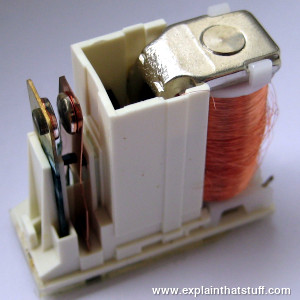
Photo: A typical relay with its plastic outer case removed. You can see the two spring contacts on the left and the electromagnet coil (the red-brown copper-colored cylinder) on the right. In this relay, when a current flows through the coil, it turns it into an electromagnet. The magnet pushes a switch to the left, forcing the spring contacts together, and completing the circuit they're attached to. This is a relay from an electronic, hot-water immersion heater programmer. The electronic circuit in the programmer switches the magnet on or off at preprogrammed times of day using a relatively small current. That allows a very much bigger current to flow through the spring contacts to power the element that heats the hot water.
A relay is an electromagnetic switch operated by a relatively
small electric current that can turn on or off a much larger electric
current.
The heart of a relay is an electromagnet (a coil of wire that becomes a
temporary magnet when electricity flows through it). You can think of a relay
as a kind of electric lever:
switch it on with a tiny current and it switches on ("leverages") another appliance
using a much bigger current. Why is that useful? As the name
suggests, many sensors are incredibly sensitive pieces of
electronic equipment and produce only small electric currents. But
often we need them to drive bigger pieces of apparatus that use
bigger currents. Relays bridge the gap, making it possible for small
currents to activate larger ones. That means relays can work either as switches
(turning things on and off) or as amplifiers (converting small
currents into larger ones).
Artwork: If relays were dogs: Suppose you had a huge, ferocious dog that slept so soundly it never woke up when it heard a noise. It wouldn't be much use as a guard dog! But what if you bought a small, very alert dog as well? If the small dog heard a noise, it would start barking and wake the big dog, which could then attack an intruder. This is how relays work: they use a small electric current to trigger a much bigger one.
How relays work
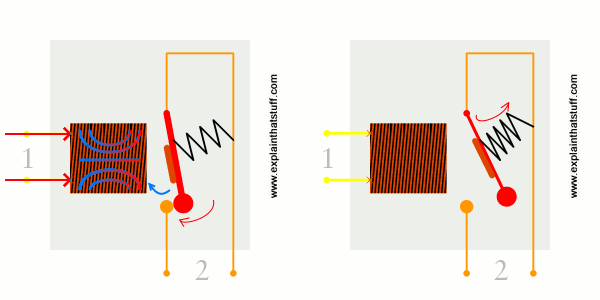
Here are two simple animations illustrating how relays use one circuit to switch on a second circuit.
When power flows through the first circuit (1), it activates the electromagnet (brown), generating a magnetic field (blue) that attracts a contact (red) and activates the second circuit (2). When the power is switched off, a spring pulls the contact back up to its original position, switching the second circuit off again.
This is an example of a "normally open" (NO) relay: the contacts in the second circuit are not connected by default, and switch on only when a current flows through the magnet. Other relays are "normally closed" (NC; the contacts are connected so a current flows through them by default) and switch off only when the magnet is activated, pulling or pushing the contacts apart. Normally open relays are the most common.
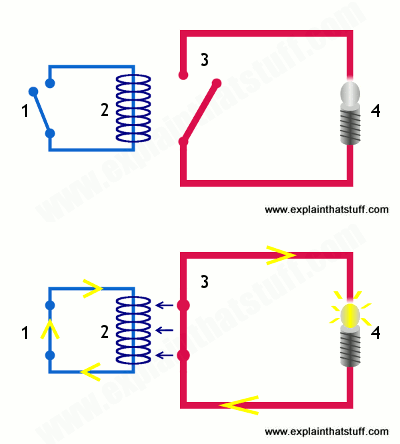
Here's another animation showing how a relay links two circuits
together. It's essentially the same thing drawn in a slightly different way.
On the left side, there's an input circuit powered by a switch
or a sensor of some kind. When this circuit is activated, it feeds
current to an electromagnet that pulls a metal switch closed and
activates the second, output circuit (on the right side). The relatively small
current in the input circuit thus activates the larger current in the
output circuit:
The input circuit (blue loop) is switched off and no current flows through it until something (either a sensor or a switch closing) turns it on. The output circuit (red loop) is also switched off.
When a small current flows in the input circuit, it activates the electromagnet (shown here as a dark blue coil), which produces a magnetic field all around it.
The energized electromagnet pulls the metal bar in the output circuit toward it, closing the switch and allowing a much bigger current to flow through the output circuit.
The output circuit operates a high-current appliance such as a lamp or an
electric motor.
Sponsored links
Relays in practice
Photo: Another look at relays. Top: Looking straight down, you can see the spring contacts on the left, the switch mechanism in the middle, and the electromagnet coil on the right. Bottom: The same relay photographed from the front.
Suppose you want to build an electronically operated cooling
system that switches a fan on or off as your room temperature
changes. You could use some kind of electronic thermometer circuit to
sense the temperature, but it would produce only small electric
currents—far too tiny to power the electric motor in a great
big fan. Instead, you could connect the thermometer circuit to the
input circuit of a relay. When a small current flows in this
circuit, the relay will activate its output circuit,
allowing a much bigger current to flow and turning on the fan.
Relays don't always turn things on; sometimes they very helpfully turn things off instead. In
power plant equipment and electricity transmission lines, for example, you'll find protective relays that trip when faults occur to prevent damage from things like current surges. Electromagnetic relays similar to the ones described above were once widely used for this purpose. These days, electronic relays based on integrated circuits do the same job instead; they measure the voltage or current in a circuit and take action automatically if it exceeds a preset
limit.
Other types of relays
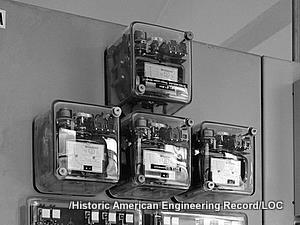
Photo: Four old-fashioned overcurrent protective relays pictured at an obsolete power substation in 1986, shortly before its demolition. Photo by courtesy of US Library of Congress.
What we've looked at so far are very general switching relays—but there are quite a few variations on
that basic theme, including (and this is by no means an exhaustive list):
High-voltage relays: These are specifically designed for switching high voltages and currents
well beyond the capacity of normal relays (typically up to 10,000 volts and 30 amps).
Electronic and semiconductor relays (also called solid-state relays or SSRs): These switch currents
entirely electronically, with no moving parts, so they're faster, quieter, smaller, more reliable,
and last longer than electromagnetic relays. Unfortunately, they're typically more expensive, less
efficient, and don't always work as cleanly and predictably (due to issues like leakage currents).
Timer and time-delay relays: These trigger output currents for a limited period of time (usually from
fractions of a second to about 100 hours, or four days).
Thermal relays: These switch on and off to stop things like electric motors from overheating, a bit like bimetallic strip thermostats.
Overcurrent and directional relays: Configured in various different ways, these stop excessive currents from flowing in the wrong direction around a circuit (typically in power-generation, distribution, or supply equipment).
Differential protection relays: These trigger when there are current or voltage imbalances in two different parts of a circuit.
Frequency protection relays (sometimes called underfrequency and overfrequency relays): These solid-state devices trigger when the frequency of an alternating current is too high, too low, or both.
Who invented relays?
Photo: Professor Joseph Henry, photographed some time between 1860 and 1875.
Photo courtesy of Brady-Handy photograph collection,
US Library of
Congress, Prints and Photographs Division.
Relays were invented in 1835 by American electromagnetism pioneer
Joseph Henry;
in a demonstration at the College of New Jersey,
Henry used a small electromagnet to switch a larger one on and off, and speculated that relays could be used to control electrical machines over very long distances. Henry applied this idea to another invention he was working on at the time, the electric telegraph (the forerunner of the telephone), which was successfully developed by William Cooke and Charles Wheatstone in England and (much more famously) by Samuel F. B. Morse in the United States.
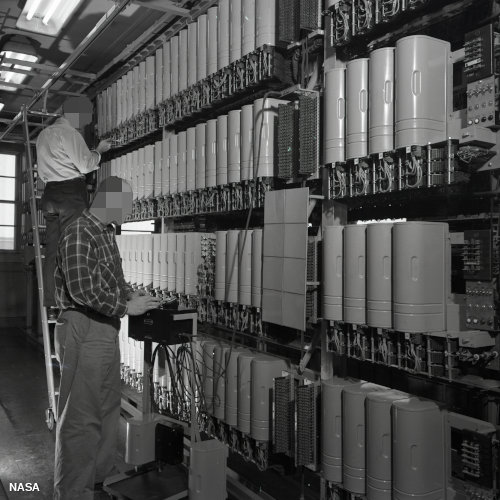
Relays were later used in telephone switching and early electronic computers and remained hugely popular until transistors came along in the late 1940s; according to Bancroft Gherardi, marking the 100th anniversary of Henry's work on electromagnetism, there were an estimated 70 million relays in operation in the United States alone by that time.
Photo: Relays were widely used for switching and routing calls in telephone exchanges
such as this one, pictured in 1952. Photo by courtesy of NASA Glenn Research Center (NASA-GRC).
Transistors are tiny electronic components that can do a similar job to relays, working as either amplifiers or switches. Although they switch faster, use far less electricity, take up a fraction of the space, and cost much less than relays, they generally work with only tiny currents so relays are still used in many applications. It was the development of transistors that spurred on the computer revolution from the mid-20th century onward. But without relays, there would have been no transistors, so relays—and pioneers like Joseph Henry—deserve some of the credit too!
Henry as an Electrical Pioneer by Bancroft Gherardi, Bell Systems Technical Journal, July 1932. This interesting historic article from the Bell archives was published to celebrate the centenary of Joseph Henry's electrical discoveries. It gives an excellent summary of Henry's importance and how he helped to "switch on" the world to electricity during his lifetime.
Joseph Henry by Mitchell Wilson, Scientific American, July 1954, pp.72–77: An analysis of Henry's importance in electromagnetism.
Videos
How to make a relay: A fairly simple 2.5 minute video guide shows you how to wind your own electromagnets and mount them on a board to produce your very own homemade relay.
How an automotive relay works: This short and simple video explanation talks you through the stuff I explained up above. Same explanation, slightly different words.
Books
Simple, practical guides
MAKE: Electronics by Charles Platt.
Maker Media, 2015. Experiment 7, investigating a relay, is a great hands-on introduction. You get to open up a relay and play around with the inner workings!
Eyewitness: Electronics by Roger Bridgman.
New York: DK, 2007. (For younger readers aged 9–12. Includes history, science, and technology.)
Electric Relays: Principles and Applications
by Vladimir Gurevich. CRC Press, 2018. After opening with a brief history of relays, this book takes us through
magnetic principles, the workings of relay contacts, external design and packaging considerations, and related devices such as reed switches. Later chapters explore variations on the basic relay, including high-voltage, thermal, and time relays.
Eyewitness: Electronics by Roger Bridgman.
New York: DK, 2007. (For younger readers aged 9–12. Includes history, science, and technology.)
Please do NOT copy our articles onto blogs and other websites
Articles from this website are registered at the US Copyright Office. Copying or otherwise using registered works without permission, removing this or other copyright notices, and/or infringing related rights could make you liable to severe civil or criminal penalties.