Excuse me, sir, have you any idea how fast you were going? That's the question every motorist dreads being asked by a police officer at
the side of the road. If you were staring straight ahead, not looking
at the dashboard, you might have only a vague idea what to say. If
you were looking at the speedometer, on the other hand, you'll know
the answer exactly, possibly to within one or two kilometers or miles
per hour. Have you ever stopped to think how a speedometer actually
works? It's a really ingenious use of electromagnetism!
Photo: Speedometer and instruments on the dashboard of a restored 1949 Plymouth. Photo by
Christina Russo courtesy of US Air Force.
If you've read our article about motion, you'll know that
speed is very simply defined: it's the distance you travel divided
by the time you take. So if you go 200 kilometers and it takes you
four hours to do it, your average speed is 50 kilometers per hour.
Measuring your average speed after you've traveled is not actually
that much help, especially if a police officer is asking you
questions. How fast were you going sir? Erm, pull me over again in a
couple of hours, when I get to my destination... and I'll divide the
distance I've gone by the time it took... and then I should be able
to give you some kind of an answer. Okay?
Artwork (below): To find your average speed from A to B, you could divide the distance between them by the time it took you. But that doesn't tell you anything about your speed on the way, because you might have traveled by different routes or paused your journey. Only a speedometer can tell you your actual speed at any given moment.
What we're talking about here is average speed; what you need to
know as a motorist is your instantaneous speed: the speed
you're going at any given moment. Figuring that out is a lot harder
than you think. If you've seen traffic cops (or speed cameras) by the
side of the road, you'll probably be aware that they use radar
beams to check speeds. The radar gun (handheld or mounted inside the speed
camera) shoots an invisible electromagnetic beam at your car at the
speed of light. Your car reflects the beam back again, modifying
it very slightly. The gun figures out how the beam has been
affected and, from that, calculates your speed. Now in theory we
could all have radar guns mounted in our cars, shooting beams out at
lamp-posts and buildings and waiting for the reflections to come
back—but that's an awful lot of bother! Isn't there a simpler way of
finding out how quickly we're going?
Photo: Measuring speed with a radar gun. Some speed guns use LIDAR (reflected laser light) instead of radar (which uses reflected radio waves).
Photo by Lek Mateo courtesy of US Air Force.
What we really need is a way of figuring out how fast the car's
wheels are turning. If we know how big the wheels are, we can then
figure out the speed fairly easily. But how do you measure a wheel's
rate of rotation? Even that problem isn't simple. Imagine how much
harder it must have seemed in the early days of motoring, back in
1902, when German engineer Otto Schulze invented the first
practical solution: the eddy-current speedometer.
Photo: Speedometers might look like moving-coil meters (voltmeters, ammeters, and so on), but they work in a totally different way—using the swirling power of eddy currents.
Sponsored links
Mechanical (eddy-current) speedometers
Here's what we want out of our speedometer. We have the car's
wheels rotating at a certain speed and we want to know, with a simple
pointer and dial, what that speed is. So we need to connect the
spinning wheels to the pointer in some clever fashion. Even that is
pretty tricky: the wheels are racing around but the pointer, some
distance away, merely flicks back and forth. How do we convert
continuous, spinning motion into intermittent, flickery, pointer
motion? The answer is to use electromagnetism!
The shaft that turns the car's wheels is connected to the
speedometer by a long, flexible cable made of twisted wires. The
cable is a bit like a mini driveshaft: if one end of the cable
rotates, so does the other—even though the cable is long and bendy.
At the top end, the cable feeds into the back of the speedometer.
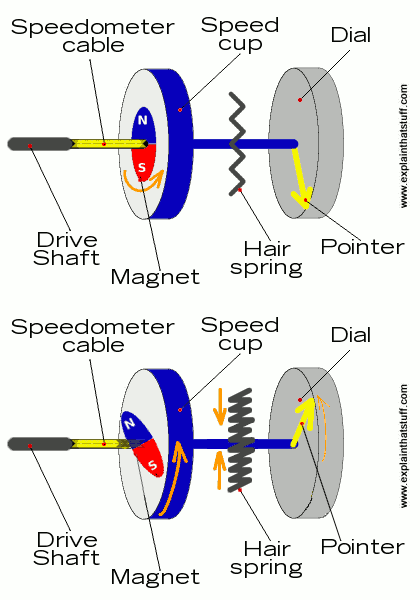
When it rotates, it turns a magnet inside the speedometer case at the
same speed. The magnet rotates inside a hollow metal cup, known as
the speed cup, which is also free to rotate, though restrained by a
fine coil of wire known as a hairspring. However, the magnet and
the speed cup are not connected together: they're separated by air.
The speed cup is attached to the pointer that moves up and down the speedometer dial.
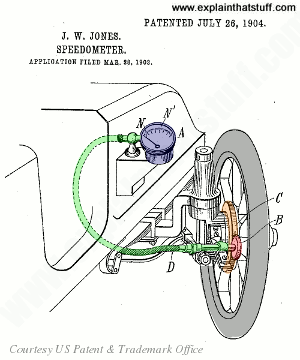
Artwork: Until about the 1960s, virtually all speedometers used a combination of mechanical power and electromagnetism. A small wheel (red), driven by a disc (orange) attached to one of the car's front wheels (gray), spun a cable (green) that snaked up to the speedometer (blue). This very early example, dating from 1904, used a "centrifugal" mechanism to move its needle; later designs switched to electromagnetism. Artwork from US Patent 765,841: Speedometer by Joseph W. Jones, July 26, 1904, courtesy of US Patent and Trademark Office (with colors added for clarity).
How does it all work? As the speedometer cable rotates, it turns
the magnet at the same speed. The spinning magnet creates a
fluctuating magnetic field inside the speed cup and, by the laws of
electromagnetism, that means electric currents flow inside the cup as
well. In effect, the speed cup turns into a kind of electricity
generator. But, unlike in a proper generator
(the kind that makes electricity for your home in a
power plant), the currents in the
speed cup have nowhere to go: there's nothing to carry their power
away. So the currents just swim about uselessly in swirling
eddies—we call them eddy currents for that very reason. Since
they're electric currents, and they're moving in an electrical
conductor inside a magnetic field, another law of electromagnetism says they will create motion.
How? The currents actually make the speed-cup rotate in such a way that it tries to
catch up with the spinning magnet. But the hairspring stops the cup from
rotating very far so it just turns a little bit instead, pulling the
pointer up the dial as it does so. The faster the car goes, the
faster the cable turns, the quicker the magnet spins, the bigger the
eddy currents it generates, the greater the force on the speed cup,
and the more it's able to pull the pointer up the dial. If you can't picture all that clearly,
take a look at the little animation below.
How speedometers work—a closer look
When the engine turns over, the driveshaft turns to make the wheels spin round.
The speedometer cable, powered by the driveshaft, turns as well.
The cable spins a magnet around at the same speed inside the speed cup. The magnet rotates continually in the same direction
(in this case, counter-clockwise).
The spinning magnet creates eddy currents in the speed cup.
The eddy currents make the speed cup rotate counter-clockwise as well in an attempt to catch up with the magnet. Remember that
the magnet and the speed cup are not joined together in any way—there's air in between them.
The hair spring tightens, restraining the speed cup so it can turn only a little way.
As the speed cup turns, it turns the pointer up the dial, indicating the car's speed.
Sponsored links
Other mechanical speedometers
Photo: A centrifugal governor used in some old-fashioned mechanical speedometers and speed-regulating equipment.
Apart from eddy currents and spinning cables, late-19th- and early-20th-century inventors tried a few other ways of measuring speed using ingenious mechanical methods.
There were governor speedometers, for example, which worked a bit like
centrifugal governors (speed limiters) in steam engines, with weights that lifted up higher as an axle span round faster. The weights were connected to a lever that pushed a needle up and down a dial to indicate speed.
In 1916, a company called Waltham patented an air-cup mechanism similar to the eddy-current design but with a pair of air-filled cups facing one another. As one cup rotated, the spinning air inside it pulled on the air in a second nearby cup, connected to a pointer and hair spring, just like in an eddy-current speedometer.
This idea was devised by none other than the great electrical pioneer and prolific inventor Nikola Tesla.
Other speedometers used electromagnetism in different ways. A 1960s patent by Henry Magnuski of Motorola describes a speedometer based on a kind of electricity generator
built around the vehicle axle, which produces a current proportional to the vehicle's speed that operates both the speedometer and odometer (mileage indicator). By replacing the mechanical cable in a traditional speedometer with an electrical one, Magnuski envisaged a more reliable instrument that could also be used for automatic speed control.
Electronic speedometers
Photo: There are quite a few speedometer apps for smartphones, which calculate your speed using GPS (satellite positioning) (or other phone-location) signals (how far you've traveled) and the time. This one's Speedometer Complete for the iPhone, by Daniel J. Pérez.
Android apps include GPS Speedometer and Odometer and SpeedView.
Pretty much all speedometers produced until the 1980s worked using the eddy current and cable mechanism—much like Schulze's original, patented design. But there are drawbacks. First, there are lots of mechanical parts to wear out (which makes them inaccurate)
or fail suddenly. If the speedometer cable breaks, the whole contraption instantly becomes useless—and it takes
a mechanic to make a repair. Long speedometer cables are particularly
impractical, which has always been something of a problem in large commercial vehicles such as trucks and buses.
Eddy-current speedometers are also less than ideal for bicycles, not least because there
isn't really room to mount a large speedometer on the handlebars!
And it's not just the cable that poses a problem: it can be difficult to read a conventional speedometer dial if you're
racing down the freeway, especially at night: do you really want to take your eyes off the road to figure
out where the needle is on the dial? Some people prefer to see their
speed as a simple number on a well-lit digital display.
Artwork: How an electronic speedometer works: 1) A magnet connected to one of the wheels (or more likely to a driveshaft attached to one of the wheels) rotates at high speed. 2) Every time it makes one complete revolution, it passes a Hall-effect (or other magnetic) sensor and the field from the magnet triggers the sensor. 3) A circuit amplifies the signals from the sensor and translates them into your instantaneous speed and distance traveled. 4) A digital display on the dashboard acts as both a speedometer and odometer, displaying the speed and distance side by side.
Electronic speedometers work in a completely different way. Small
magnets attached to the car's rotating drive shaft sweep past tiny
magnetic sensors (either reed switches or
Hall-effect sensors)
positioned nearby. Each time the magnets pass the sensors, they
generate a brief pulse of electric current. An electronic circuit
counts how quickly the pulses arrive and converts this into a speed,
displayed electronically on an LCD display.
Since the circuit is measuring the number of wheel rotations, it
can also keep a count of how far you've traveled, doubling-up
as an odometer (distance-measuring meter).
Electronic speedometers can also display speeds with analog pointers and dials, just like
traditional eddy-current speedos: in that case, the electronic
circuit drives a highly controllable electric motor
(called a stepper motor) that rotates the pointer through an appropriate angle.
Electronic speedometers are more reliable and compact than mechanical ones and the
motion sensors can be any distance from the display that shows you your speed, making
them suitable for any kind of vehicle from a bicycle to a 40-ton truck!
"Any idea how fast you were going sir?"
"'Fraid not, officer—but I've got a pretty good idea how my car figures it out. Does that count?".
How a speedometer works: Popular Science, August 1959. Here's an alternative explanation from the ever-excellent Popular Science magazine, with a better drawing of the speedometer mechanism than the one I've done. It also explains how moving-bar-type speedometers work.
What you should know about your speedometer by Schuyler Van Duyne. Popular Science, September 1941. Another classic article with a great cutaway drawing of a speedometer. Also some historic photos of how speedometers used to be assembled in factories. Probably all done by robots now!
US Patent 1,209,359: Speed indicator by Nikola Tesla, Waltham Watch, Co., May 29, 1914. An eddy-current or air-drag speedometer patented by one of the pioneers of electromagnetism.
Speedometers In the Subway: A Bumpy Life by Richard Perez-Pena. The New York Times, August 21, 1995. How New York subways have switched from mechanical to radar speedometers for greater safety. An interesting piece from the Times archive.
Please do NOT copy our articles onto blogs and other websites
Articles from this website are registered at the US Copyright Office. Copying or otherwise using registered works without permission, removing this or other copyright notices, and/or infringing related rights could make you liable to severe civil or criminal penalties.