Electric doorbells
by Chris Woodford. Last updated: April 1, 2022.
Ding dong! Sometimes we love that sound, sometimes we hate it. But if there's one thing I love it's the science behind it. When someone's finger pushes on my doorbell, what I can hear is the sound of impressively simple 19th-century physics—the science of electromagnetism, to be exact. Just what happens when the doorbell goes "ding"? Let's take a closer look!
Photo: A simple "push-to-make" switch activates the doorbell's electric circuit when you push it in. When you release it, a spring makes it pop out and it breaks the circuit again.
Sponsored links

Contents
How does an electric doorbell work?
When I was about eight or nine, I built a very crude doorbell for my bedroom. It was a simple electric circuit containing a battery, a switch, and an electric motor standing on a large cardboard box. When a caller pressed the switch, the battery fed power to the motor and made it spin around with a buzzing noise (a bit like the vibrating alert on a cellphone or pager). Standing on the box, the motor made a reasonably audible but rather dull humming noise.
Real electric doorbells aren't that different. Instead of using an electric motor and a cardboard box, they use an electromagnet (a temporary magnet whose magnetism can be turned on and off instantly by electricity) to make a more attractive sound, either with an electric bell, a buzzer, or chime bars struck by a magnetic hammer. Like my toy bell, many household doorbells are powered by batteries; others draw small amounts of power from the household electricity supply with the help of a transformer.

Photo: A piezoelectric buzzer makes a chirping noise—the "ring tone" in modern landline telephones. Although cheaper doorbells do sometimes contain buzzers like these, most have more sophisticated ringers.
Clapper doorbells
Most doorbells have what's called a "push-to-make" switch outside your door, like the one in our top photo. When you prod the button, your finger pushes two electric contacts together to complete ("make") the circuit; when you release the pressure, a spring moves the button back out again so the circuit is interrupted.
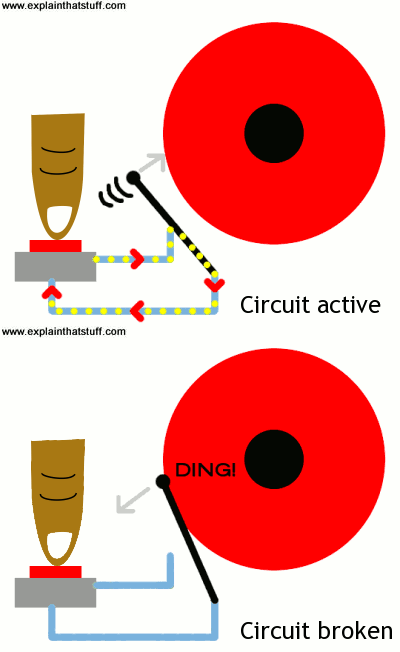
Animation: How a doorbell clapper works as part of a self-interrupting circuit. For the sake of simplicity, this picture doesn't include the electromagnet and the battery (which are wired into the circuit) or the spring that pulls the clapper back to its original position; those are shown in the next picture.
Like my own primitive doorbell, the circuit itself contains only two basic elements: a battery and something that makes a noise. The "something" is often an electric bell: a little metal bell (like one on a bicycle) and a clapper (hammer) powered by an electromagnet. When someone presses the button, the electromagnet is activated and pulls on the clapper, which strikes the bell. But here's the clever bit: the clapper is actually also part of the circuit. When it flips out to strike the bell, it breaks the circuit at the same time, cutting the power to the electromagnet. A spring attached to the clapper pulls it back to its original position, whereupon it completes the circuit, energizes the electromagnet, and rings the bell once more. This goes on for as long as you keep the button pressed. Or until the batteries run out!

Artwork: Inside a clapper doorbell. Press the button (red) and the electromagnets (green) attract the clapper (yellow). As the clapper moves in, it breaks the circuit and its mounting spring lets it spring back out again. The process repeats until you let go off the button. Artwork from US Patent 592,269: Electric vibrating bell by Henry F. Albright, courtesy of US Patent and Trademark Office.
Push-to-make switches can be used to make more sophisticated doorbells. The one below, dating from the early 20th century, uses two interlinked push-to-make circuits. The first one, shown in red, connects a pressure switch (green, 12), battery (10), and lamp (yellow, 21). The switch is placed under a doormat so it closes, operates the circuit, and lights the lamp whenever someone approaches the house. The lamp is meant to be placed right next to the push-button doorbell switch (44)—perhaps even to shine right through it—so it indicates what the caller should press when he or she arrives in the dark. When the switch (44) is pressed, it breaks the red circuit and operates the blue one instead. Now power from the batteries energizes the electromagnet (pink, 15), bringing the bell clapper (green, 14) repeatedly in contact with the bell itself (orange, 16).

Artwork: From US Patent: 769,203: Electric Signal by William Wheeler, patented September 6, 1904, courtesy of US Patent and Trademark Office.