You've seen those amazing, Olympic cyclists leaning forward,
crouching, head-down into a snug, aerodynamic position to shave every
possible second off their time? The only real problem is if they hit
something and crash. Riding with your head so far forward means it's
much more likely to bear the brunt of the impact when you smash into
the road. Head injuries are really bad news. According to the
US CDC: "1000 bicyclists die and over 130,000 are injured in crashes that occur on roads in the United States every year," while
some 60–75 percent of deaths involve a head injury.
[1]
Thank goodness, then, for bicycle helmets. Like your
favorite candy, they're hard on the outside and squashy in the
middle—and that two-layer design helps them absorb impacts and save your life. Let's
take a closer look at how they work!
Photo: When cyclists lean forward to create a more aerodynamic shape, it automatically puts their head at greater risk of injury in a crash. That's why wearing a helmet is important. Note how this rider's helmet helps to create a much more aerodynamic shape for his body by smoothing out the transition between his head and the curve of his back.
Photo by Justin Davidson Beebe courtesy of U.S. Air Force.
At first sight, a cycle helmet looks much like any other hat, but look more
closely and you'll see a lot more thought—and science—has gone into
the design. A typical helmet has two main parts: a hard outer shell
and a soft inner liner:
The hard shell is designed to spread the
force of an impact over a broader area so your skull is less likely
to fracture, while the soft liner is meant to squeeze inward and
absorb the impact energy, so less of it is transmitted to your head.
Artwork: How a helmet saves your life: When you bump your head, the hard outer shell (black) spreads
the impact over a wide area. The whole of the soft inner liner (orange) then absorbs the energy evenly so (hopefully)
there's minimal damage to your head. Without the helmet, the entire impact would be concentrated on a tiny part of
your head, very likely fracturing your skull and quite possibly damaging your brain too.
Bicycle helmets are a good example of how the right material can make all the difference to
how well something does its job. Shells are typically made of composite materials like fiberglass or
lightweight carbon fiber, or very hard plastics such as polycarbonate
or ABS. Liners are usually about 20mm (0.8 inches) thick and made of
two layers of foam: a soft, bouncy layer that absorbs small bashes and
bumps and a stiff layer that permanently deforms to absorb very hard
impacts. Some helmets are now incorporating energy-absorbing plastics like
D3O® that are soft in normal use but harden instantly
the moment you hit them, but most still use cheaper and simpler
materials like expanded polystyrene (EPS) or expanded polypropylene (EPP).
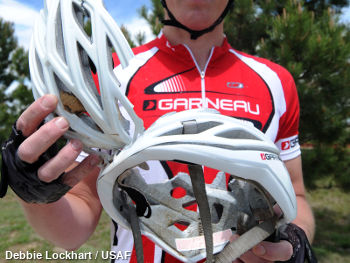
Photo: The badly torn remains of this cycle helmet soaked up the energy of an impact. This cyclist suffered serious injuries in a crash, but his helmet saved his life: a smashed helmet is better than a smashed head. Photo by Debbie Lockhart courtesy of U.S. Air Force.
Structure of a typical bicycle helmet
In some ways, the human body is like a smokestack: lots of the heat our bodies lose disappears straight up through our heads.
We wear woolly hats on cold days to keep the heat trapped inside. But by the same token,
wearing any kind of close-fitting hat on a hot day can really make you perspire. That's why bicycle helmets generally contain lots of ventilation holes. The trouble with punching holes in things is that it makes them structurally much weaker, so the vent holes in cycle helmets work directly
against the job they're designed to do (protecting your head). Not only that,
they also disrupt the airflow over the helmet, causing turbulence that slows you down.
Designing a decent bicycle helmet involves a careful balance between protecting your head, keeping you cool,
and making you aerodynamic enough to go reasonably fast.
Here's a recent helmet from Bell Sports of California, with a novel design for maximizing
airflow and ventilation around the rider's head, while retaining strength and reasonable streamlining.
I've kept Bell's numbers on the artwork, but provided my own simplified descriptions of them.
The front of the helmet (the rider's nose) is on the left.
10. The overall helmet design.
14. Hard outer shell made of ABS plastic, Kevlar®, polycarbonate, fiberglass, or similar.
18. Inner foam layer typically made of EPS or EPP.
22. Chinstrap.
26. Strap adjustment mechanism.
30. Protection for the front of the head.
34. Protection for the crown of the head.
38. Protection for the back of the head (and the brain's occipital lobe).
42. Structural, longitudinally extending ribs.
46. Laterally protecting webs connecting the ribs together.
52. Ventilation openings.
Sponsored links
What's the best bicycle helmet to buy?
The best helmet isn't necessarily the one that looks cool; it's the one you're
most likely to wear. If it looks brilliant but feels uncomfortable or
gets too hot, you're less likely to keep it on your head—so it's a
waste of time. The most important things to think about when you buy
a helmet are:
Does it fit snugly and stay properly in position on your head?
Is it light and comfortable?
Does it have enough ventilation holes so it stays cool?
Do you like the look of it and will you actually wear it?
Does it meet the latest consumer standards?
It may sound strange, but the last one of these is probably less important than the others:
the best helmet in the world is no good at all if it's too hot or
uncomfortable for you to keep it on your head. But assuming you find
a helmet that fits, looks good, and you're definitely going to wear,
make sure it meets the toughest test: that's the US Consumer Product
Safety Commission (CPSC) bicycle helmet standard. There are other,
lesser standards you don't need to bother with. If a helmet doesn't
meet the CPSC standard, don't buy it.
You can buy a new helmet anytime you get sick of your old one, but
you must always buy a new helmet if you have a crash. If you
crack your helmet or compress the foam, it's not going to work
properly the next time—so get rid of it! For the same reason, never
buy secondhand helmets in thrift stores, from friends, or on places
like Web auction sites; you don't know what they've been through already
and whether they're still going to give you the protection you need.
Do I really have to wear a helmet?
People used to think bicycle helmets were uncool, but that's all
changed now. You won't find any professional cyclist racing on the
road or a track without a helmet clamped firmly to their head. And
helmets are so much better than they used to be. Have you noticed how
cool Olympic cyclists look in those teardrop-shaped chrono hats?
Virtually all modern cycle helmet are amazingly swish and can make
even the slowest of riders cut a dash. One word of warning, though. Everyone wants to look good,
but remember that a cycle helmet is primarily about protection.
Fussy, elaborate extras are usually just marketing gimmicks—so don't
waste your money.
Sponsored links
Do bicycle helmets really save lives?
Photo: The best helmet for you depends partly on how you ride. BMX riders prefer ones
like this, which are more like climbing and skating helmets with full ear protection.
You're not cycling so fast in BMX, and aerodynamics and ventilation are much less important than
effective, all-round impact protection. You're guaranteed to fall off if
you do this kind of riding so a good helmet is really important.
Photo by Shawn Miller courtesy of US Army and Wikimedia Commons.
There is an argument that helmets don't make as much overall
difference to how many people are killed or injured in bicycle accidents as you might expect.
People who study the psychology of risk point out that if
we make ourselves feel safer (with helmets on bicycles or seat belts
and airbags in cars) we ride or drive more dangerously and put
ourselves at greater risk of an accident—so the two factors cancel out leaving
us no better off.
Could helmets put people off cycling?
There's another problem too. Society has become much more safety-obsessed and risk-averse,
and that's often neither a good thing nor a rational one. Some people will look at cyclists
hurtling by in helmets and high-visibility jackets and conclude that it's far safer to sit at home or take the bus
than to venture out on the road. In other words, cycle helmets could deter people from cycling
altogether—making them miss out on the health benefits of the excellent exercise it provides.
If we consider society as a whole, inactivity and lack of exercise could actually pose a bigger risk to health
than injuries and fatalities caused by cycling. So whether helmets save lives overall is actually a much more
subtle and complicated issue than it first appears—and it's especially contentious
in countries such as Australia where helmet wearing is compulsory.
This argument has been forcefully made
by Australian researcher Bill Curnow in a variety of papers, including
Bicycle Helmets: A Scientific Evaluation [PDF].
Chris Rissel, Professor of Public Health at the University of Sydney, argues that "... the benefits of cycling outweigh the risks, with helmet legislation actually costing society more from lost health gains than saved from injury prevention."
Others argue that the risk of putting people off cycling is less relevant than it might appear. In a
recent review of 21 separate studies, Alena
Høye, from the Institute of Transport Economics in Norway, has suggested: "People who may be deterred from cycling are among those with the highest injury risk and the smallest health effects from cycling."
Photo: An aerodynamic chrono helmet being worn by a triathlon rider. The teardrop shape reduces
air resistance around the rider's head, which means it has a smoother surface and fewer ventilation openings than on a
typical road cycling helmet. Photo by Suzanne Day courtesy of US Air Force.
What do the studies say?
Scientific studies of cycle injuries paint a mixed picture:
A recent two-year study of injuries treated in one hospital by Dinh et al found that "A lower proportion of people wearing helmets had significant head injury... or facial injury... compared with non-helmet users... [and] helmet use was associated with a 70% decrease in the odds of significant head injury."
Another study, by Canadian researchers Costa et al, concluded that not wearing a helmet doubles the cost of hospital treatment for cyclists who suffer traumatic brain injuries.
But that doesn't mean helmets are guaranteed to help in every situation.
A 2020 study by researchers at the UPMC Children's Hospital of Pittsburgh
(Strotmeyer et al)
found that "Approximately 75% of all bicycle-related mortality is secondary to head injuries, 85% of which could have been prevented by wearing a bicycle helmet."
A recent study of 3854 injured cyclists (by Rivara, Thompson, and Thompson) concluded that "Prevention of serious bicycle injuries cannot be accomplished through helmet use alone, and may require separation of cyclists from motor vehicles." That's perhaps not surprising when you consider the relative mass and speed of a cyclist and an automobile—and imagine what happens when they collide. Whether a helmet helps you also
depends on who you are.
One 2015 German study ("Prevention of Bicycle Accidents" by
Zwipp et al) argued that "Elderly bicyclists... are a minority... but represent a majority... of all fatalities. They profit most by wearing a helmet."
Back in Australia, where the debate continues to rage over compulsory cycle helmets, a 2016 statistical review of
some 40 separate studies by Jake Olivier and Prudence Creighton concluded that "Bicycle helmet use was associated with reduced odds of head injury, serious head injury, facial injury and fatal head injury"—a 70 percent reduction in serious head injury and a 65 percent reduction in fatal head injury.
A 2018 meta-analysis by A. Høye
of 55 studies carried out between 1989 and 2017 found that helmets "reduce head injury by 48%, serious head injury by 60%, traumatic brain injury by 53%, face injury by 23%, and the total number of killed or seriously injured cyclists by 34%," and concluded that "wearing a helmet while cycling is highly recommendable."
It's difficult to argue that bicycle helmets benefit everyone, equally, in all situations,
or that wearing a helmet should be a legal requirement. Ultimately, the choice is yours. If you're an ordinary, careful rider and you just happen to have an accident that you survive, a cycle helmet could reduce your risk of a serious head injury and save your life. That's why many cyclists conclude that wearing a helmet is a no-brainer, while not wearing one could leave you with no brain. But while scientists and doctors argue over whether helmet wearing is a good or a bad thing overall, the evidence is pretty clear that if you are involved in an accident,
you're generally better off if you're wearing a helmet. As Diane C Thompson from the University of Washington and colleagues found in a 1999 review: "Wearing a helmet dramatically reduces the risk of head and facial injuries for bicyclists involved in a crash, even if it involves a motor vehicle."
Sponsored links
Don't want to read our articles? Try listening instead
Materials for Bicycle Helmets: For the more scientifically minded, this interesting research paper explains how different helmet foams compare in energy-absorbing performance.
Cyclist safety: Arguments for cycle helmets from Brake, the UK road safety charity.
Bicycle Helmets as Fashion Statements by Simone S. Oliver. The New York Times, July 10, 2013. Why humdrum helmets have become stylish fashion accessories.
The Myth of the Bicycle Helmet by Mark Stewart, Risk Sense, 14 June 2012. This blog post suggests that wearing bicycle helmets can be counterproductive, advancing the argument that "people accepted the idea that helmets work, and then created studies to 'prove' that they do." [Archived via the Wayback Machine.]
The secret ingredient for a safer bike helmet: paper by Anna Lacey, BBC News, 12 January 2014. Inventor Anirudha Surabhi believes corrugated paper structures could slow down an impact and reduce injuries more effectively than conventional foam.
Patents
Patents are a great place to find detailed technical descriptions of how things work. Here are a few that cover modern bicycle helmets:
↑ A 1999 news release from the
US CPSC tells us "about 60 percent of these deaths involve a head injury."
The more recent (2020) study by Strotmeyer et al, referenced above, put the figure at "approximately 75%".
The mortality figures have not changed significantly (and certainly not gone down)
in two decades. The CPSC news release notes that: "About 900 people, including more than 200 children, are killed annually in bicycle-related incidents..."
Please do NOT copy our articles onto blogs and other websites
Articles from this website are registered at the US Copyright Office. Copying or otherwise using registered works without permission, removing this or other copyright notices, and/or infringing related rights could make you liable to severe civil or criminal penalties.