When Alexander Graham Bell (1847–1922) spoke the immortal words
"Mr. Watson! Come here! I want to see you!" into his primitive
telephone in March 1876, he became one of
the founding fathers of the
modern
age of telecommunications. But just suppose for a moment that
he'd wanted to send his colleague a picture instead of spoken
words—how exactly would he have done it? Most people assume fax
machines (which send documents down phone lines) are newer than the
telephone lines they use, but the first fax (Alexander Bain's
"chemical telegraph") was actually patented decades before
the phone in the 1840s. Today, the Internet
has largely made faxing obsolete,
but many businesses still rely on trusty old fax technology. Let's take a closer look at how it
works!
Artwork: The basic concept of fax, short for "facsimile": the idea is to create a replica of an original document at the other end of the telephone line.
Suppose you have an urgent contract you want me to sign and
you need to get it to me as quickly as possible. You could mail it,
of course, but that will take at least a day to reach me and another
day for me to return it. You could use a courier—but, unless we live near
one another, we're still talking about a turnaround time of hours. Or
you could send the contract down the phone with a fax machine in a
minute or so.
Let's imagine for a moment that fax machines haven't been
invented, but you still want to use the phone. Suppose you need to
transmit a one-page document to me. What can you do? Let's make the
problem really easy. Let's say the document can be either a totally
black page or a totally white one. Now transmitting the document is
really easy. You simply pick up your phone, dial my number, wait for
me to answer, and then say either "black" or "white".
Okay, let's make the problem a bit harder. Suppose the document is
a single page divided into four squares and each of the four areas can
be either black or white. Again, it's fairly easy for you to transmit
this document. You ring me up and just say "Black black white
black", "White black white white" or whatever—and I can
instantly recreate the document in my mind's eye at the other end.
Now let's make the problem much harder. You have to
send to me an entire page covered in black-and-white,
computer-printed words. Actually, this problem isn't as hard as it
looks. All you have to do is divide the page into thousands of grid
squares and then read out, from left to right and from top to bottom,
whether each square is black or white. Suppose I'm sitting at the
other end of the phone with a piece of paper ruled with an identical
grid of squares. As you read out "black", "white", "white",
"black", I just need to shade in all the black squares with a
pencil and skip the white ones. By the time you get to the bottom of
the page, my shaded-in page will look just like yours. If we make the
squares small enough, so each one is slightly bigger than a pinhead,
I will magically end up with an exact, readable copy of your page.
Simply speaking, this is how fax machines work.
Sponsored links
How real fax machines work
Well, okay, it's not exactly how they work!
A fax machine is designed to both send and receive documents so it has a sending part and a
receiving part. The sending part is a bit like a computer scanner, with a CCD (charged-coupled device)
that scans only one line of a document at a time, and only in black and white.
Crudely simplified, it looks at each line separately, detects
the black areas and the white areas, and transmits one kind of
electric pulse down the phone line to
represent black and another to represent white (just like saying "black" and "white",
in fact). The phone line transmits this information almost instantly
to a fax machine at the other end. It receives the electrical pulses
and uses them to control a printer.
If the receiving fax hears "black", it draws a tiny black dot on the page; if it hears
white, it moves along slightly, leaving a white space instead. It
takes about a minute or so to transmit a single page of writing (or a
complex drawing) in this clumsy but very systematic way.
What happens inside a fax machine?
Ever wondered what goes on inside your machine when you send or receive a fax?
To send a fax, you feed the page into the input slot and it's pulled in between several pairs of rollers.
Larger fax machines have built-in document feeders that automatically feed in multiple pages from a stack, so you don't have to stand at the machine feeding in pages one at a time.
As the paper moves down, a bright light shines onto it. White areas of the page reflect
a lot of light; black areas reflect little or none.
The CCD turns the analog pattern of black and white areas on the page
into a numeric (digital) pattern of binary zeros and ones and passes the information to an electronic circuit.
The circuit sends the digital information down the telephone line to the fax machine at the receiving end.
When you receive a fax, the same circuit takes incoming digital information from the phone line and routes it to a built-in printer.
In a typical personal fax machine, paper is pulled from a large roll inside the machine. (In a larger office fax machine, it usually comes from a plain-paper hopper, similar to the one in a laser printer.)
The thermal (heat-based) printer, operated by the circuit, reproduces the incoming fax on the paper as it moves past.
An automatic blade cuts the page and the printed fax emerges from the output slot.
You can see that there are really two separate machines in one: a fax-sender and a fax-receiver. When you use
a fax machine to make quick "photocopies" of documents, the two machines link up together: instead of sending
a fax down the phone line, the circuit reroutes the scanned data directly to the printer so you get a copy
of your original document.
Inside a real fax
To see how it's all set up in a real machine, take a look at this patent drawing that shows the layout of
a typical Ricoh fax from the 1980s.
Artwork: 1) During scanning, the original document feeds through a series of rollers (green)
along the orange-dotted path on the left, past the bright scanning light (yellow, 48). The light reflects the black and white surface of the document along the yellow and black dotted optical path into the scanner (red). The CCD (grey, 36) digitizes the image ready for transmission.
When faxes are received, the thermal printer (blue, 29) reproduces them on paper feeding through from the large roll in the
center. A paper slicing mechanism (green, 27) cuts the roll into single sheets as it passes by.
Artwork from US Patent 4630123: Compact facsimile machine by Shigeru Kadomatsu, Ricoh Co. Ltd, 16 December 1986, courtesy of US Patent and Trademark Office.
Sponsored links
Fax groups
Photo: How a fax machine would transmit a picture of the Mona Lisa. Every part of the image becomes either black or white. Not shades of gray, but crude, binary black or white. You can still recognize the picture, but much of the detail has been lost. This matters much less for text documents than for images.
Fax machines come in three main kinds called group 1, group 2,
and group 3. The group number is, broadly speaking, a measure of how
fast the machine can send and receive: a group 1 machine sends and
receives at the slowest speed (about six minutes per page), group 2
can manage a page in about three minutes, and group 3 zips along at
a few pages per minute by using digital compression to reduce the amount of data that
has to be sent and received. Most fax machines still used today fall into groups 2 and 3.
When a fax machine first dials another
fax machine, there's a short (typically 15–30 second) period of
handshaking where the machines agree on the speed they will use
for the transmission. It's always the slower machine that governs the
speed so, even if you have a fast group 3 machine, it will still work
at the slowest possible speed if you're sending faxes to (or
receiving faxes from) a group 1 machine at the other end of the line.
Pros and cons of fax machines
The great thing about faxing is that it's very simple: just put
your document in the machine, dial the number, wait for the other
machine to reply, and hit the START button. Receiving a fax is even
easier: assuming your machine is set to AUTO, you don't need to do a
thing. But there are some drawbacks too. Most fax machines use
low-cost thermal printers that burn images into heat-sensitive paper
(fax machines like this typically use tight rolls of paper rather than
sheets). The paper is quite expensive to use, fades very quickly,
and can't be recycled in the usual way. It also
takes a long time to send a fax: if it takes a minute per page, a
30-page document will take over half an hour to transmit.
Another drawback is the crudeness of faxed documents. A fax
machine senses areas of black and white by shining a bright light
onto the page it's transmitting and using photocells
(light-sensitive electronic components)
to measure the light
reflected back again. The photocells transmit when they see white areas
and don't transmit when they see black. In other words, they can't
distinguish shades of gray (or what printers call "half-tones").
That means a photograph or artwork sent by fax will lose much of its
detail and may even become completely unrecognizable at the other
end.
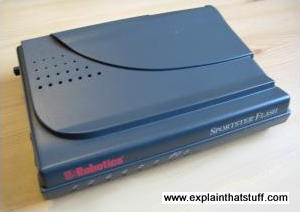
Photo: A fax modem from the 1990s. Before broadband Internet arrived, you'd use a little gadget like this to go online ("dial-up" to the Internet). You could also use it to send faxes from your computer, in a similar way to sending
documents to a printer or to receive faxes from other people's fax modems or actual fax machines.
For all these reasons, many people now prefer to send documents as
email attachments. They're quicker and more convenient, you can print
them out (or not, as you wish) on decent paper, and you can send and
receive things in full-color and shades of gray. Perhaps most importantly,
the files you receive by email are generally digital documents that you can edit in other ways,
whereas a fax is essentially an analog thing—and all you can do is
read it or file it (if you're very lucky, you might be able to scan it
and turn it into an editable document).
Some telephone companies also offer fax-to-email services where you're allocated a
unique telephone number. If someone faxes you on that number, the
company receives the fax for you at a central computer complex,
converts it into an image file (such as JPG or TIFF) or PDF, and then
forwards it on to you by email. In much the same way, most computers
that
have a dialup (fax) modem can also send
faxes to people very easily
without extra equipment. So, dated though it may be, fax technology
is probably here to stay for a few more years yet!
A brief history of fax
Photo: Back in the 1960s, meteorologists started using early fax machines, like this Muirhead Mufax, to receive weather charts from satellites through a radio-broadcast system called
Automatic Picture Transmission (APT).
Photo courtesy of NASA on the Commons.
1843–1850: Scotsman
Alexander Bain (1811–1877) develops two different types of primitive document-sending machines, based on the telegraph: one is electromechanical, while the second uses a mixture of chemical and electrical technology. Bain's ideas are further improved by Englishman
Frederick Bakewell
(1800–1869), who introduces the idea of rotating cylinders—still used in fax machines to this day.
1865: Giovanni Caselli (1815–1891), an Italian physicist, develops a more practical electromechanical method of sending documents down telegraph wires. He calls his invention a
Pantelegraph, a portmanteau of "pantograph" and "telegraph," because it copies documents (using a pantograph) and sends them by telegraph.
1876: Alexander Graham Bell (1847–1922) files his telephone patent (US Patent 174,465: Telegraphy) on February 14, 1876. Whether he deserves all the credit for inventing the telephone is still disputed, but he certainly
helps it to become an essential piece of global communication technology.
1920s: Western Union, RCA, and Associated Press develop rival
wirephoto technologies, which allow photographs to be sent down ordinary phone lines.
1930s: Telex (a way of sending text messages down telephone lines between teleprinter units
that look like oversized typewriters) is pioneered in Berlin by Siemens and the German Reich mail service, later spreading to Europe and the rest of the world.
1951: Muirhead, a company founded by physicist Alexander Muirhead (1848–1920), applies for a US trademark
for the word "Mufax" to cover "long distance transmitting and recording apparatus for telegraphic, telephonic, telephotographic, and wireless telegraphic purposes and electro-sensitive recording paper for use with facsimile recorders in the transmission and reception of communications from a distance." Mufax machines (like the one photographed above)
are among the first popular desktop fax machines.
1964: Xerox uses its experience inventing
photocopiers (originally called xerography machines) to develop a document-transmitting system called
Long Distance Xerography (LDX).
1964: Meteorologists start using Automatic Picture Transmission (APT) to receive charts from a weather satellite on fax machines. The first broadcast, from the Nimbus-1 satellite, is on August 28, 1964.
Late 1960s/early 1970s: Thanks to further innovations by pioneers such as Xerox, the first self-contained fax machines begin to appear, though they're still relatively big (the size of a large modern, office photocopier) and expensive.
1980: Canon, the Japanese electronics company, announces its very first compact fax machine, the FAX-601. During the 1980s, affordable, personal fax machines, virtually all of them made in Japan, power the fax revolution, quickly making telex obsolete.
1990s: The rapid growth of the Internet means millions of people suddenly have access to small fast
modems, which enable an ordinary PC to send and receive documents as faxes.
2020: The UK's National Health Service, which was still using an estimated 9,000 fax machines as recently as 2018, is directed to switch to more modern technology.
2021: Attempts to banish fax machines from government departments in Japan are thwarted by a backlash.
Fax Machines by Jonathan Coopersmith, Associate Professor of History at Texas A&M University. Engineering and Technology History Wiki, 2015. A very good account of the development of fax technology, from the 1840s to the present day. For even more detail, see Jonathan Coopersmith's book, below.
Books
Faxed: The Rise and Fall of the Fax Machine by Jonathan Coopersmith. Johns Hopkins University Press, 2015. A fascinating chronological history that places fax in the wider context of communications technology.
Fax, Modem, and Text for IP Telephony
by David Hanes and Gonzalo Salgueiro. Cisco, 2008. "Chapter 2: How fax works" will give you a deeper technical overview of things like fax modulations, the different stages of a fax call, how information is transmitted in frames, and so on. Later chapters cover related issues like fax servers and store-and-forward fax.
[Mythbusters] Facing the Facts about Fax Usage in Japan by Earl Kinmonth. Japan Forward, October 18, 2021. It's a popular myth that the Japanese are unique and somehow "backward" in still using fax machines but, as this author points out, faxes are still used elsewhere too—and (as I explain above) they're compatible with computers and email (to a certain extent).
Leeds NHS trust has 345 fax machines. I want to get rid of them by Richard Corbridge. The Guardian, October 25, 2018. Fax machines might seem charming and retro, but in hospitals, where their use is still very widespread, they can be positively dangerous.
In High-Tech Japan, the Fax Machines Roll On by Martin Fackler. The New York Times, February 13, 2013. Fax is a dependable and reassuring
technology—and the Japanese see no good reason to let it go.
The fax machine uprising by Giles Turnbull. BBC News, 24 June 2002. How fax machines played an important part in a campaign to cripple digital privacy laws.
Patents
Facsimile transceiving apparatus by Peter Mason et al, Xerox Corporation, 4 March 1975. One of the earliest modern-style fax machines, in which a laser beam scans a document and transmits it by video to another location.
Compact facsimile machine by Shigeru Kadomatsu, Ricoh Co. Ltd, 16 December 1986. Describes a modern fax machine with all the components built into a single desktop case.
Secret Life Of Machines: The Fax Machine by Tim Hunkin. A 30-minute clip from the excellent series by the quirky British cartoonist. His human demonstration of faxing is quite similar to the one I've described above.
Please do NOT copy our articles onto blogs and other websites
Articles from this website are registered at the US Copyright Office. Copying or otherwise using registered works without permission, removing this or other copyright notices, and/or infringing related rights could make you liable to severe civil or criminal penalties.