High-speed Internet access anywhere,
anytime—that's what we've increasingly come to expect in the 21st-century information age. But
what if you live in a rural area where it's too expensive for a
telecoms company to provide broadband?
Or what if your house has old telephone wiring or the room you
want to work in doesn't have a telephone access point? Worry not! The solution could be
BPL (broadband over power lines), also called EOP (Ethernet over power)—a way of piping broadband to your home and channeling it from one room to another using the standard
electricity supply.
BPL is also known as HomePlug (the name of an alliance of manufacturers who make the equipment) and,
in the UK, as "networking over the mains."
Let's take a closer look at how it works!
Photo: Powerlines like this run almost everywhere, so why not use them to carry broadband Internet as well as electricity? Photo by Ryan Quijas courtesy of
US Space Force and DVIDS.
If you know something about broadband
Internet already, you're
probably aware that it works by splitting your ordinary telephone
line into a number of separate channels. Some of them carry your
phone calls, as usual, some carry downloads (information coming from
the Internet to your home), and some handle uploads (information
going the opposite way). Broadband uses low-frequency electric
signals (the equivalent of low-pitched sounds) to carry ordinary phone calls and higher-frequency signals
(like high-pitched sounds) to carry Internet data. Electronic filters separate the two kinds of
signal, with the low frequencies going to your telephone and the
higher frequencies to your Internet modem.
Does that sound so strange? It's really not so hard to use a
single medium to carry more than one thing. People work this way all
the time. If you've ever stood quietly in a corner of a cocktail
party tuning in on different conversations, you'll know how easy it
is to do. The air in the room is like a giant pipe carrying many
different sounds to your ears. But, using something called selective
attention, your brain can tune into one conversation or another
depending on whom you find most interesting. Broadband Internet works
a bit like this too. A single piece of telephone cable carries both
phone calls and Internet data. Your telephone listens just to the
calls; your modem lists only to the data.
Sponsored links
Access BPL: bringing broadband to your home
Photo: With BPL, your modem takes its signal from your domestic
electricity socket rather than your telephone socket.
If you can send computer data down a phone line, there's no reason
why you can't channel it down a power line as well. Some Internet
service providers (ISPs) are already using overhead and underground
power lines to carry broadband data long distances to and from their
customers in what's called access BPL. It's
exactly the same
principle as sending broadband over a phone line: a high-frequency
signal carrying the broadband data is superimposed on the
lower-frequency, alternating current that carries your ordinary
electric power. In your home, you need to have slightly modified
power outlets with an extra computer socket. Plug in a special BPL
modem, plug that into your computer, and your broadband is up and
running in no time.
Photo: The basic concept of powerline broadband: electric power lines can be used to bring broadband Internet to your home (or carry it from one room to another). That's because you can do more than one thing with the same electricity cable at the same time. Note that this is just an illustration: real-world BPL uses low- and medium-voltage lines, not the very high voltage lines that dangle between pylons.
In-house BPL: carrying broadband within your home
You can also use BPL with traditional telephone or cable broadband
to bring Internet access to all the different rooms in your home. You
simply plug the Ethernet
lead from your normal modem into a special adapter that fits into
one of the power outlets. Your home electricity circuit then takes
the broadband to and from every room in your house as a
high-frequency signal superimposed on top of the power supply. If you
want to use broadband in a bedroom, you simply plug another Ethernet adapter
into one of the ordinary power outlets in that room and plug your
computer into it. In-house BPL, as this
system is known, is a great way of getting broadband in any part of your home. It's
particularly useful if you have a big house with thick walls that
make wireless Internet impossible.
Hybrid approaches
Another approach to BPL is to use powerline infrastructure—either above or below ground—as a kind of physical backbone for entirely separate fiber-optic cables, so the Internet cables simply run alongside existing power
cables without actually sending signals through them. This saves the considerable expense of acquiring land and digging trenches for fiber, and also avoids the technical challenges of trying to combine two separate signals in a single cable. It's similar
to the idea of running cables alongside railroad tracks, down the middle of highways, and so on, but doesn't really have
anything else in common with what we think of as BPL.
Smart homes of the future?
BPL opens up an even more exciting possibility for the future. If
we can connect computers using the ordinary power lines in our home,
there's nothing to stop us connecting up domestic appliances both to
one another and to the Internet.
Smart homes (in which
appliances are switched on and off automatically by electronic
controllers or computers) have used this basic idea for years—but
BPL could take it much further and make it far more widespread.
Imagine a future where you can use a Web browser on your computer at
work to switch on the electric cooker in the kitchen at home, ready
for when you arrive. Or how about using the Web browser on your cellphone to turn your
home lights on and off when you're staying in a hotel, to give added
protection against intruders? Just imagine the possibilities: BPL could take remote control to an amazing new level!
How does BPL compare with wireless broadband?
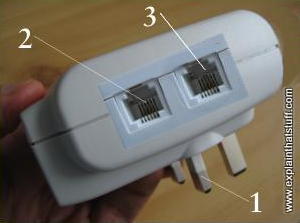
Photo: A typical BPL Ethernet adapter (wired for the British power supply). You plug the adapter (1) into your electricity outlet and then plug your computer or modem into the Ethernet socket (2) on the side. There are extra Ethernet sockets so you can connect games consoles or other equipment too (3).
According to companies who sell the equipment, BPL is a great way to distribute a computer
network through your home that's at least as convenient as wireless Internet (Wi-Fi):
It can send signals up to 200m or 650ft (further than a typical Wi-Fi router, which offers only 35m or 115ft).
It offers data rates from 200Mbps (million bits per second) to over 1 Gbps (gigabits per second = thousand megabits per second), comparable with or better than a typical Wi-Fi router.
It will work with other networking products based on Ethernet, such as Net-linked computer games machines.
It uses encryption to protect signals traveling around your home and is (theoretically at least) much more secure from eavesdropping than wireless networks. However, as with any network, there are still security loopholes.
You don't need any additional wiring. All you need is two plug units, one for each socket you want to use.
Hybrid setups
There's nothing to stop you using BPL and Wi-Fi in a combined, hybrid setup—and that can work really well for larger homes or older buildings with Wi-Fi "dead spots" (where walls or other obstacles interfere with decent wireless signals). So you could have a wireless router connected to the Internet through satellite, cable, or phone, in the conventional way and talking to smartphones, tablets, and other wireless devices using Wi-Fi. You could plug your in-house BPL adapter into the same router, and into a home power socket, to carry wired broadband signals to other devices, such as desktop computers, smart home equipment, or devices that are simply too far to reach with conventional Ethernet cables or have poor Wi-Fi connectivity. You're free to mix and match as you wish.
Advantages and disadvantages of broadband over power lines
Advantages
Electricity power lines are ubiquitous in most developed countries.
Access BPL may be quicker, cheaper, and simpler to deploy in rural areas than higher cost, high-speed broadband over telephone lines or cable.
Access BPL technology is relatively simple.
Power companies who already supply electricity could also provide inexpensive broadband to existing customers over the same lines, which could help to push down the cost of broadband across the board.
In-house BPL is perfectly compatible with Wi-Fi and helps to overcome distance and reliability limitations in existing wired and wireless networks.
Disadvantages
Access BPL is still relatively uncommon. At the time of writing, it's failed to gain momentum in countries such as the United States, the UK, and Australia. In-house BPL is much more popular, however, and still widely available.
Only low and medium voltage power cables can be used for access BPL.
Different countries use different power voltages, which would make it harder to sell equipment internationally and push up the cost.
Signals need booster equipment to make them travel long distances. Transformers, circuit breakers, and surge protectors can interfere with broadband signals.
Most people already use DSL (traditional broadband) or wireless systems and own routers, modems, and other equipment compatible with it. They'll be reluctant to buy new equipment unless there's a compelling reason to do so.
More of us use mobiles to go online than desktop computers, which arguably makes BPL less relevant—at least if people
are using cellphone networks to browse with. The huge, rapid growth of mobile (cellphone) broadband in developing countries (coupled with the lower availability of conventional electricity power networks) makes it unlikely that BPL will ever catch on there.
Worldwide, mobile broadband grew at over 20 per cent per year between 2012 and 2017 alone (according to the
ITU-T's ICT Facts and Figures 2017); the number of connections increased 20-fold between 2007 and 2020, from 268 million to 5.83 billion
(according to Statista); BPL hasn't caught on at anything like the same rate.
HomePlug Powerline Alliance: An industry group promoting a standardized approach to powerline technology. The website has some useful background information and a comprehensive catalog of certified products from manufacturers such as Belkin, devolo (dLAN), Netgear, and ZyXEL.
Books
These are detailed technical guides mainly aimed at electronic engineers or undergraduate students:
The US broadband battle by Drew Clark, BBC News, 27 May 2009. How a variety of different broadband technologies, including BPL, are competing for the lucrative US market historically dominated by telephone and cable companies.
IBM Delivers Rural Broadband Over Power Lines by Saul Hansell, The New York Times, 19 February 2009. IBM sees an important role for delivering broadband to rural areas using existing powerlines, especially where the terrain blocks wireless.
Broadband Over Power Lines?: Wired News, 9 February 2003. This old article shows how huge early enthusiasm for BPL has, so far, failed to live up to expectations.
Patents
This is a small selection of BPL patents you can find on the USPTO database (or Google Patents); they offer much greater technical detail than the general articles above, but are somewhat harder to understand:
Please do NOT copy our articles onto blogs and other websites
Articles from this website are registered at the US Copyright Office. Copying or otherwise using registered works without permission, removing this or other copyright notices, and/or infringing related rights could make you liable to severe civil or criminal penalties.
Woodford, Chris. (2008/2020) Broadband over power lines. Retrieved from https://www.explainthatstuff.com/broadbandoverpowerlines.html. [Accessed (Insert date here)]