Concorde, they called it, but it
could just as easily have been named Titan.
Whizzing through the sky at twice the speed of sound (up to 2200 km/h
or 1350 mph), the world's
favorite supersonic plane
was protected from air friction by a heat-proof titanium
skin that could stretch as much as 25 cm (10 inches) during flight!
It's not surprising titanium is the metal of choice in
airplanes like this: it's as strong as steel but only about half as heavy and it doesn't go rusty.
Although three quarters of the world's titanium is used in aerospace,
you won't just find this metal soaring through the sky: it has a huge range of other applications, from the manufacture of toothpaste, false teeth, and wedding rings to the development of artificial hip joints and deep-diving submarines. Impressed? You will be! Let's take a closer look at how this amazing material works.
Think "strong, light, and rustproof" and you have the essence of
what makes titanium so important. It's a brilliant all-round
material—similar to aluminum but very much
stronger and quite a bit
heavier.
Like aluminum, titanium is a silvery-white metal that resists
corrosion (rusting): that's because it reacts readily with oxygen and
forms a protective layer of titanium oxide that keeps out air and water.
Titanium also resists attack by strong acids and alkalis. It's
relatively hard and brittle when it's cold and you have to heat it up
to work it into shape or draw it into wires. In chemical reactions, it
forms lots of interesting compounds
(when atoms
of titanium bond to atoms of other elements); it also forms some extremely useful
alloys (when titanium metal is "mixed" with other metals to combine their
useful properties).
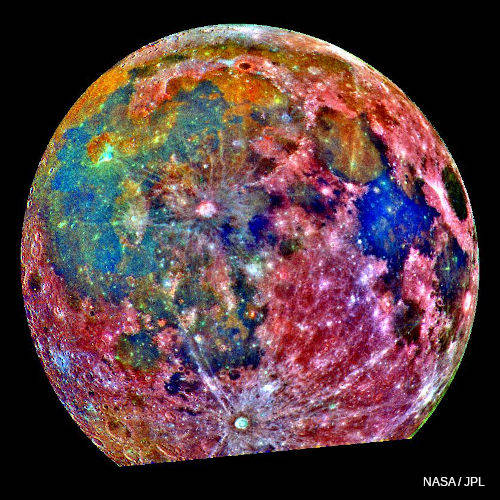
Photo: There's plenty of titanium on the Moon. This false-color photo is a composite of 15 images taken by the Galileo spacecraft. Areas colored blue are richer in titanium than those colored orange or red.
The deep blue, titanium-rich patch on the right is Mare Tranquillitatis (Sea of Tranquility)
where Apollo 11 landed in 1969. Photo courtesy of
NASA Jet Propulsion Laboratory (NASA-JPL).
Sponsored links
Uses
Perhaps the best-known use of titanium is in the compound titanium dioxide (TiO2 also known as
titanium white), which is one of the whitest substances known. About 95 percent
of the titanium consumed in the United States is used in titanium dioxide, which puts the
whiteness in everything from paints, toothpastes, and
paper to porcelain ceramics, floor
coverings, textiles, and even concrete;
the other 5 percent finds its way into welding rods, carbide manufacture, and a variety of smaller uses.
[Source: USGS Minerals Commodity Summaries, January 2022.]
Chart: Where is titanium dioxide used? Most titanium is used in the form of titanium dioxide,
and 80 percent of that, in turn, goes into paints and plastics.
Drawn using data from USGS Minerals Commodity Summaries, January 2022.
Arguably titanium's use as a whitener is a trivial—if economically
very important—use for such a versatile material, because it doesn't really matter what color
our toothpaste and paint is: we could live without such things, if we
really had to.
Photos: Everyday uses of titanium: Titanium dioxide puts the white color in white paint, which is why this tube is labeled "Titanium White."
But could we live without the titanium
alloys that are used to make airplane parts? In some modern planes,
titanium has been used in everything from the outer "skin" and the
landing gear to the
hydraulic pipes and the innermost parts
of the jet engines
(because it's light and good at withstanding high-temperatures and the
stresses
and strains caused by friction when air moves through at supersonic
speeds). Since titanium is so useful in airplanes, it's not surprising
it's used in spacecraft too. And in gleaming buildings like this.
Photos: Titanium can be used as a striking construction material. The Frederic C. Hamilton Building, part of Denver Art Museum, Colorado is covered with 9000 shiny titanium panels.
Credit: Gates Frontiers Fund Colorado Collection within the Carol M. Highsmith Archive, Library of Congress, Prints and Photographs Division."
And what about medical items made from titanium—could we live
without those? Many people have strong but flexible eyeglasses made
from titanium alloys. Thanks to its protective oxide coating, titanium
is a perfect metal for making things like replacement hip joints because it
won't rust or react adversely with tissue or bone. The same quality
makes it ideal for lining food manufacturing equipment. You can
probably see that strength, lightness, and an ability to resist rusting in
seawater for years on end also makes titanium a perfect construction
material for submarines.
Photos: Everyday uses of titanium: My eyeglass frames are made from
a nickel-titanium alloy. They're called shape memory frames because you can bend them and they'll spring straight back to shape.
Behind them, the tiny loudspeaker on my laptop is also made from titanium.
Titanium and its compounds are also important in the manufacture of
other chemicals. Titanium chlorides are used as catalysts (accelerators
that speed up chemical reactions) in the manufacture of plastic
polypropylene and many other organic (carbon-based) chemicals.
If all that sounds a bit mundane, how about jewelry made from
titanium?
There's a gem called titania that's made from titanium oxide. It's even
more brilliant than diamond, though it's much softer, so less
useful. Wedding rings made from titanium are also increasingly popular.
Photo: Using sunlight and titanium dioxide to
purify water. Photo of research at Sandia National Laboratories by courtesy of US
Department of Energy.
New uses are being found for titanium all the time. In our environmentally
conscious age, more people are installing
heat-reflecting windows (also called
low-E windows) to reflect heat back into their homes (or keep sunlight out) and save
on heating and air-conditioning bills.
A thin layer of titanium oxide (or another metal) on the glass is the secret ingredient
that makes these windows work.
If titanium is so wonderful, why don't we use it everywhere? The main reason is that it's mined in
relatively small quantities, so it's considerably more expensive than rival materials like steel. In 2022, world titanium metal production was a mere 200,000 tonnes or so (according to the US Geological Survey), while world steel production was ~2.0 billion tonnes (2000 million tonnes or 2,000,000,000 tonnes)—some 10,000 times greater
(according to the World Steel Association).
Sponsored links
Extraction and production
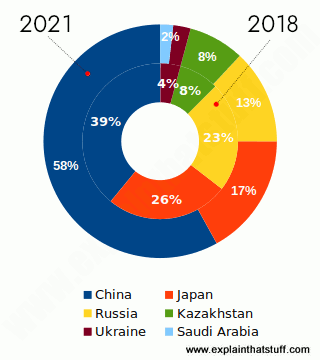
Chart: Top countries producing titanium metal (sponge). The inner
ring shows 2018, the outer ring 2021. Source: Titanium and Titanium Dioxide, USGS Mineral Commodity Summaries, January 2020 and January 2022.
Although similar in many ways to aluminum, titanium is somewhat less
common. While aluminum is the third most abundant element in Earth's
crust, titanium ranks only ninth. Even so, it's still found in
virtually all rocks, sands, soils, and clays, as well as in
plants, animals, and water. Like aluminum, titanium's readiness to
react with oxygen means it is never found on Earth as a pure metal.
Instead, it has to be made from mineral ores called ilmenite (a complex
compound of iron, titanium, and oxygen with chemical formula FeTiO3)
and rutile (mostly titanium
dioxide, a compound of titanium and oxygen with
chemical formula TiO2) using a series of
chemical reactions that can be
difficult and costly.
Most titanium is now made by the Kroll process,
in which titanium dioxide is reacted with chlorine to form titanium
tetrachloride, which is then reacted with magnesium to strip away the
chlorine and leave behind the pure metal (known as titanium "sponge").
So we have, essentially, a pair of chemical reactions that look like this:
1: TiO2 (titanium dioxide) + 2Cl2 (chlorine)
+ C (carbon in charcoal form) → TiCl4 (titanium chloride) + CO2 (carbon dioxide)
The titanium sponge is then cast into large bars called ingots. Japan leads
world titanium sponge metal production, followed by Kazakhstan,
China, and the Ukraine.
History
1791: British clergyman William
Gregor (1761–1817) discovers a
mysterious substance in the mineral menachanite and names it menachite.
1795: A German chemist named Martin
H. Klaproth (1732–1817) finds the same substance in the mineral
rutile and gives it its modern name, titanium, after the
powerful Greek rulers named the Titans.
1910: American chemist Matthew
A. Hunter makes the first 99.9 percent pure
sample of titanium metal from titanium tetrachloride.
1930s: William Justin Kroll
(1889–1973), a metallurgist from Luxembourg, invents
the modern Kroll process, making possible large-scale production of titanium.
1950s–: Thanks to the Kroll process, titanium becomes less
expensive and is soon prized for its strength, light weight, and
all-round versatility.
Titanium is about a third more stretchy (elastic) than steel.
The US Airforce SR-71 Blackbird (the world's fastest supersonic
plane for much of the 1960s, 1970s, and 1980s) had a structure made from 85
percent titanium and 15 percent composite
materials.
Photo: The SR-71B Blackbird.
Titanium and titanium alloys stopped this plane from melting in the
extreme heat generated by flying at three times the speed of sound
(Mach
3).
Photo courtesy of NASA Armstrong Flight Research Center and
Internet Archive.
Titanium kept Concorde in the air, but it was also responsible
for its downfall. On July 25, 2000, when a Continental Airlines DC-10 took
off from Charles de Gaulle Airport in Paris, a rogue piece of titanium alloy broke off
it and landed on the runway. A few minutes later, an Air France Concorde
took off from the same runway and hit the debris,
bursting a tire, which led a fuel-tank to explode, causing a horrific crash that killed everyone on board. After
that incident, other Concordes were grounded and the plane was later
phased out of service.
Most things will burn in oxygen gas. Titanium can also burn in
nitrogen gas!
In 2019, about 80 percent of US titanium metal was used in
aerospace construction (up from 77 percent in 2015 and 75 percent in 2014); the rest was used in armor-plating,
power generation, marine, medical, and other applications. [Source: USGS: Minerals Commodity Summaries: Titanium, January 2020]. The latest figures don't disclose exact end-use percentages for commercial reasons.
The United States made about $3.0 billion of titanium dioxide
pigment in 2021. Just under two thirds of it (70 percent) was used in paint manufacture;
the rest found its way into plastics (20 percent), paper (5 percent), and other
uses (15 percent). [Source: USGS: Minerals Commodity Summaries: Titanium, January 2022]
Many countries produce titanium, but the United States currently gets
about 97 percent of its titanium from just two countries: Japan and Kazakhstan,
with the rest coming from Ukraine, China, and Russia. [Source: USGS: Minerals Commodity Summaries: Titanium, January 2022]
A Russian company called VSMPO-Avisma is the world's largest manufacturer of titanium, exporting to
50 different countries around the world. [Source: VSMPO-AVISMA website, June 2022.]
Artwork: The periodic table of chemical elements showing the position of titanium (Ti). Notice how early in the table it occurs; with just 22 protons, it's made of relatively small and light atoms. It's positioned right next
to vanadium (V), so its atoms are of similar size, and that's why the two elements form many useful alloys.
Key data
Melting point: 1660°C (3020°F).
Boiling point: 3287°C (5949°F).
Atomic number: 22 (one titanium atom contains 22 protons, 22
electrons, and 26 neutrons).
USGS Minerals Information: Titanium: Background information about the quantities of titanium mined and used around the world. Includes the Mineral Commodity Summaries from which most of the statistics in this article are quoted.
Books
For older readers
Titanium: A Technical Guide by Matthew J. Donachie. ASM International, 2000. Probably the best detailed reference about titanium currently available. Covers titanium metal and its alloys, processing methods, and future trends.
Titanium by Gerd Lütjering and James Case Williams. Springer, 2014. A more up-to-date reference covering all aspects of titanium metallurgy, extraction, and processing.
For younger readers
Titanium by Chris Woodford. Benchmark Books, 2003. A short introductory book on titanium I wrote a few years ago. It goes into a bit more depth than this article, especially about titanium chemistry and the periodic table. Suitable for ages 9–12 (grades 4–6).
Titanium by Greg Roza. Rosen Group, 2008/2014. An alternative, slightly longer guide for younger readers and also best for the 9–12 age group.
Articles
Citizen Marks 50 Years of Titanium by Vivian Morelli. The New York Times, 20 June 2020. Citizen watches have used titanium because "it's lighter than stainless steel, durable and less allergy-prone."
Playing golf can 'damage hearing': BBC News, 5 January 2009. Titanium golf clubs can help you drive further, but their "sonic boom" could damage your hearing.
Please do NOT copy our articles onto blogs and other websites
Articles from this website are registered at the US Copyright Office. Copying or otherwise using registered works without permission, removing this or other copyright notices, and/or infringing related rights could make you liable to severe civil or criminal penalties.