If you want to move forward, you need to push backward; that fundamental law of physics was first described in the 18th century by Sir Isaac Newton and still
holds true today. Newton's third law of motion (sometimes called "action and
reaction") is not always obvious, but it's the essence of anything
that moves us through the world. When you're walking down the street, your feet push
back against the sidewalk to move you forward. In a car, it's the
wheels that do something similar as their tires kick back against the
road. But what about ships and planes powered by propellers? They too use Newton's third law, because a propeller pulls or pushes you
forward by hurling a mass of air or water behind you. How exactly
does it work? Why is it such a funny shape? Let's take a
closer look!
Photo: Most propellers have two, three, or four blades; this Hamilton Sundstrand NP2000 propeller,
mounted on a US Navy E-2C+ Hawkeye, has eight blades, which makes for improved safety and easier maintenance. They're made of tough composite materials mounted on a single-piece steel hub.
Photo courtesy of US Navy and
Wikimedia Commons.
Propellers, often shortened to "props," are sometimes called
screws—and it's easy to see why. To push a screw into the wall, you apply a
clockwise turning force to the head with your screwdriver. The spiral
groove (sometimes called a helical thread) on the screw's surface
converts the turning force into a pushing force that drives the screw
into the wall and holds it there. But suppose, for a moment, that you
wanted to keep on going...
Photo: A propeller is like a cut-off screw and works much the same way: it converts the spinning motion of the engine into a forward force (thrust) that powers you through the sky.
If you were a beetle and you wanted to move through an infinitely long wooden wall,
you could use a screw thread on the outside of your body to do it.
You wouldn't need a screw running along the whole length of your
body: you could manage with just a little thread on your head—a kind
of screw cap—to bite into the wood in front of you. Now suppose you
were a fly, not a beetle, and you wanted to go through air rather
than wood. There's no reason why you couldn't use a screw thread in
exactly the same way to pull you through the sky. In effect, you'd be
a fly with a propeller—and that's pretty much what the first
airplanes were. Planes took to the sky when the Wright brothers
figured out how to combine engine-powered propellers and wings so
they could go forward and upward at the same time.
A propeller is a machine that moves you forward through a fluid (a
liquid or gas) when you turn it. Though it works the same way as a screw,
it looks a bit different: usually it has two, three, or four twisted
blades (sometimes more) poking out at angles from a central hub spun
around by an engine or motor.
The twists and the angles are really important.
Photo: Attaching a propeller to the engine that powers it. You can see that the four blades are fitted at an angle and twist along their length.
Photo by Jillian Lotti courtesy of US Navy published on
Flickr
as a US government work.
Sponsored links
Why a propeller has angled blades
Propeller blades are fixed to their hub at an angle, just as the thread on a screw
makes an angle to the shaft. This is called the pitch (or pitch angle) of
a propeller and it determines how quickly it moves you forward when
you turn it, and how much force you have to use in the process. Sometimes (and this can be confusing) the distance a propeller moves you forward as it turns through one complete revolution is also called its pitch,
but it's easy to see that the angle of the blades and how far they move you forward in a single rotation are related.
Propellers look like screws, so how are the two connected?
A screw converts the turning motion of your hand into forward motion that drives the screw's body
(and anything it's attached to) firmly into the wall. The angle of the thread on a screw determines
how much force you have to use to turn it. A screw with a steep thread (and fewer turns along
its length) will be harder to turn but will go into the wall faster, while one with a shallow thread (and more turns along its length) is easier to rotate but you have to turn it more times to drive it in. If you find screws confusing, think of a screw standing upright on its flat end (like the photo above) and imagine you're an ant walking up the thread from the bottom the top, so the thread is like a zig-zag path winding up a hillside. The more gently the path winds (the shallower the thread), the easier it is to climb (the less force your body needs to exert), but the further you'll walk and the longer it will take. Like gears, pulleys, and levers, screws are examples of simple machines—devices that multiply (or otherwise transform) forces.
Propellers are similar to screws but not exactly the same, because they're doing a totally different job. The purpose of a screw is to hold something like a shelf to a wall and minimize the amount of force you need to drive it into a solid material such as wood or plasterboard; with a screw, the driving force is pretty much constant. But the purpose of an airplane propeller is to make more or less thrust (driving force) at different points of a flight (during takeoff, for example, or steady cruising). The angle of a propeller's blades and its overall size and shape affect the thrust, and so too does the speed of the engine. Another difference is that while a screw is moving into a simple, solid material and meeting a more or less constant force of opposition, a propeller is moving in a fluid airstream and there all kinds of extra factors to take into consideration.
For example, although a propeller makes thrust to move you forward, it also produces drag that tends to hold you back and slow you down, and the amount of drag it makes depends on the angle of the blades.
These sorts of things make propellers far more complex than simple wood screws!
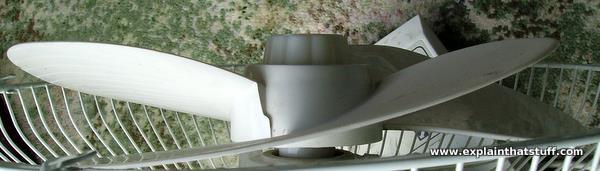
Photo: This electric desk fan (we're looking down from above) has blades set at an angle to the central motor shaft, just like a propeller. The blades have a large area, much like marine propellers, because they're designed to move a large volume of air at a relatively low motor speed. You don't want a fan to spin too quickly and skid across your desk. Unlike with a plane propeller, drag isn't an issue, so it doesn't really matter how big the blades are.
Why a propeller has twisted blades
“It was apparent that a propeller was simply an aeroplane [wing] traveling in a spiral course..”
Wilbur and Orville Wright
Another complicating difference between screws and propellers is that propeller blades are
twisted as well as angled: while a screw has a constant pitch, the pitch of a propeller
blade changes along its length. It's steepest at the hub (in
the center) and shallowest at the tip (outer edge).
Here's why. Look side on at an airplane propeller and you'll see it resembles an
airfoil (aerofoil), a wing that has a curved top and
flat bottom. An airfoil wing produces lift mainly by accelerating air
downward and it works most efficiently when it's tilted slightly
backward to make what's called an angle of attack
with the horizontal.
(Read more about this in our main article on airplanes.)
Now suppose you take two airfoil wings, mount them either side of a wheel and spin
it around. Turn fast enough, with the wings at just the right angle, and
instead of generating lift you'll produce a screwing effect and a backward force that
pushes you forward. This is effectively how a propeller works.
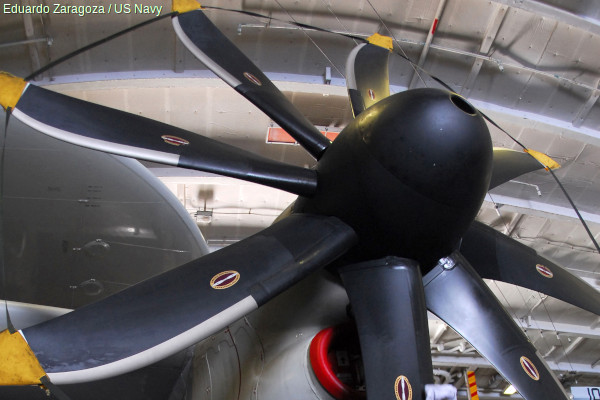
Photo: The blades of a propeller are shaped like airfoil wings, make an angle to the hub,
and are twisted so they produce constant propulsive force along their length (see artwork below).
Photo by Eduardo Zaragoza courtesy of US Navy and
Wikimedia Commons.
Different parts of a propeller move at different speeds: the tips of the blades move
faster than the parts nearest the hub. To ensure a propeller produces a constant force (thrust) all along its length, the angle of attack needs to be different at different points along the blade—greater near the hub where the blade is moving slowest and shallower near the tips where the
blade is moving fastest—and that's why propeller blades are twisted.
Without the twist, the propeller would be making different amounts of thrust
at the hub and the edges, which would put it under great stress.
Artwork: The blades are moving slowest nearest the hub (small yellow arrow),
so the airfoil sections (orange) are steeper there. The blade tips are moving much faster
(large yellow arrow), so the airfoil sections are shallower there to compensate.
Artwork drawn onto a photo by Eduardo Zaragoza courtesy of
US Navy and
Wikimedia Commons.
Variable pitch
“It has long been recognised that a fixed airscrew [propeller] cannot give the best results under all flying
conditions.”
Dr Henry Selby Hele-Shaw and T. E. Beacham, 1928.
Simple propellers on small aircraft (such as light training craft) have their blades permanently fixed at a certain angle to the hub, which never changes; that's why they're called fixed-pitch propellers.
But the optimum angle of a propeller's blades varies according to what the plane is doing.
When the blades are at a shallow angle to the oncoming air (a shallow or low pitch), they create less drag (air resistance),
so the propeller can spin faster and make more power, which is what you need when you're taking off.
During cruising flight, the opposite is true and steeper blades (high pitch) work better.
Typically, fixed-pitch propellers are optimized either for cruising or climbing. Cruising propellers have a higher pitch (steeper blades) and, as their name suggests, work most
efficiently when a plane is chugging along at cruise velocity for long periods;
they're less efficient during takeoff and climbs.
Climbing propellers have a lower pitch (shallow blades) and give better performance in climbs and takeoffs,
though they're not so good for cruising. You can see that fixed-pitch propellers are bound to work inefficiently quite a lot of the time but, in their defence, they are mechanically simple,
and therefore lightweight, reliable, and cheap.
Photo: Bigger planes can change the angle of their propeller blades
during flight using gear mechanisms like this. This is one of the four propeller hubs from a large
C-130H Hercules plane undergoing maintenance on the ground. Photo by Robert Barney courtesy of US Air Force.
Bigger and more sophisticated planes have variable-pitch propellers,
which come in three basic flavors.
Adjustable-pitch propellers can have their pitch
changed by tinkering with the plane when it's on the ground, though not during flight,
which is why they're sometimes called ground-adjustable propellers.
Controllable-pitch propellers can be adjusted by the pilot during flight,
typically through a hydraulic mechanism.
Constant-speed propellers have automated hydraulic mechanisms that change the blade pitch
as necessary, allowing the propeller aalways to turn at the same (constant) speed,
which helps the engine to generate power efficiently no matter what the plane is doing
or how fast it's going.
You can see some examples on
Wikimedia Commons: Constant-speed propellers.
Planes with variable-pitch propellers (including World-War fighter
planes) have another useful feature: the ability to feather the
propellers if an engine fails. Feathering means turning the propeller
blades so they're edge on, making a very shallow angle to the oncoming air,
minimizing drag (air resistance) and allowing the plane either to keep on
flying on its remaining engines or glide to a crash landing. On some
planes, the pitch of the blades can be reversed so a propeller makes
a forward draft of air instead of one moving backward—handy for
extra braking (especially if the main brakes
on the wheels suddenly fail).
Sponsored links
Why airplane and ship propellers work differently
Airplane propellers (sometimes referred to as "airscrews,"
especially historically and in Britain) have thick and narrow blades that turn at high
speed, whereas ship propellers have thinner, broader blades that spin
more slowly. Although the basic theory is the same, plane and ship
propellers are optimized for very different speeds in very different
fluids—faster in air, slower in water—and a propeller that works
well in one isn't necessarily going to work as well (or at all) in the other.
Chart: You might think ship propellers are always bigger than plane propellers, but that's not really true, as this chart shows. I've picked five examples of marine propellers (dark blue) and five aircraft propellers (light blue) for comparison. The smallest real propellers you're likely to find are the ones on outboard motors; the biggest are the rotors on large aircraft like the Bell Boeing Osprey. Perhaps surprisingly, even giant ships don't have propellers quite as big as the ones on the Osprey. As a general rule, however, the bigger the ship or plane, the bigger the propeller (or propellers) it needs.
It's easy to see why there's a difference if we go back to Newton's third law. The
simplest way to think of a propeller is as a device that moves a
vehicle forward by pushing air or water backward. The force on the
backward-moving fluid is equal to the force on the forward-moving
vehicle. Now force is also the rate at which something's momentum
changes, so we can also see a propeller as a device that gives
a ship or a plane forward momentum by giving air or water an equal
amount of backward momentum. Sea water is about 1000 times more dense
than air (at sea level), so you need to move much more air than water
to produce a similar change in momentum.
That's one reason why airplane propellers turn much faster than ship propellers. Another
reason is that airplanes generally need to go fast to fly (lift produced by the
movement of fast air over the wings is what balances the force of
gravity and holds them in the sky), whereas ships don't: buoyancy
lets them float whether they move or not. While planes travel
entirely through air, remember that ships operate at the tricky
interface between the oceans and the atmosphere where waves make life
complicated; submarines, which operate mostly underwater, have an
easier time in calmer water. Ships have powerful diesel engines that
rotate at high speed, so their propellers could easily turn as fast as airplane propellers
if that were what we wanted. In practice, propellers work most
efficiently in water at slower speeds, so a ship has a gearbox that transforms power
from the fast-turning engine down to much lower speeds in the propeller.
Propeller materials
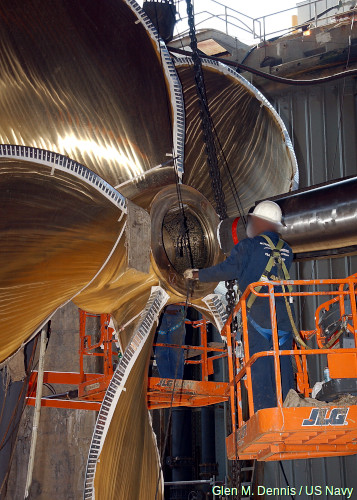
Photo: Ship propellers are made from alloys such as brass, but don't stay this color for long! This new propeller was fitted to the aircraft carrier USS George Washington in 2005.
It's 6.7m (22ft) in diameter and weighs about 30 tonnes (33 tons).
Photo by Glen M. Dennis courtesy of US Navy and
Wikimedia Commons.
Once laboriously carved from wood, propellers are now more likely to be made from more
predictable materials. Airplane propellers are typically made from lightweight
aluminum or magnesium alloys, hollow
steel, wooden laminates or
composites. Ship propellers have to withstand the corrosive effects
of saltwater, so they're typically made from copper alloys such as brass. They
range in diameter from about 15cm (6in) on smaller outboard motors to
as much as 9m (30ft) on the world's biggest container ships.
Ship propellers are also designed to minimize a problem called cavitation,
which happens when a propeller working under heavy load (turning too
quickly, for example, or operating too near the surface) creates a
region of low pressure. Bubbles of water vapor form suddenly and then
burst next to the propeller blades, blasting little pits into the
surface and wearing it away.
Who invented propellers?
Here's a quick summary of a few key moments in propeller history:
3rd century BC: The idea of using screws to move things dates back to Greek
scientist Archimedes, who figured out how to enclose a long spiral
screw inside a cylinder so it could lift water.
Archimedes screws,
as these are known, are still widely used in factories today for
moving things like powders and pellets. They're also a key feature
of agricultural machines such as combine harvesters.
16th century CE: Leonardo da Vinci (1452–1519) sketched an upward-facing screw
propeller on his design for a helicopter, which he never built.
1796: American inventor John Fitch made the first basic propeller, shaped like a screw, for a steamboat.
1836: Englishman Francis Petit-Smith and Swedish-American John Ericsson
independently developed modern-style propellers with blades for ships.
1903: The brothers Wilbur and Orville Wright used twisted propellers shaped
like airfoils to make the first powered flight, ushering in the modern age of air travel.
1904–1905: The first variable-pitch propellers began to appear, though their pitch could be adjusted
only on the ground. William Hayden filed a patent for one in the United States in October 1904.
1924–1928: English engineers Dr Henry Selby Hele-Shaw and T. E. Beacham outlined the theory of the hydraulically
operated variable-pitch propeller. Practical models appeared several years later.
1945–1949: Hartzell Propeller (originally called the Hartzell Walnut Propeller Company) pioneered the
use of composite materials in propellers. In 1978, it introduced the first mass-produced composite propeller (for use on the Spanish-made CASA C-212 Aviocar cargo airplane).
Photo: Developing effective propellers was a major part of the Wright Brothers' success in
taking to the air in 1903. By 1908, their plane was advanced enough to offer to the US military for use in war. Above: Here's the Wright Flyer
pictured at a military test that fall. Catastrophically, one of the propellers split during flight,
causing a crash that injured Orville seriously and killed his passenger.
Below: Here's a closeup of one of the propellers and the mechanism that powered it.
Note how the propeller twists along its length. You can also see how it's driven from the engine
at the center by a chain drive similar to that used on a bicycle.
No wonder, really: the Wright brothers were originally bicycle makers!
Photo by courtesy of NASA on the Commons.
1903 Wright Propellers: A quick overview of the Wrights' highly scientific approach to propeller design.
Books
Marine Propellers and Propulsion (Fourth Edition) by John Carlton. Butterworth-Heinemann, 2018. Covers propeller materials and design, fluid-flow, and the mechanics of propulsion through water in detail.
The Propeller Handbook by Dave Gerr. McGraw-Hill Professional, 2018. Less theoretical, this is a much simpler and more practical guide for everyday boat owners.
Theory and Practice of Aircraft Performance by Ajoy Kumar Kundu, Mark A. Price, David Riordan. John Wiley, 2016. A complete guide to the process of plane design, from aerodynamics and materials to safety and cost estimation. Propellers are covered in Chapter 7.
The Airplane
Propeller: US Army Air Corps, 1921. A dated but nevertheless interesting technical guide to propeller design and manufacturing in the early 20th century, including lots of interesting practical information about making
wooden propellers. This would be of great interest if you're experimenting with your own propellers.
Technical articles
The Variable Pitch Airscrew by Dr Henry Selby Hele-Shaw and T. E. Beacham, The Aeronautical Journal, Volume 32, Issue 211, July 1928, pp.525–554. A talk about variable-pitch propellers by two of the pioneers in the field.
Patents
For a deeper technical understanding, try reading patents. Here's a very small selection covering ship and airplane propellers:
US Patent 442,614: Marine propeller by Herman Dock, December 16, 1890. Describes a guide that can be placed around a propeller to maximize its propulsive force.
US Patent 794,010: Propeller by William B. Hayden, July 4, 1905. An early design for a variable-pitch plane propeller.
US Patent 2,500,382: Folding propeller by Elton Rowley, March 14, 1950. An early example of a marine propeller whose blades automatically fold to reduce drag in the water when the engine is stopped.
Please do NOT copy our articles onto blogs and other websites
Articles from this website are registered at the US Copyright Office. Copying or otherwise using registered works without permission, removing this or other copyright notices, and/or infringing related rights could make you liable to severe civil or criminal penalties.