Be glad, be very glad that your eyes aren't as powerful as
electron microscopes. If they were, you'd see the world around you
crawling with all kinds of horrible bugs. How filthy and nasty life would seem! Just as well, then, that we
have autoclaves: machines for sterilizing things
and keeping them germ-free. They're a bit like giant pressure
cookers that use the power of steam to kill off microbes that might
survive a simple wash or wipe with hot water and detergents.
They're easy to use, good for wholesale sterilizing (large quantities of equipment), and because they use steam,
are relatively economical to operate. Let's take a closer look at what they are and how they work!
Photo: Scientific autoclaving: US Navy engineers load an autoclave with a piece of aluminum to heat and bond a composite patch onto it with an adhesive. Photo by Jonathan L. Correa courtesy of US Navy and
DVIDS.
Although autoclaves have many important scientific and industrial uses, which we'll cover later, the main focus of this article is going to be on how these handy machines are used in sterilization.
Photo: Testing a steam-sterilizing autoclave before use. This one is a microprocessor-controlled Hanshin HS-4085G, which can sterilize loads of up to 85.6l (22.6 gal) at temperatures up to 135°C (275°F).
Photo by Roadell Hickman courtesy of US Navy (via the Wayback Machine).
You've probably heard of pressure cookers? They were all the rage until microwave ovens became popular in the 1980s. They're like over-sized saucepans with lids that seal on tightly and, when you fill them with water, they produce lots of high-pressure steam that cooks your food more quickly (if you want to know more, please see the box at the bottom of this page). Autoclaves work in a similar way, but they're typically used
in a more extreme form of cooking: to blast the bugs and germs on
things with steam long enough to sterilize them. The extra
pressure in an autoclave means that water boils at a temperature higher than
its normal boiling point—roughly 20°C hotter—so it holds and
carries more heat and kills microbes more effectively. A lengthy blast of high-pressure
steam is much more effective at penetrating and sterilizing things
than a quick wash or wipe in ordinary hot water and disinfectant.
According to one recent review by scientists from New Zealand: "Steam sterilization (autoclaving) is the most widely used method for sterilization and is considered the most robust and cost-effective method for sterilization of medical devices."
Why is pressure important in an autoclave?
Artwork: Tires have springiness because of the energetic air molecules inside them, which causes
pressure.
Pressure is the way a force acts over a surface. If you pump air
into a bicycle tire, the energetic molecules of gas
rush about inside, colliding with the tire walls and pressing outward. The tire stays
springy and inflated because the air molecules push its inner walls with as much
(or greater) force than the air molecules outside are pushing the outer walls. If you heat up a
tire, you give the air molecules more energy. They rush about faster,
collide with the rubber walls of the tire more often and exert even
more force. The tire feels more pumped up or, if you're unlucky,
bursts!
In physics, we say the pressure on a surface is the force
pressing on it divided by the area over which the force acts:
Pressure = Force / Area
This simple equation tells you that if you apply a given force to half the area, you double the pressure. Apply the force to twice the area and you halve the pressure.
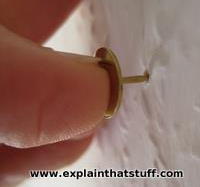
Photo: Thumbtacks (drawing pins) use the science of pressure. The difference in area between
the head you push and the sharp point that enters the wall effectively magnifies your pushing force.
It's very helpful to know about pressure in everyday life. Suppose
you want to put a poster up on your bedroom wall. Assuming you don't
have a hammer, you'll find it much easier to use thumbtacks (drawing pins) than
nails. A thumbtack has a huge flat head connected to a very thin
pin with a sharp tip. When you push on the flat head, you apply a
certain amount of force to a fairly big area. The force is
transmitted right through the pin to the tip, where it now acts on an
area of metal that's maybe 100 times smaller. So the pressure on the
tip is effectively 100 times greater—and that's why the pin enters
your wall so easily. Snowshoes and tractor tires use exactly the same
principle only in reverse. They spread weight (the force of gravity) over a bigger area to
stop your body (or a machine) from sinking into soft ground.
How pressure and temperature affect boiling
Suppose you have a saucepan full of potatoes that you want to
cook. You fill the pan with water, put it on a hot stove, and wait
for the water to boil. Now you probably think the water will boil
"when it's hot enough"—and that's true, but only half true.
The water will actually boil when most of the molecules it contains have
enough energy to escape from the liquid and form water vapor (steam) above it.
The hotter the water is, the more energetic the molecules are and the more easily they can escape.
So temperature plays an important part in making things boil.
But pressure is important too. The higher the pressure of the air
above the water, the harder it is for the molecules to break free;
the lower the pressure, the easier it is.
If you've ever tried making a cup of tea on a mountain with a
portable camping stove, you'll know the water boils at a lower
temperature at high altitudes. That's because air pressure falls the
higher up you go. At the top of Mount Everest, air pressure is about
a third of what it would be at sea level, so water boils at roughly
70°C or 158°F (see why on this MadSci forum posting). Mountain-top tea tastes pretty disgusting because the water boils
at too low a temperature: even though it's boiling,
the water is too cold to "cook" the tea leaves properly.
An autoclave is essentially just a large steel vessel through
which steam or another gas is circulated to sterilize things, perform scientific
experiments, or carry out industrial processes. Typically the chambers in autoclaves
are cylindrical, because cylinders are better able to withstand
extreme pressures than boxes, whose edges become points of
weakness that can break. The high-pressure makes
them self-sealing (the words "auto" and "clave" mean
automatic locking), though for safety reasons most are also sealed manually from
outside. Just like on a pressure cooker, a safety valve
ensures that the steam pressure cannot build up to a dangerous level.
Photo: Closing the door on a typical laboratory autoclave. Note the large handle on the right
being used to seal the door completely. Also note the dials on the right-hand side
that indicate temperature and pressure. Photo by PHAA Sarna courtesy of US Navy.
Sponsored links
How do you use an autoclave?
Once the chamber is sealed, all the air is removed from it either
by a simple vacuum pump (in a design called
pre-vacuum) or by pumping
in steam to force the air out of the way (an alternative design called
gravity displacement). Next, steam is pumped through the chamber at a
higher pressure than normal atmospheric pressure so it reaches a temperature of about
121–140°C (250–284°F). Once the required temperature is reached,
a thermostat kicks in and starts a timer. The steam pumping continues
for a minimum of about 3 minutes and a maximum of about 15–20 minutes
(higher temperatures mean shorter times)—generally long enough to
kill most microorganisms. The exact sterilizing time depends on a
variety of factors, including the likely contamination level of the
items being autoclaved (dirty items known to be contaminated will
take longer to sterilize because they contain more microbes) and how
the autoclave is loaded up (if steam can circulate more freely,
autoclaving will be quicker and more effective).
Artwork: How an autoclave works (simplified): (1) Steam flows in through a pipe at the bottom and around a closed jacket that surrounds the main chamber (2), before entering the chamber itself (3). The steam sterilizes whatever has been placed inside (in this case, three blue drums) (4) before exiting through an exhaust pipe at the bottom (5). A tight door lock and gasket seal (6) keeps the steam securely inside. A safety valve (7) similar to the ones on a pressure cooker will pop out if the pressure gets too high.
Autoclaving is a bit like cooking, but as well as keeping an eye
on the temperature and the time, the pressure matters too!
Safety is all-important. Since you're using high-pressure,
high-temperature steam, you have to be especially careful when you
open an autoclave that there is no sudden release of pressure that
could cause a dangerous steam explosion.
Photo: Looking inside the open door of a large autoclave. Note the gasket seal on the door to keep the steam inside and the pressure gauges on top. Photo by Carol M. Highsmith courtesy of The George F. Landegger Collection of Alabama Photographs in Carol M. Highsmith's America, Library of Congress, Prints and Photographs Division.
Industrial and scientific autoclaves
Although best known as sterilizers, autoclaves can also be used to
carry out all sorts of industrial processes and scientific experiments that work best at high-temperatures
and pressures.
Unlike sterilizing autoclaves, which usually circulate steam, industrial and scientific autoclaves
may circulate other gases to encourage particular chemical reactions to take place. Industrial autoclaves are often used for "curing" materials (applying heat to encourage the formation of long-chain polymer molecules).
Artwork: A simple industrial autoclave from the early 20th century, designed for manufacturing various industrial chemicals using acids. It's essentially a reinforced, acid-resistant cooking vessel (blue) with a removable screw-on top (orange). You can add chemical ingredients through the smaller screw-on entry hole (green) and stir them using a gear-driven agitator (red). This is more like a modern pressure cooker than an autoclave. From US Patent 1,426,920: Autoclave by Oliver Sleeper, August 22, 1922, courtesy of US Patent and Trademark Office.
Some examples of how industrial autoclaves are used:
Rubber can be vulcanized (heated, toughened, and hardened with sulfur) in an autoclave.
Nylon (a plastic) can be made by "cooking" a concentrated salt solution in an autoclave to encourage what's called condensation polymerization.
Polyethylene (polythene, another plastic) can be made by circulating air or organic peroxides through an autoclave to polymerize ethylene.
Airplane materials made from composites are also typically cured in large industrial autoclaves
(although various alternative processes, including microwave curing and out-of-autoclave (OOA) manufacturing, are becoming increasingly popular).
Some autoclaves combine elements of both sterilization and industrial manufacture. For example, natural cork (wooden) bottle stoppers have to be boiled and sterilized before they're suitable for use. Traditionally, that was done in large water tanks; now it's much more likely to be done on a large scale in computer-controlled, industrial autoclaves.
Photo: Scientific autoclave: Inspecting a crystal grown in microgravity inside a cylindrical autoclave. This scientific experiment was carried out onboard the Space Shuttle in October 1995. Photo by courtesy of NASA Marshall Space Flight Center (NASA-MSFC).
Industrial autoclaves can be enormous. Check out this photo of the
world's largest autoclave, which, according to
Guinness World Records, was built in 2006 for making parts of the Boeing 787 Dreamliner airplane.
It has a volume of 2,321 cubic meters (82,000 cubic feet), which is very nearly big enough to hold
all the water drained from of an Olympic-sized swimming pool!
Sponsored links
Who invented autoclaves?
Ancient Greeks use boiling water to sterilize medical tools.
1679: French engineer Denis Papin (1647–1712) invents the
steam pressure cooker—an important step in the development of
steam engines.
1860s: French biologist Louis Pasteur (1822–1895) helps to
confirm the germ theory of disease. He realizes that heating things
to kill germs can prevent diseases and extend the life of foodstuffs
(which leads him to the invention of pasteurization).
1879: Pasteur's collaborator Charles Chamberland (1851–1908)
invents the modern autoclave. It looks like much like a pressure cooker, with a lid
on top sealed tight with clips.
1881: Microbiologist
Robert Koch and others criticize Chamberland's high-pressure steam method, which they believe may damage laboratory equipment, and develop an alternative, unpressurized sterilizer instead. This eventually evolves into a machine called the
Koch autoclave.
1889: German physician
Curt Schimmelbusch builds on
the work of Chamberland and Koch to produce a drum-type sterilizer known as the Schimmelbusch autoclave (sterilization drum).
What's the difference between an autoclave and a pressure cooker?
Want to cook your dinner in a fraction of the time? You could use
a microwave to zap it with energetic waves. But another popular
solution is to seal it in a pressure cooker: a kind of saucepan that
cooks things quicker by boiling them at a higher temperature than
usual. Although considered old-fashioned by some, pressure cookers are still a convenient and economical way to prepare
food. The basic concept—using pressure to achieve a higher temperature—is the same
as what happens in an autoclave.
Photo: A pressure cooker in action. Notice the valve on the top through which steam escapes and the double handle arrangement used to lock the lid. Photo by George Danor, US Office of War Administration, courtesy of US Library of Congress.
We've already seen that high pressure raises the boiling point of water. Suppose we could somehow arrange things so that the air above our
saucepan was actually at a much higher pressure than usual. That
would make the water boil at a significantly hotter temperature,
which would make the potatoes cook more quickly.
This is the basic idea behind pressure cookers. A pressure cooker
is a big steel saucepan with a tight-fitting lid. The outer edge of
the lid has a thick circle of rubber called a gasket that fits
between the bottom of the lid and the top of the pan to make a really
tight seal.
When you fill the pan with water and place it on the
stove, the water heats up and some of its molecules escape to form
steam up above it. With a normal pan, the steam would just drift off
into your kitchen and disappear. But with a pressure cooker, the
gasket and lid stop the steam escaping so the pressure soon builds up.
Although the water inside the pan boils, the higher pressure means it boils at a higher
temperature than normal that cooks your food more quickly. A special
valve on the top of the lid allows a small amount of steam to escape,
keeping the pressure higher than normal but not so high that the
cooker explodes. If the pressure inside the pan builds up too much, the valve pops right out, rapidly lowering the pressure to a safe level again.
Disinfection, sterilization, and preservation by Seymour Stanton Block. Lippincott Williams & Wilkins, 2001. A comprehensive practical guide that covers most everyday applications.
Inside the aerospace factory of the future by Jon Excell. The Engineer, June 17, 2014. Autoclaves loom large in plane manufacturing, but might not do so for much longer.
Geometries | Ellis Island Autoclave: The New York Times, April 9, 2008. A fascinating photographic glimpse into how an autoclave sterilized the belongings of sick, would-be immigrants.
Instant steam could banish MRSA: BBC News, July 29, 2007. Superheated steam from a handheld "gun" could be an alternative to autoclaving.
Microbe breaks temperature record by Helen Briggs. BBC News, August 15, 2003. Why a microbe from the oceans can survive high-temperature autoclaving.
Health Sterilisation 'can spread CJD': BBC News, February 10, 1999. Researchers question whether simple autoclaving is sufficient to kill prions (proteins) that cause Creutzfeldt-Jakob disease.
Please do NOT copy our articles onto blogs and other websites
Articles from this website are registered at the US Copyright Office. Copying or otherwise using registered works without permission, removing this or other copyright notices, and/or infringing related rights could make you liable to severe civil or criminal penalties.