Have you ever been to Cornwall, that romantic coastal county in
the southwest of England? If so, you've probably seen the remains of
tin-mine smokestacks poking up from the landscape. Cornwall was one
of the world's leading tin producers until the market collapsed
in the mid-1980s, largely due to the switch from using tin in food
cans and packages to alternatives such as aluminum and plastics.
Despite this, tin remains an important metal in many other products
and industrial processes, from welding and soldering to coating roofs
and making insecticides. Let's take a closer look!
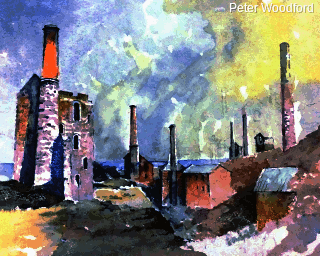
Photo: The engine house from a ruined tin mine in Cornwall, England. After the
last Cornish tin mine closed in 1998, the
industry is now just a romantic memory. Image from an original
watercolor artwork by Peter Woodford.
Tin is a silvery white metal that lives in group IV of the
periodic table of chemical elements. To look at it, you'd never know
that it was (according to archeologists) one of the earliest and most
important metals in human history!
[1]
It was the discovery of how tin and copper could be combined
in an alloy called
bronze (a much
stronger material than either metal alone) that ushered in one of the
major eras of civilization: the Bronze Age. The earliest evidence we
have of people using tin is in bronze finds from 3000–3500BCE, though
it was apparently not widely used as a pure metal until several thousand years
later (probably c.600BCE).
[2]
Photo: Cats on a hot tin roof. Naval engineers put a new tin roof on a building in Guatemala. Photo by Eric Tretter courtesy of US Navy and DVIDS.
Sponsored links
Where does tin come from?
Photo: "Tin can" is a bit of a misnomer because cans aren't made entirely of tin.
Tin cans are made of tinplate steel (steel electroplated with a thin coating of tin) or sometimes even of tin-free steel. According to the Can Manufacturers Institute, the amount of tin used in cans fell by some 60 percent during the two decades to 2013.
Although we think of tin as an everyday material, it's actually
much less common than comparable metals such as copper or
zinc (according to the US Geological Survey, copper is over 30 times and
zinc about 50 times more common than tin).
[3]
In terms of abundance, tin is roughly halfway down the list of chemical elements: the 49th most
common in Earth's rocky crust, existing in concentrations of about 2
parts per million (0.0002 percent).
[4]
In other words, if you dig up a
tonne of rock, a measly 2 grams of it will be tin!
There are tin deposits right across the world, though most tin now comes from the southern
hemisphere—and chiefly from south-east Asia. The most important producer
countries are now China, Indonesia, Peru, Bolivia, and Brazil.
England (Cornwall) is no longer the important producer it
once was and the United States, despite being the world's biggest
consumer of tin, has not (according to the US Geological Survey)
mined any of the metal since 1993.
[5]
Photo: Processing tin at the Rock Island Arsenal.
Photo courtesy of US Army.
Most tin is produced from an ore (raw rocky mineral) called
cassiterite, which is turned into tin by smelting.
First, the ore is crushed to a powder and washed free of impurities before being
heated with carbon (in the form of coal) and limestone in a giant
furnace. Other metals, such as iron, copper and
zinc, separate out. Molten tin sinks to the bottom of the furnace and is shaped into
solid blocks known as ingots.
[6]
Like most other metals, tin can also be
separated or purified using electrolysis (an electrical-chemical
process that works in the opposite way to a battery).
[7]
World mine production of tin, 2021. Seven countries (China, Indonesia, Burma, Brazil, Bolivia, Peru, and DR Congo mine about 90 percent of the world's tin. Source: USGS Mineral Commodity Summaries: Tin, January 2022.
What is tin like?
There are two common forms (allotropes) of tin that look and
behave differently because of their quite different internal
crystalline structures. One is the familiar, silvery-white form
called white tin or beta tin, which has a
body-centered tetragonal
structure and predominates at everyday temperatures. The other form,
gray tin or alpha tin, is powdery, about two thirds as dense, and appears spontaneously at low temperatures. It's less useful because it's weaker and more brittle,
with a face-centered cubic
crystalline structure. The sudden degradation of white tin into gray tin is
called tin pest.
[8]
Physical properties
Photo: Tin surprise! Did you know that tin (II) fluoride puts the fluoride in toothpastes?
Tin is a typical metal inasmuch as it's extremely malleable (easy
to work in many different ways), ductile (easy to draw into wires),
and readily forms a grayish protective oxide on its surface, but it's
much weaker than metals such as iron so it's not used as a
construction material. It has a relatively low melting point (one of
the reasons it's used as a component of solder),
but a relatively high boiling point, which means it's a liquid over a wide range
of temperatures and can be usefully employed as such in a number of industrial processes.
Chemical properties
Tin has a valency (chemical combining power) of either two (II) or
four (IV) and accordingly forms two different forms of compounds: tin
(II) compounds (which used to be called stannous) and tin (IV)
compounds (formerly called stannic). Notable tin compounds
include tin (II) chloride used in galvanizing, dyeing, and perfume
production; tin (II) fluoride, which provides the fluoride in some
toothpastes; and tin (IV) oxide, an industrial catalyst. Compounds of
carbon and tin include a number of important insecticides and
disinfectants.
Key data
Artwork: The periodic table of chemical elements showing the position of tin. Being reasonably
far down the table, it's moderately dense and heavy (just above lead, Pb).
Melting point: 232°C (450°F).
Boiling point: 2590°C (4690°F).
Atomic number: 50 (the most common form of tin atom contains 50 protons, 70 neutrons, and 50 electrons).
Relative atomic mass: 118.7.
Density: White tin: 7.29 g/cc; gray tin: 5.75 g/cc.
Isotopes: Ten stable isotopes, the most common of which are tin-120 (~33%), tin-118 (24%), tin-116 (~15%), and tin-119 (~8.6%).
Photo: Tin is still used in cans and containers, but much less than it used to be.
From: Carol M. Highsmith's America Project in the Carol M. Highsmith Archive, Library of Congress, Prints and Photographs Division.
In the United States, most tin is now used for making chemicals of various kinds,
including PVC plastic and polymer catalysts.
Tin plating was—and remains—one of the most important uses of tin. It
involves applying a very thin protective coating of tin to other
materials, such as steel and copper, either by dipping them into
molten tin or by electroplating. The dull, tin oxide that forms on
the surface of the tin plate protects both the tin and the material
it covers up. In the early decades of the 20th century, most food
cans were handmade this way and sealed up by soldering. The tin
rustproofed the steel cans and protected them from acidic foods, and
some tins cans also had an enamel coating inside to protect the food
from reacting with them. Now, plastic, board, and composite
containers and aluminum cans often do the job instead. Tin is also
used to rustproof such things as paperclips, hair grips, and safety
pins. Apart from tin plate, another important uses for tin is
the production of many different alloys, including bronze, solders of
various kinds, babbitt metal, and pewter.
[10]
Chart: Tin use in the United States in 2021. The US no longer mines or smelts any of the tin it uses (and hasn't done for over a quarter century now). Roughly two thirds of US tin comes from just three
countries (Indonesia, Malaysia, and Peru). Source: USGS Mineral Commodity Summaries: Tin, January 2022.
Tin and Tin Mining by R.L. Atkinson. Shire/Bloomsbury, 2010. A fascinating (if brief) historical account of tin and how people have extracted it, from ancient times to modern.
Tin by Janet Levy. Rosen Group, 2009. A 48-page introduction covering the history of tin, its atomic structure and place in the periodic table, how it's mined and processed, its various compounds, and how we use it in everyday life. Ages 9–12.
Tin by Leon Gray. Benchmark Books, 2004. A basic 32-page overview of the chemical element tin, its physical and chemical properties, and its various uses. Ages 9–12.
Please do NOT copy our articles onto blogs and other websites
Articles from this website are registered at the US Copyright Office. Copying or otherwise using registered works without permission, removing this or other copyright notices, and/or infringing related rights could make you liable to severe civil or criminal penalties.