Every day, there are hundreds—perhaps even thousands—of
advertising messages knocking on your head trying to gain access to
the part of your brain that decides to buy things. With so much money
at stake, it's hardly surprising that advertisers go to such
extraordinary lengths to catch our attention. The only trouble is,
our brains habituate: they quickly get used to seeing the same
thing over and over again. So the advertisers have to keep thinking of new tricks to stay
one step ahead. One of their latest ideas is to print posters,
magazines, and book covers with lenticulars—images that seem
to change as you move your head. Let's take a closer look at how they
work!
Photo: The LEGO® robot image on the cover of my book
Cool Stuff Exploded
changes as you tilt it back and forth. A plastic lenticular insert shows you one of two
different images depending on which side you look from.
Photo: Lentils like this one gave lenses their name. Convex lenses bulge out in the middle like lentils, while concave lenses "cave in" in the middle and bulge out at the edges.
Nothing! Lentils are tiny orange, green, or brown pulses popular with
vegetarians and—no—they have nothing to do with how book covers
work. The connection between "lentil" and "lenticular" is
simply a matter of words. Lenticulars are so-called because they use
lenses, which are pieces of plastic or
glass that bend (or "refract")
light to make things look bigger or smaller. Lenses got their name
because some of them just happen to look a bit like lentils!
You can find more in our main article on lenses
(we even tell you how to make a lens of your own, in about 5 seconds flat, from a drop of water).
How do you make a lenticular?
Here's the cover of my book (from the top photo) in close-up. Now you can see the individual lenticles. Each one is a hemispherical plastic lens that magnifies only one of the sliced images underneath it, depending on where you're eyes are in relation to the book cover. Different lenticulars have what's called a different pitch, which is the number of lenticles per inch (LPI). They also work differently at different distances from the viewer. Both these factors—the pitch and the viewing distance—have to be taken into account to make a convincing lenticular print.
Sponsored links
How do you make something like this? You
take your two different images and load them into a
computer graphics
program. The program cuts each image into dozens of thin strips and
weaves them together so the strips from the first image
alternate with the strips from the second. This process is called
interlacing. If you look at the doubled-up image printed this
way, it's just a horribly confusing mess, but not for long! Next, you
place a transparent plastic layer on top of the doubled-up image.
This is made of dozens of separate thin, hemi-spherical lenses called lenticles. These refract (bend) the light passing through them so, whichever side you're looking from,
you see only half the printed strips. Move your head back and
forth and the image flips back and forth too like a kind of "visual
see-saw".
For all this to work properly, everything has to be printed with
incredible precision. The lenticles have to be exactly the same size
as the printed strips underneath them and lined up with them exactly.
Not only that, the image has to be adjusted and printed so that it
looks exactly right when viewed through a certain piece of lenticular
plastic (with a certain "pitch"—or number of lenticles per inch) at a certain viewing distance.
(That's a fiddly technical process and I won't go into the details here, but
you can find out more in the articles and videos in the further reading section
below.)
Artwork: Who invented lenticular printing? One strong contender is Walter Hess of Rapperswil, Switzerland. Here's a drawing from his 1912-filed patent clearly outlining the method of lenticular printing still used to this day. A lenticular surface (1) based on segments of cylindrical lenses (2) diverts light rays in different directions. Looking from point (3), you see the image at point (5); looking from point (4), you see the alternate image at point (6). Artwork from US Patent #1,128,979: Stereoscopic picture by Walter Hess, granted February 16, 1915, courtesy of US Patent and Trademark Office.
How many images can you have?
Nothing says lenticulars have to flip back and forth between just two images:
some have as many as 20 different images or "frames" (as they're sometimes
called, using the language of moviemaking). You could have half a dozen different images designed to point in slightly different directions, so an advertising poster slowly and subtly changes its message as you walk
past! You can also use lenticulars to create amazing 3D images similar
to holograms.
Photo: One of the problems with lenticulars is that, just at the point where one image should flip to another, you can see both images at once. Sometimes this works in your favour; sometimes it's jarring and undermines the illusion. In this example, you can see a lenticular of an iPod that shows the normal (external) case and the (internal) circuit board. From a certain angle, you can see both images at once.
How lenticulars work
How do lenticulars work? Well...
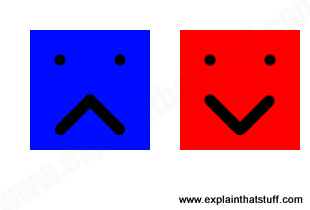
1. You start off with two (or more) separate images:
2. You interlace them (cut the two images into strips and join them together so the strips from the first image alternate with the strips from the second image). This looks a bit weird!
3. Now you add a row of hemispherical lenticles on top. Each one refracts (bends) the light passing through it. If you look from the left, you see only the blue image; if you look from the right, only the red image is visible. It's not magic—it's science!
What else can you do with lenticulars?
Photo: Retail packaging is a great application for lenticular printing. This example comes from a popular brand of interdental toothbrush, which can hinge back and forth as you wiggle it around your mouth. You wouldn't necessarily understand that just by looking at the pack, but the lenticular demonstrates it as you tilt the packaging in your hand.
For a basic flip image that changes as you move your head, you need to arrange the lenticles so
both eyes always see the same image; as you move your head, both eyes then switch simultaneously to the other image. Adding more images, it's possible to create a basic illusion of movement (a bit like a flip book) and a zooming effect, so the image appears to get closer or further away as you move the lenticular back and forth. With a slightly different arrangement of lenticles, arranged vertically, we can send one image to one eye and the alternate interleaved image to the other, giving the illusion of a three-dimensional picture.
The Visual Dictionary of Graphic Design by Gavin Ambrose and Paul Harris. AVA Publishing, 2006 (reprinted 2019). An A-Z guide covering the many different techniques that graphic designers use to catch our eyes.
Forms, Folds, Sizes by Poppy Evans and Aaris Sherin. Rockport, 2009. An everyday print and production reference book for designers covering all the little details you can never remember!
Lenticular Vernacular by Wm. Ferguson, The New York Times, March 7, 2011. A new digital tehcnique combines lenticulars with animated GIFs to produce wobbly, 3D online images with an illusion of depth.
How to make lenticular images: A basic introduction to making your own 3D lenticulars, featuring photographer Dan Vojtěch. This video glosses over the technical details, leaving all the hard stuff to the software.
How lenticular posters are made: A longer, 12-minute introduction from 3D Focus TV goes through all the steps of printing a lenticular poster (and explains how to get convincing 3D effects). There's also quite an interesting interview at the end about where lenticular technology may be going in the future.
Patents
If you're interested in the technical details of lenticulars, these patents might be of interest:
US Patent #1,128,979: Stereoscopic picture by Walter Hess, February 16, 1915. One of the earliest recorded methods of producing 3D images using an array of side-by-side lenses.
US Patent #5,311,329: Digital filtering for lenticular printing by
Paul E. Haeberli and Leonard J Flory, Silicon Graphics, May 10, 1994. A method of producing sharper 3D lenticular images by digitally filtering and sharpening the interleaved components before they're printed.
Please do NOT copy our articles onto blogs and other websites
Articles from this website are registered at the US Copyright Office. Copying or otherwise using registered works without permission, removing this or other copyright notices, and/or infringing related rights could make you liable to severe civil or criminal penalties.