You can survive without food for several weeks, because your body
will gradually switch to using stored fat and protein to make its energy. But cut
off your water supply and you'll be dead within days. Water equals
life: it's as simple as that. Around two thirds of your body (as much
as 75 percent if you're a baby) is H2O. Even your bones, which you
might think are completely solid, contain about 25 percent water. On
average, according to Britain's most authoritative source of health information, the NHS, we need "6 to 8 cups or glasses [of water] a day" (1.5–2.5 liters or 0.3–0.6 gals)
to keep ourselves healthy, although how much any individual actually needs is
a bit more complicated, for various reasons.
With water so important to our lives, it's hardly surprising we like it clean, pure, and tasty.
That's one reason people spend so much money on water filters that
can remove any harmful impurities. How do they work—and do we really
need them? Let's take a closer look!
Artwork: A typical jug-type water filter "converts" tapwater into cleaner drinking water using replaceable filters. Typically, each filter lasts about a month and there's a timer display on the jug that reminds you when you need to replace it. Jugs like this are made by Brita, Biocera, and many others.
Thanks largely to an unusual molecular structure, water is amazingly good at dissolving things.
(We look at this in more detailed in our main article on water.)
Sometimes that's helpful: if you want to bust the dust from your jeans, simply
throw them in your washing machine with some detergent and the water and soap will pull the muck away like a magnet.
But there's clearly a downside to this too.
All of our water constantly circulates through the environment in what's known as the
water cycle. One minute it's rushing through a river or
drifting high in a cloud, the
next it's streaming from your faucet (tap), sitting in a glass on your
table, or flushing down your toilet. How do you know the water you're about to drink—with its brilliant ability to attract and dissolve dirt—hasn't picked up all kinds of nasties on
its journey through Earth and atmosphere? If you want to be sure, you can run it through a water filter.
Physical and chemical filtration
Water filters use two different techniques to remove dirt. Physical
filtration means straining water to remove larger
impurities. In other words, a physical filter is a glorified sieve—maybe a piece of
thin gauze or a very fine textile membrane. (If you have an
electric kettle,
you probably have a filter like this built into the spout to remove
particles of limescale.) Another method of filtering, chemical filtration, involves passing water through an active
material that removes impurities chemically as they pass through.
There are four main types of filtration and they employ a mixture of physical and
chemical techniques.
Activated carbon
The most common household water filters use what are known as activated
carbon
granules (sometimes called active carbon or AC) based on
charcoal
(a very porous form of carbon, made by burning something like wood in
a reduced supply of oxygen). Charcoal is like a cross between the graphite
"lead" in a pencil and a sponge. It has a huge internal surface area, packed with
nooks and crannies, that attract and trap chemical impurities through
a process called adsorption (where liquids
or gases become trapped by solids or liquids).
Photo: Charcoal filter: A classic wastewater filtering system outlined in a 1901 patent by Cleophas Monjeau of Middletown, Ohio. Dirty water drips down from the tank at the top (blue), passes through vegetation (probably a reed bed), which removes nutrients, organic matter, some kinds of pollution, and some bacteria, before dripping down through sand, charcoal, and gravel filters. The cleaner water is collected for reuse in another tank at the bottom. Reed beds are still widely used in purifying wastewater to this day, including in systems for cleaning up runoff from highways. Artwork from US Patent 681,884: Purifying water by Cleophas Monjeau, issued September 3, 1901, courtesy of US Patent and Trademark Office.
But while charcoal is great for
removing many common impurities (including chlorine-based
chemicals introduced during waste-water purification, some pesticides,
and industrial solvents), it can't cope with "hardness"
(limescale), heavy metals (unless a special type of activated carbon
filter is used), sodium, nitrates, fluorine, or microbes. The main
disadvantage of activated carbon is that the filters eventually clog
up with impurities and have to be replaced. That means there's an
ongoing (and sometimes considerable) cost.
Photo: A water treatment plant filters water for reuse by
passing dirty water from homes and factories through beds of charcoal and sand.
It's like a giant version of the filter in our artwork up above, though there's
no reed bed in this system.
Photo courtesy of US Environmental Protection Agency and
US National Archives.
Reverse osmosis
Reverse osmosis means forcing contaminated water through a membrane (effectively, a very
fine filter) at pressure, so the water passes through but the
contaminants remain behind.
A closer look at reverse osmosis
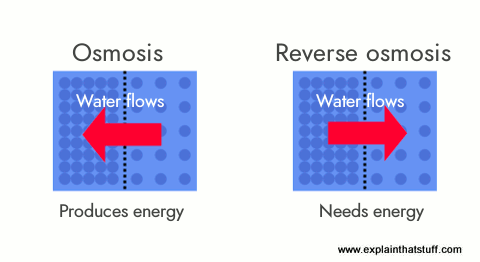
If you've studied biology, you've probably heard of osmosis. When you have a
concentrated solution separated from a less concentrated solution by
a semi-permeable membrane (a kind of filter through which some things
can pass, but others can't), the solutions try to rearrange
themselves so they're both at the same concentration.
Wait, it's simpler than it sounds!
Suppose you have a sealed glass bottle full of very sugary water and you stand it inside a big glass jug full of
less sugary water. Nothing will happen. But what if the bottle
is actually a special kind of porous plastic through which water (but not
sugar) can travel? What happens is that water moves from the outer
jug through the plastic (effectively, a semi-permeable membrane) into the bottle until
the sugar concentrations are equal. The water moves all by itself
under what's called osmotic pressure.
That's osmosis, so what about reverse osmosis? Suppose you take some contaminated water and
force it through a membrane to make pure water. Effectively, you're
making water go in the opposite direction to which osmosis would
normally make it travel (not from a less-concentrated solution to a
more-concentrated solution, as in osmosis, but from a
more-concentrated solution to a less-concentrated solution).
Since you're making the water move against its natural inclination,
reverse osmosis involves forcing contaminated water through
a membrane under pressure—and that means you need to use energy. In
other words, reverse-osmosis filters have to use electrically powered pumps
that cost money to run. Like activated charcoal, reverse osmosis is
good at removing some pollutants (salt, nitrates, or limescale), but
less effective at removing others (bacteria, for example). Another
drawback is that reverse osmosis systems produce quite a lot of
waste-water—some waste four or five liters of water for every liter
of clean water they produce.
Here's what a reverse osmosis filter unit looks like in practice, shown in cutaway. Unfiltered water (blue pipe) is pumped
into a purification unit (gray) and passes through a plastic, semi-permeable membrane (yellow) made (in this case) of
cellulose acetate. Clean water flows out through the red pipe; impurities flush away through the green pipe:
Artwork: A cutaway of a basic, reverse osmosis membrane filter.
Artwork courtesy of US Patent and Trademark Office from US Patent 3,390,773: Water purification system by Ulrich Merten. Gulf General Atomic Inc, July 2, 1968.
Sponsored links
Ion exchange
Ion-exchange filters are particularly good at "softening" water
(removing limescale).
They're designed to split apart atoms of a contaminating substance to
make ions (electrically charged atoms with too many or too few
electrons). Then they trap those ions and release, instead, some
different, less troublesome ions of their own—in other words, they
exchange "bad" ions for "good" ones.
Artwork: How ion exchange works: Magnesium and calcium ions (orange and red) flow into the water filter crystals (gray), which initially contain sodium ions (yellow). The magnesium and calcium ions become trapped and the sodium ions are released in their place.
How do they work? Ion
exchange filters are made from lots of zeolite beads containing sodium ions. Hard
water contains magnesium and calcium compounds and, when you pour it
into an ion-exchange filter, these compounds split apart to form
magnesium and calcium ions. The filter beads find magnesium and
calcium ions more attractive than sodium, so they trap the incoming
magnesium and calcium ions and release their own sodium ions to
replace them. Without the magnesium and calcium ions, the water tastes softer and (to
many people) more pleasant. However, the sodium is simply a different
form of contaminant, so you can't describe the end product of
ion-exchange filtration as "pure water" (the added sodium can
even be problematic for people on low-sodium diets). Another
disadvantage of ion-exchange filtration is that you need to recharge
the filters periodically with more sodium ions, typically by adding a special
kind of salt. (This is why you have to add "salt" to dishwashers,
from time to time: the salt recharges the dishwasher's water softener
and helps to prevent a gradual build-up of limescale that can damage
the machine.)
Distillation
One of the simplest ways to purify water is to boil it, but although the heat kills off
many different bacteria, it doesn't remove chemicals, limescale, and
other contaminants. Distillation goes a step further than ordinary boiling: you boil water
to make steam, then capture the steam and condense (cool) it back
into water in a separate container. Since water boils at a lower temperature than some of the
contaminants it contains (such as toxic heavy metals), these remain
behind as the steam separates away and boils off. Unfortunately,
though, some contaminants (including volatile organic compounds or
VOCs) boil at a lower temperature than water and that means they
evaporate with the steam and aren't removed by the distillation
process.
Artwork: Distillation involves heating water to kill contaminants and
separate out impurities. Water boils at 100°C (212°F), so steam captured at exactly this temperature
should, in theory, consist of nothing but water. In practice, it's not quite so easy!
Conclusion
You can see that different types of filtration remove different pollutants—but there's no single
technique that removes all the contaminants from water.
That's why many home water-filter systems use two or more of these processes together.
If you're looking for a home water filter, tread carefully. Bear in mind that you won't necessarily
remove all the nasties. Remember, too, that most water filters require some kind of ongoing
cost and, without regular maintenance to keep them working properly, can leave your water in worse shape than it was
to begin with!
Should we stop drinking bottled water?
Many people buy water filters or bottled water in an often mistaken belief that all tap water
is dirty or harmful to drink. In fact, as the
Environmental Protection Agency (EPA) reveals,
around 92 percent of US community water systems
met "all applicable health-based drinking water standards" in 2018
(up from 85 percent in 2005). In England and
Wales, for the year 2020, the
Drinking Water Inspectorate reported that 99.96 percent of drinking water met
national and European standards (involving some 40 different quality
measurements). Those figures are pretty remarkable really, when
you consider just how dirty we make water and some of the things
(like pesticides and car oil) that people flush down their drains.
Even so, the high quality of most drinking water doesn't stop people spending something like
$280 billion, worldwide, each year, buying bottled water that's several thousand times more expensive than tap water.
Photo: It's great for disasters and emergencies, but do we really need bottled water at other times? Photo by Brett Cote courtesy of
US Navy.
One reason for this disconnect is high-profile (and completely justified) media coverage of the
exceptionally poor—and indeed downright dangerous—water quality that some people really do experience.
If just 8 percent of the US population have water systems that fail to meet standards, we're talking about 2–3 million people. But the true picture could be much worse. It's not hard to find
examples of dangerous drinking water quality.
A 2017 report by Environment Working Group and Northeastern University argued
some 15 million Americans might be at risk from certain toxic chemicals.
That's a great concern, but it still doesn't mean the answer is for everyone
to drink bottled water instead. The answer is to crack down on water pollution
and clean up our tap water with more effective filtration.
?
We spend billions on takeaway water, but cost isn't the only drawback. Most of it comes in disposable
plastic bottles that are hard to recycle. Dumped in landfills, washed away in rivers, dropped on
beaches, burned in incinerators—plastic bottles add to the pollution
that's reducing the quality of Earth's natural water supply. How ironic: by buying
"clean" bottled water to keep ourselves healthy, we're helping to
make Earth a dirty place and making things worse overall.
Why not break the habit of buying bottled water?
You can reuse certain types of disposable plastic bottles,
providing you wash them out thoroughly and air dry them, but it's
safer to buy yourself a hygienic reusable plastic or aluminum
water bottle and fill that from the tap instead.
Do that as few as 10–20 times and your
bottle will soon pay for itself.
Best of all, give the money you save on bottled water to WaterAid and help some of the people who genuinely lack clean water in developing countries. Let's count ourselves lucky we don't have to drink water straight from a dirty river, like many people still do. As an interesting aside, remember that we spend $280 billion a year on bottled water? Let's put that in context. One of the UN's Millennium Development Goals was to "halve by 2015 the proportion of people without sustainable access to safe drinking water and basic sanitation"; in 2012, the
World Bank estimated that the annual cost of achieving that would be $184 billion.
Bottled Water Is Sucking Florida Dry by Michael Sainato and Chelsea Skojec, The New York Times, 15 September 2019. How water bottling is destroying our dwindling natural water supplies.
The Story of Bottled Water: The Guardian, 14 December 2010. A couple of great videos here that explain the real cost of bottled water.
Bottled water: who needs it? by Tom Heap, BBC Panorama, 18 February 2008. Examines the case against bottled water asking questions such as this: is it morally acceptable to import bottled water from Fiji where one third of the population lack clean, safe drinking water?
[PDF] EPA: Water Health Series: Filtration Facts: This eight-page, independent guide to water filtration discusses whether you really need to filter your water and compares the effectiveness (and cost-effectiveness) of the different methods.
Books and articles
Ask Well: Should You Filter Your Water? by Roni Caryn Rabin. The New York Times, December 31, 2015. Your tap water might pass the legal limits, but are those limits stringent enough?
For more details about how water filters are constructed in practice, try these references. I've picked one typical example of each of the main types of filter; you can find many more examples by searching Google Patents or the USPTO website.
Please do NOT copy our articles onto blogs and other websites
Articles from this website are registered at the US Copyright Office. Copying or otherwise using registered works without permission, removing this or other copyright notices, and/or infringing related rights could make you liable to severe civil or criminal penalties.