Now that's what I call hot! But how hot is it, exactly? If you
want to measure the temperature of something as hot as a volcano, an ordinary thermometer
isn't any use. Stick the bulb of a mercury thermometer into volcanic lava (which can be
well over 1000°C or 1800°F)
and you'll get a surprise: the mercury inside will instantly boil
(it turns from liquid to gas at a mere 356°C
or 674°F) and the glass itself
might even melt (if the lava is really hot). Try measuring something
super-cold (like liquid nitrogen) with a mercury thermometer and you'll
have the opposite problem: at temperatures below −38°C/38°F,
mercury is a solid lump of metal. So how do you measure really hot or cold things? With a
cunning pair of electric cables called a thermocouple. Let's take a
closer look at how it works!
Photo: Measuring the temperature of volcanic lava with a thermocouple.
This photo was taken at Hawaii Volcanoes National Park following the eruption of Kilauea Volcano in 1983. Photo by J.D. Griggs courtesy of US Geological Survey (USGS).
Have you noticed that when we talk about conduction in
science we can be referring to two things? Sometimes we mean heat and
sometimes we mean electricity. A metal
like iron or gold
conducts both heat and electricity really well; a material like a plastic
doesn't conduct either of them very well at all.
There is a connection between the way a metal conducts heat and the way it
conducts electricity. If you've read our main article on
electricity, you'll know electric current is carried through
metals
by tiny charged particles inside atoms called
electrons. When
electrons "march" through a material, they haul electricity with
them a bit like ants carrying leaves. If electrons are free to carry
electrical energy through a metal, they're also free to carry heat
energy—and that's why metals that conduct electricity well are also
good conductors of heat. (Things aren't quite so simple for
nonmetals, however, because heat travels through them in other, more
complex ways. But for the purposes of understanding thermocouples,
metals are all we need to consider.)
Sponsored links
Thomas Seebeck and the thermoelectric effect
Suppose you stick an iron bar in a fire. You'll have to let
go of it quite quickly because heat will be traveling up the metal
from the fire to your fingers. But did you realize that electricity
is traveling up the bar as well?
The first person to properly cotton
on to this idea was German physicist Thomas Seebeck
(1770–1831), who found that if two ends of a metal were at different temperatures, an
electric current would flow through it. That's one way of stating what's
now known as the Seebeck effect or thermoelectric effect.
Seebeck found things got more interesting as he explored further. If
he connected the two ends of the metal together, no current flowed;
similarly, no current flowed if the two ends of the metal were at the
same temperature.
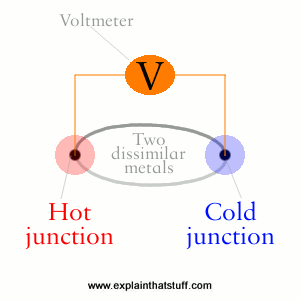
Artwork: The basic idea of a thermocouple: two dissimilar metals (gray curves) are joined together at their two ends. If one end of the thermocouple is placed on something hot (the hot junction) and the other end on something cold (the cold junction), a voltage (potential difference) develops. You can measure it by placing a voltmeter (V) across the two junctions.
Seebeck repeated the experiment with other metals and then tried
using two different metals together. Now if the way electricity or
heat flows through a metal depends on the material's inner structure,
you can probably see that two different metals will produce different
amounts of electricity when they're heated to the same temperature.
So what if you take an equal-length strip of two different metals and
join them together at their two ends to make a loop. Next, dip one
end (one of the two junctions) in something hot (like a beaker of
boiling water) and the other end (the other junction) in something
cold. What you find then is that an electric current flows through
the loop (which is effectively an electric circuit) and the size of
that current is directly related to the difference in temperature
between the two junctions.
The key thing to remember about the Seebeck effect is that the size of the voltage
or current created depends only on the type of metal (or metals) involved
and the temperature difference. You don't need a junction between
different metals to produce a Seebeck effect: only a temperature difference.
In practice, however, thermocouples do use metal junctions.
Why does the Seebeck effect happen?
Artwork: How the Seebeck effect works: if you heat one end of a metal (red arrow), electrons (white blobs) "diffuse" along it, making the colder end slightly more negatively charged than the hotter end.
As we've already seen, there's a close connection between how well electricity
flows in a material (electrical conductivity) and how well heat flows (thermal
conductivity). We can think of the electrons in a metal as being a bit like
the molecules in a gas, which jiggle around with kinetic energy. The hotter the
gas, the more kinetic energy each molecule has, on average, and the faster it
jiggles. Just as gas molecules move faster when you heat them,
so electrons tend to "diffuse" more when a metal is hotter. If you heat
one end of a metal bar, electrons move quicker there and produce a net flow toward the colder
end. This makes the hotter end slightly positively charged and the colder end
slightly negatively charged, producing a voltage difference—the Seebeck effect.
Photo: A thermocouple (orange) attached to a hot water pipe. Photo by Leiko Earle courtesy of NREL (image id 6307251.
What about the Seebeck effect in a junction between two different metals?
Electrons move more freely in some materials than others. That's the basic
difference between conductors and insulators and between good conductors and bad ones.
If you connect two different metals together, free electrons tend to move from one material to the other
through a kind of diffusion. So, for example, if you connect a lump of copper to a lump of iron, electrons tend to move from the iron to the copper, leaving the copper more negatively charged and the iron more positively charged.
If the iron and copper are joined in a loop with two junctions, one of the junctions will
gain a positive voltage and the other will gain an equal and opposite negative voltage, making
no voltage overall. But if one of the junctions is hotter than the other, electrons will diffuse
between the metals more readily there. That means the voltage at the two junctions will be
different by an amount that depends on their temperature difference.
That's the Seebeck effect—and it's the basis of how most thermocouples work.
Measuring temperatures with a thermocouple
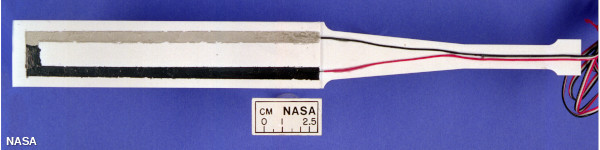
Photo: The kind of high-temperature laboratory test for which thermocouples are invaluable. Photo by courtesy of NASA Glenn Research Center (NASA-GRC).
See where we're going with this? If you measure a few known
temperatures with this metal-junction device, you can figure out the
formula—the mathematical relationship—that links the current and
the temperature. That's called calibration: it's like marking the
scale on a thermometer. Once you've calibrated, you have an
instrument you can use to measure the temperature of anything you
like.
Simply place one of the metal junctions in a bath of ice (or
something else of a precisely known temperature). Place the other
metal junction on the object whose temperature you want to find out.
Now measure the voltage change that occurs and, using the formula you
figured out before, you can precisely calculate the temperature of
your object. Brilliant! What we have here is a pair (couple) of
metals that are joined together (coupled) for measuring heat (which,
in Greek, was called "thermos"). So that's why it's called a
thermocouple.
What are thermocouples like in practice?
All we really care about is one of the two junctions—the one measuring the unknown temperature. So when you see a photograph or an illustration of a thermocouple, that's usually all that's shown:
Photo: A typical thermocouple. You can see clearly here how two different metals have been joined together inside a protective outer sheath. Photo by courtesy of NASA Glenn Research Center (NASA-GRC)
and Internet Archive.
What you see here is the part of a thermocouple that measures the unknown temperature. In practice, it's wired into a larger circuit, something like the one below, with the two outputs feeding into an
electronic voltage amplifier. This increases the very small voltage difference between the two parts of the circuit (the upper and lower paths in this diagram) so it can be measured more accurately. To be absolutely clear, the instrument you see in the photo up above is just the extreme left part of the artwork below:
Photo: How a typical thermocouple is used in practice, as part of a
larger circuit that includes two metal junctions and a voltage amplifier.
A wide range of different thermocouples are available
for different applications based on metals with high conductivity,
such as iron, nickel,
copper, chromium, aluminum,
platinum, rhodium
and their alloys. Sometimes a particular
thermocouple is chosen purely because it works accurately for a particular temperature
range, but the conditions under which it operates may also influence
the choice (for example, the materials in the thermocouple might need
to be nonmagnetic, noncorrosive, or
resistant to attack by particular
chemicals).
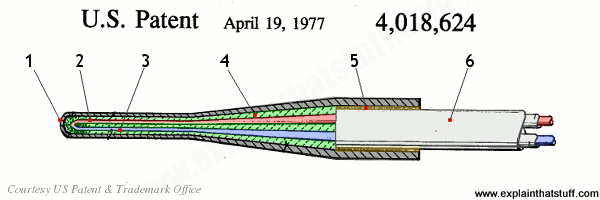
Artwork: Parts of a typical thermocouple. 1) Protective metal sheath (dark gray) made from stainless steel or an alloy (perhaps nickel and chromium); 2) First wire made from one metal (red); 3) Second wire made from a different metal (blue) joined to first wire to make a thermocouple; 4) Insulation (green) made from crushed and compacted mineral oxide. 5) Cement to hold insulation in place; 6) Electrical insulation made from rubber or plastic. Artwork from US Patent 4,018,624: Thermocouple structure and method of manufacturing same by Silvio J. Rizzolo, courtesy of US Patent and Trademark Office.
What are thermocouples used for?
Photo: Measuring temperatures deep below ground in an oilfield is a perfect example
of where thermocouples are really useful. Photo courtesy of US Department of Energy
published on Flickr.
Thermocouples are widely used in science and industry because
they're generally very accurate and can operate over a huge range of
really hot and cold temperatures. Since they generate electric
currents, they're also useful for making automated measurements: it's
much easier to get an electronic
circuit or a computer to measure a
thermocouple's temperature at regular intervals than to do it
yourself with a thermometer. Because there's not much to them apart
from a pair of metal strips, thermocouples are also relatively
inexpensive and (provided the metals involved have a high enough
melting point) durable enough to survive in pretty harsh
environments.
Notes on using thermocouples: A much more detailed introduction from Electronics Cooling magazine that builds on the information we have here.
More scholarly
The Revival of Thermoelectricity by Abram F. Joffe, Scientific American, Vol. 199, No. 5 (November 1958),
pp. 31–37. A half-century ago, this article suggested the Seebeck (and Peltier) effects would revolutionize energy use in just a few years; we're still waiting!
Thermoelectrics Run Hot and Cold by Terry M. Tritt, Science, May 31, 1996, pp. 1276–1277. A more modern look at how can we use the Seebeck Effect in refrigeration and electricity generation?
Photos of thermocouples: A quick flickr search reveals a few hundred photos of thermocouples and related kit for measuring high temperatures.
Patents
If you're looking for much more technical descriptions of thermocouples, patents are a great place to begin. Here are a few examples I've picked out from the USPTO database (but there are hundreds more):
US Patent 1,643,734: Thermocouple by Vladimir Zworykin, September 27, 1927. An improved thermocouple, coincidentally designed by one of the pioneers of television.
Please do NOT copy our articles onto blogs and other websites
Articles from this website are registered at the US Copyright Office. Copying or otherwise using registered works without permission, removing this or other copyright notices, and/or infringing related rights could make you liable to severe civil or criminal penalties.