If you're unlucky enough to be caught in a storm at sea,
there's nothing more reassuring than the friendly wink from a nearby lighthouse.
But have you ever stopped to think how that light can travel so far across
the ocean? It's largely down to lenses—amazing, curved, Fresnel lenses (pronounced "Fre-nel," with a silent "s") that concentrate light into a super-powerful beam. Let's take a closer look
at how they work!
Photo: If you see a light shining through a piece of
glass or plastic
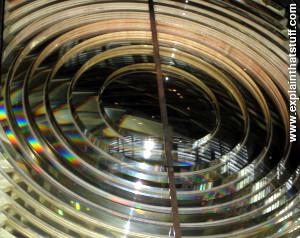
with this weird pattern of concentric circles on its surface, you can be sure you're looking at a Fresnel lens.
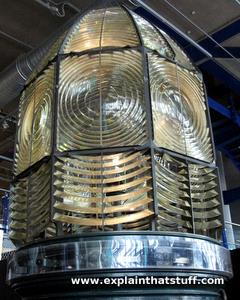
Photos: The Fresnel lens at Anvil Point lighthouse near Swanage in Dorset, England, which was originally built in 1881 and fully automated over a century later in 1991.
A lighthouse uses similar science to a telescope, but works in
exactly the opposite way—with the help of a Fresnel lens. The glass lenses in a telescope refract (bend) light rays from distant objects so they seem to be much nearer. But in a lighthouse,
the Fresnel lens wrapped around the lamp concentrates the light rays into a
powerful and parallel beam so people can see it, with just a naked
eye, as far as 30 km (about 20 miles) away or more!
Three cunning tricks make this possible:
Lighthouses use amazingly powerful xenon lamps (a little
bit like neon lamps) that
are hundreds of thousands of times brighter than the lamps in your home.
They mount their lamps in towers high above the sea level, which makes
them visible roughly five times further away.
They use specially shaped lenses and prisms to concentrate their light into a
super-powerful beam.
Sponsored links
Photos: A closeup of the Fresnel lens in the Anvil Point lighthouse. The 1080-candela beam fires out at about 45m (148ft) above sea level, and it can be spotted up to 17km (9 nautical miles) away.
In theory, you could make a lighthouse beam with just an
ordinary glass lens, but it would need to be enormous and heavy
and that would make it incredibly expensive and quite impractical. That's why lighthouses use
hollow, lightweight Fresnel lenses, which have a very
distinctive "stepped" surface that bends the light as much as a
thick, heavy glass lens. They're named for Augustin-Jean Fresnel, (1788–1827), the French physicist
who pioneered them in the early 19th century. Car headlamps use Fresnel lenses molded from plastic
in much the same way and you'll also find them in some of the traffic signals (traffic lights)
standing on your street.
Look closely at a lighthouse and you'll see the Fresnel lens surrounding the lamp. The concentric rings are actually "steps" (thick ridges) in the lens surface. Each step bends the light slightly more than the one beneath it, so the light rays all emerge in a perfect, parallel beam that travels many kilometers/miles across the ocean.
The lamp in this particular lighthouse rotates so it sweeps across a much greater area of the sea. The rotation also means the light seems to flash every 10 seconds when you're far away from it. That makes the lamp much more noticeable and, because different lighthouses flash at different rates, sailors can time the flashes to figure out which lighthouse they're looking at and where they are.
It's hard to get close enough to the Fresnel lens in a lighthouse to see exactly what it's like, but if you're near a science museum you might just be lucky—they sometimes have old Fresnel lenses on show. Here are some photos I took of the working Fresnel lens at Think Tank, the science museum in Birmingham, England. Note how there is a Fresnel lens on each side of the lamp (making eight in total) with prisms (curved chunks of glass) mounted above and below the lens to pull in light rays that deviate further from the central axis, making an even brighter beam.
Photos: The Fresnel lens exhibit at Think Tank, the science museum in Birmingham, England. The silvery thing at the bottom is the electric turntable that makes the whole lamp and lens assembly rotate very slowly.
How do you make a Fresnel lens?
Lenses work by bending (refracting) light beams. The bending happens when light enters
the glass (passing from the air into the glass) and when it leaves again (passing from the glass back into the air).
It follows that the only part of a lens that really matters is the border between the glass and the air (in other
words, the outer edge of the lens); most of the lens doesn't really do that much at all.
What if we could cut a lens right down so that all we had left was the useful outer part?
That's the basic theory of the Fresnel lens—and here's how it works in practice.
Suppose our lens is made of some material we can cut easily, like yellow jell-o (jelly). Let's try and cut away the useless
inner part of the lens leaving behind the useful outer curve!
Let's say we want our Fresnel lens to be about a third the thickness of the original lens. We can divide its height by drawing three equally spaced horizontal lines.
Where each horizontal line touches the upper curve of the lens, we draw a vertical line down to the base.
The interesting bits of the lens are the orange upper segments, so let's save these and lose the rest of the lens.
Drop the orange segments down to the baseline and what we have is a finished Fresnel lens!
Sponsored links
Which materials are best?
Photo: Car headlamps often use inexpensive, plastic Fresnel lenses to throw light off into the distance. Although plastic Fresnel lenses are cruder and produce poorer quality images than traditional glass lenses, it doesn't matter in this case: all that's important is concentrating light into a beam at a reasonably well focused point on the road ahead.
Fresnel lenses are all about making big, powerful beams of light that stretch very long distances. Unlike the conventional
lenses in something like a telescope, the optical quality of the light beam emerging from a Fresnel lens often doesn't matter very much:
if you're operating a lighthouse, all you're trying to do is throw light off into the distance; it's not important if sailors see a "blurred" image of the lighthouse... as long as they can see something! That means Fresnel lenses can be made from relatively inexpensive plastic, such as acrylic or polycarbonate, as well as glass. You simply need a mold containing the lens pattern in reverse—and then you can make as many identical Fresnel lenses as you want! Plastic Fresnel lenses are smaller, thinner, weigh less, and cost less than comparable glass lenses.
Artwork: Lighthouses and car headlamps aren't the only places where you'll find Fresnel lenses.
Projection TV systems sometimes use them to make large, magnified images. In this 1980s design by RCA, an image generator (green, 102, maybe a traditional CRT or LCD screen), fires its picture onto a back-projection screen via a prism and mirrors (blue, 103/104), through a compound Fresnel lens (red, 10) and focusing lens (9, pink). Artwork from US Patent 4,482,206: Rear projection television screen having a multi-surface Fresnel lens by Bertram VanBreemen, RCA, November 13, 1984, courtesy US Patent and Trademark Office.
Correcting aberrations
If you want to use a Fresnel lens the other way—to collect light rays from a distance and bring them into a sharply focused image—you need to be more precise. Inexpensively made Fresnel lenses make poorer quality images than traditional glass lenses because of a problem called spherical aberration: light rays traveling through a Fresnel lens at different angles will come to a focus at slightly different points, giving a blurred image. You get quite a bit of distortion because the surface
of a Fresnel lens is discontinuous: unlike with a smoothly curving lens, there are sudden jumps from one segment of a Fresnel lens to the next.
Artwork: Spherical aberration blurs an image.
You'll probably also find that different colors are refracted by the lens to different degrees, giving you unwanted color fringes in your image (a problem called chromatic aberration). Although it's possible to adjust the angle of the steps in a Fresnel lens to minimize aberrations, generally you'd use a conventional lens (probably made from optical quality glass) for higher optical performance.
Artwork: Chromatic aberration (exaggerated here) stops the colors in an image from aligning properly.
Saving Earth from climate change?
Fresnel lenses save wayward sailors from shipwrecks and death on the rocks, but could they save our whole planet from
a climate catastrophe? As people become more aware of
climate change and the enormous challenge it presents, some scientists
think we will have no choice but to try one or more forms of geoengineering: technical fixes to cool the planet. One option that's been proposed is a giant Fresnel lens positioned between Earth and the Sun to diffuse the
solar radiation and cool our planet. Though schemes like this are extremely controversial, they do illustrate the
fascinating applications of Augustin-Jean Fresnel's brilliant ideas!
Artwork: How the elements of a Fresnel lens in a lighthouse bend incoming light rays by different amounts to make a parallel beam of outgoing light rays. Redrawn from a historic illustration [Adolphe Ganot (1872) Natural Philosophy for General Readers and Young Persons, D. Appleton & Co., New York, p.328, fig.257], courtesy of
Wikimedia Commons.
Why Fresnel?
But hang on just a moment, why does Fresnel get all the credit? He certainly pioneered this type of lens, in 1822/23, but
the idea of cutting a piece of glass down to its useful, refracting, outer edge wasn't original. About a half century earlier, for example, Frenchman Georges de Buffon had come up with a very similar idea, which
British optical physicist Sir
David Brewster subsequently turned into an alternative lighthouse technology called
the built-up or polyzonal lens
(sometimes also called the "Holophote") around 1811. According to The Home Life of Sir David Brewster, a book published in 1870 by his daughter, Margaret Gordon:
"It was constructed in zones or "circles"... Each zone of Brewster's lens was formed or "built up" of separate segments,
and hence it received the name of the polyzonal lens—a most important improvement for obviating the great
practical difficulty in the use of lenses for illumination, which was that of obtaining pure and homogeneous
glass in masses sufficiently large. In order to give increased power to his new form of lens, Dr Brewster
connected it with an entirely new lenticular apparatus, consisting of small lenses and plane reflectors,
for concentrating in one point or focus the light of the sun, or for throwing into one parallel beam all the
rays of light that diverged from that one focus, as represented by a lamp."
Photo: Sir David Brewster—original inventor of the lighthouse lens?—in an early (c.1844) photograph by Robert Adamson and David Hill. Photo courtesy of The Metropolitan Museum of Art.
Today, we remember Brewster for other optical innovations—notably his work on polarized light.
Ultimately, it was Fresnel who figured out how to make a simple, practical, affordable, multi-part lens that could be used effectively in lighthouses—and that's why he gets the credit! Even so, as Margaret Gordon's (admittedly
partial) book makes clear (from p.382 onward), numerous distinguished scientists regarded Brewster, not Buffon or Fresnel, as
the true inventor of the built-up lens system deployed in lighthouses.
The Fresnel Lens: An excellent 5-minute video by Jonathan Hare of the Vega Science Trust, who explains with great (lens-like!) clarity why lighthouses need lenses and why Fresnel lenses do the job best.
How to make a Fresnel lens: Steven Dufresne explains the basic theory of Fresnel lenses and shows where you can find your own.
Augustin Fresnel: Biography: A brief account of Fresnel's life and his research into how light waves behave.
4th Order Fresnel Lens: An interesting description of the Fresnel lens exhibit at Oxford Museum, Maryland.
News
A lighthouse keeper's tale: BBC News, 12 May 2010. Many people dream about the peaceful solitude of being a lighthouse keeper, but what's life like on a lighthouse in reality?
Galactic Magnifying Lens, The Science Teacher, Vol. 77, No. 7, October 2010. You thought Fresnel lenses were big? Here's a fascinating example of how astronomers have used a galaxy as a gravitational lens.
Nonimaging Fresnel Lenses: Design and Performance of Solar Concentrators by Ralf Leutz, Akio Suzuki. Springer, 2001. This is a detailed technical look at using Fresnel lenses in renewable energy applications, but several of the chapters are more generally interested. For example, Chapter 3 takes a look at the optics of Fresnel lenses, while Chapter 4 explores their history.
DK Eyewitness: Light by David Burnie. Dorling Kindersley, 2000. A good introduction to the history of light science from the excellent DK Eyewitness series. Ages 9–12.
Please do NOT copy our articles onto blogs and other websites
Articles from this website are registered at the US Copyright Office. Copying or otherwise using registered works without permission, removing this or other copyright notices, and/or infringing related rights could make you liable to severe civil or criminal penalties.