Has any other single invention changed
history quite so much as explosives? As the power behind bombs and missiles, chemical explosives
have made possible most of the great wars of the last 1000 years or so,
altering the course of history time and time again.
Before the invention of gunpowder, the first chemical explosive, sometime in the first millennium, people had to fight their enemies hand-to-hand on the battlefield with crude
weapons like swords and spears. Today, you don't even have to be able
to see your enemy—let alone touch them: it's easy to drop bombs from
airplanes, shoot them from
submarines, or launch them on rockets from
one side of the Earth to the other. But even though modern missiles are
incredibly sophisticated, the basic science and technology behind them
is pretty much the same as it was 1000 years ago!
Bullets and missiles come in all shapes and sizes. At 21.8 meters
(71 ft) long, one of the world's biggest intercontinental ballistic
missiles, the US Air Force LGM-118A Peacekeeper, was three times the
length of a station wagon (estate car)! But it worked pretty much the same way as a
handgun bullet the size of your pinkie.
What's inside a bullet cartridge?
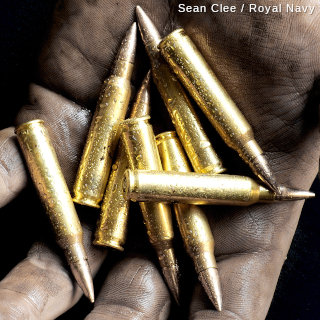
When people talk about a "bullet" in everyday language, they often mean a cartridge, which is a three-part vehicle with the actual bullet mounted on the very end.
The cartridge is the thing you load into a rifle; the bullet is the part of a cartridge that
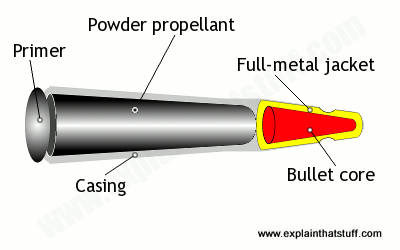
fires out the end. Cartridges are a bit like fireworks and they are arranged in three
sections: the primer, the propellant, and the bullet proper. At the
back, the primer (or percussion cap) is like the fuse
of a firework: a small fire
that starts a bigger one. The next section of the cartridge, effectively
the bullet's "main engine," is a chemical explosive called a propellant.
Its job is to power the bullet down the gun and through the air to the
target. The front part of the cartridge is the actual bullet: a tapering metal cylinder that
hits the target at high speed. It tapers to a point mainly to reduce
air resistance, so it goes faster and further, but also to help it
penetrate metal, flesh, or whatever else the target may be made
from (it must penetrate the target before it can do damage).
Artwork: The three main parts of a cartridge. 1) The primer "launches" the bullet by igniting the propellant. 2) The propellant accelerates the bullet down the gun. 3) And the bullet proper (the red and yellow bit at the end) is the part that exits the gun, flies through the air, and does the damage. This one has a complete outer casing known as a full-metal jacket, which means it can be fired faster and further, but it retains its shape on impact. Bullets with a softer point spread out on impact and do more damage, but don't travel as fast or far.
What happens when you fire?
Sponsored links
Bullet cartridges are designed to be (relatively) safe until the moment when
you fire them. When you pull the trigger of a gun, a spring mechanism
hammers a metal firing pin into the back end of the cartridge, igniting the small
explosive charge in the primer. The primer then ignites the
propellant—the main explosive that occupies about two thirds of a
typical cartridge's volume. As the propellant chemicals burn, they generate lots of gas very quickly.
The sudden, high pressure of the gas splits the bullet from the end of the cartridge,
forcing it down the gun barrel at extremely high speed (300 m/s or 1000
ft/s is typical in a handgun). It's only the bullet that fires from the gun;
the rest of the cartridge stays where it is. It has to be ejected after firing
(sometimes manually, sometimes automatically)
to make way for the next cartridge—and the next shot.
Photo: Launch of a Peacekeeper missile. The backbone of the US nuclear deterrent from 1986 to 2005,
the Peacekeeper was effectively a four-stage rocket, had a top speed of 24,000 kph (15,000 mph), and a range of almost
10,000 km (6000 miles). Photo by Don Sutherland courtesy of US Air Force.
The propellant chemicals in a handgun cartridge are not designed to
explode suddenly, all at once: that would blow the whole gun open and
very likely kill the person firing it. Instead, they are supposed to
start burning relatively slowly, through a process called
deflagration, so the cartridge moves off smoothly down
the gun. They burn faster as the bullet accelerates down the barrel, giving it a maximum
"kicking" force just as it comes out of the end. As the cartridge
emerges, the whole gun recoils (leaps backward) because of a basic law
of physics called "action and reaction" (or Newton's third law of motion). When
the gas from the explosion shoots the bullet forwards with force, the
whole gun jolts backwards with an equal force in the opposite direction.
The explosion that fires a bullet happens in the confined space of
the gun barrel. As the bullet flies out of the gun, the pressure of the
explosion is suddenly released. That's what makes a gun go BANG! It's a
bit like uncorking a bottle of wine at much higher speed and pressure. Some bullets also make noise
because they go so quickly. The fastest bullets travel at around 3000
km/h (over 1800 mph) —about three times the speed of sound. Like a
supersonic (faster-than-sound) jet fighter, these bullets make shock waves as they
roar through the air.
Photo: Unlike a conventional weapon, this recoilless weapon doesn't jerk back
when fired. It's open at the back so the explosive blast escapes from the rear of the gun, eliminating
the usual recoil. You can clearly see the heat of the explosive charge exploding from the front and the blast simultaneously shooting out from the rear. The gunner barely moves at all. Photo By Christopher Johnson, courtesy of US Army.
How bullets travel
Gun barrels have spiraling grooves cut into them that make bullets
spin around very fast as they emerge. A spinning bullet is like a gyroscope:
a sort of "stubborn" spinning wheel that always tries to
keep turning the same way. If you try to tilt a gyroscope while it's
spinning, it will try to resist whatever force you apply and, if you let go, it
will soon tilt back the other way. This is why, when things are
spinning, they are very hard to deflect from their path. We call this
idea gyroscopic inertia or stability. A bullet behaves in
exactly the same way: once it's spinning, it follows a straighter path
as it goes through the air, so it's harder to deflect and much more
likely to reach its target.
Photo: Do bullets really travel in straight lines? A bullet firing from a handgun looks almost like
a rocket launch—and works in very much the same way. Picture by Tech. Sgt. Larry E. Reid Jr.
courtesy of US Air Force..
We think of bullets flying in perfectly straight lines—but nothing
could be further from the truth. Several different forces act on a
bullet as it goes through the air. Over very short distances, bullets
do follow more or less a straight line. Over longer distances, they
follow a slight downward curve because gravity tugs them toward the
ground as they go along. Air resistance and the spinning, gyroscopic
motion of a bullet complicate things too. Usually, because of recoil,
the person firing wobbles the gun slightly when the bullet emerges.
When all these factors—the bullet's motion, gravity, air resistance,
recoil, and spinning—add together, they make a bullet follow a very
complicated corkscrew path as it flies through the air.
Sponsored links
Why bullets do damage
Photo: Close-up of a bullet hole in the fuselage of a US Air Force
plane, fired on while delivering relief supplies in Somalia. Picture by TSgt. Val Gempis courtesy of US Air Force.
A moving object has momentum,
which is the product of its mass and its velocity.
The faster something moves and the
heavier it is, the more momentum it has. A truck trundling along
slowly has a lot of momentum because it weighs so much. Even though
bullets are tiny, they have lots of momentum because they go so fast.
And because they go fast, they also have huge amounts of kinetic energy,
which they get from the chemical energy of the burning propellant.
(Remember that kinetic energy is related to the square
of an object's velocity—so if it goes twice as fast, it has four times the energy.)
Bullets do damage when they transfer their energy to the things they
hit. The faster something loses its momentum, the more force it
produces. (One way to define force is as the rate at which an object's
momentum changes.) A rifle bullet coming to a stop in a tenth of a second
produces as much force as a heavy, slow moving truck coming to rest in
10 seconds. Imagine being hit by a truck—and you'll have some idea why
bullets do so much damage!
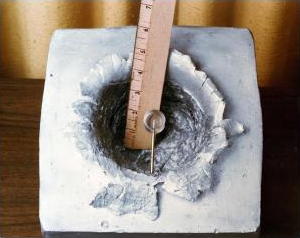
Photo: Now that's what I call kinetic energy!
This is what happens when you fire a 7g (0.25 oz) projectile at a velocity of
25,000 km/h (16,000 mph) into a cast aluminum block. This huge hole
has been made by something weighing about as much as an iron nail!
Even if something is that tiny, if it's traveling at very high speed it will
have enough kinetic energy to do a lot of damage.
Photo by R.D. Ward courtesy of Defense Imagery.
More energy = more damage?
It's easy to conclude from this that a bullet needs to have as much energy as possible to do the maximum
amount of damage but, unfortunately, it's not quite that simple. A rifle bullet has many times the velocity
and kinetic energy of a handgun bullet, so much so that it will typically enter one side of
a target, whiz straight through, and fly out the other side. If a bullet leaves the target
at high speed, it's taking valuable energy with it. So what we really want from a bullet is
that it deposits as much energy as possible inside the target, either stopping entirely without
exiting or leaving with the minimum possible velocity. There are various ways to achieve this.
The crudest way is for a bullet to expand as it enters the target. A bullet that expands has a
bigger cross-sectional area, so it creates a bigger hole (or wound) in the target. It takes more energy
to make a bigger hole in something: we need to use more force over the same distance, so we say the the bullet "does more work"
and uses more energy in the process. Bullets can be designed to expand by making them hollow at the pointed end and, after impact, they expand and squash down into a shape that looks like a button mushroom; that's why deforming bullets are called hollow-point or mushrooming bullets (Dum-Dum bullets is another common name for them, taken from the place in India where they were invented in the late 19th century). International law has restricted the use of expanding bullets like this in wartime since 1899, but some police forces do still use them. That's partly because expanding bullets do so much damage that they immediately incapacitate their target, but also because a mushrooming bullet, fired in self-defense (maybe in a crowded city street), is much more likely to stay inside its target and less likely to injure an innocent bystander by accident. Soft-point bullets work in a similar way, only using a soft lead tip instead of a hollow point, but expand more slowly and typically penetrate deeper.
Chart: Different types of bullets carry very different amounts of energy. With small bullets and relatively modest muzzle velocities, handguns are the least energetic weapons. At the opposite end of the spectrum, a Browning Machine Gun (BMG) .50 cartridge weighing about 50g (1.7oz) and traveling at about 900m/s (2000mph) carries almost 20,000 joules of energy—about 50–100 times more than a small handgun bullet. Chart data from various sources including "Ch3: Mechanisms of Injury/Penetrating Trauma" by J. Christopher DiGiacomo and James F. Reilly in The Trauma Manual by Andrew B. Peitzman (ed). Lippincott Williams & Wilkins, 2002.
How far and how fast?
In theory, you can calculate how far a bullet is going to go using the
equations of motion
based on Newton's three laws. If you know how fast a bullet is
going (and you assume it travels at constant horizontal speed), it's relatively easy to calculate
how far it travels: the distance is the average horizontal speed multiplied by the time.
How do you know the time? You can work this out from the bullet's vertical motion. You calculate how long a bullet is in the air by finding its vertical velocity. You can then calculate the time the bullet
is in the air using the acceleration due to gravity. Once you have the time, you can figure
out how far the bullet travels horizontally.
Photo: Big or small, fast or slow, bullets and missiles travel along scientifically
predictable paths called trajectories. This is the curved path followed by a
Minuteman III intercontinental ballistic missile (ICBM) test-fired from Vandenberg Air Force Base, California. The Minuteman III is up to 18m (62ft) long, weighs up to 36 tonnes (79,000lb), travels about 24,000km/h (Mach 23, 15,000mph), and has a
stated range of well over 10,000km (6000 miles). Picture by Joe Davila
courtesy of US Air Force.
Now, if you run the numbers through, you'll find something surprising. When rifle bullets exit
the barrel of a gun, they typically have an initial speed (called the muzzle velocity)
that ranges from about 2000 km/h (1200 mph or 550 m/s) up to about 4500 km/h (2800 mph or 1250 m/s).
If you put numbers like that into the equations, you'll find a rifle bullet, fired at an angle of 45°, ought to travel about 100–150km (60–90 miles) from the gun! Of course, bullets don't go anything like that far: the maximum range might be up to about 4 km or 2.5 miles.
How do we explain this? Drag! The faster things travel, the more air resistance they feel. For high-speed projectiles such as bullets, drag (air resistance) increases as the square of the velocity. Clearly if their range is reduced by about 25–40 times, drag has an enormous effect on them. Although heavier projectiles (such as artillery shells) are bigger and bulkier, they travel considerably slower. For that reason, it turns out they're slowed down much less by air resistance, so their actual range is more like a quarter to a half of their theoretical range.
Sources: I took my rifle velocities from Rifle Ballistics Summary by Chuck Hawks. Some bullets go faster, some slower, but Chuck's table gives a good indication of average speeds.
What materials are bullets made from?
Bullets and their cartridges are a bit of a riddle. They have to be tough to withstand the initial explosion inside a gun, and so they keep the aerodynamic shape that allows them to be targeted precisely. Yet, when they arrive at
the target, they need to pierce or deform in a very particular way to cause a maximum amount of damage. So the
choice of materials, the combination of materials used in different parts of a cartridge, and
how those different materials stick together and separate at just the right time are very important considerations.
Ultimately, all the materials used in a particular bullet cartridge depend on the job it's
been designed to do. In other words, cartridges with different purposes are often very different on the inside.
Photo: These two-tons of old lead bullets were retrieved from the ground as part of an environmental cleanup by the US Army at Camp Withycombe, Oregon. Picture courtesy of US Army
published on Flickr under a Creative
Commons (CC BY 2.0) licence.
As we've already seen, bullets need to be heavy to do damage so the core part is typically made from lead, a heavy, widely available, and inexpensive metal and one that deforms fairly easily. Other metals such as hardened steel, tungsten (in armor-piercing bullets), and copper or alloys such as brass are also used, as are (controversially) very dense materials like
depleted uranium.
Less-lethal bullets designed for things like riot control are meant to scare or lightly wound, so they typically have nonmetal cores made from materials such as rubber, wood, or molded plastics; "rubber bullets," for example, often contain pellets of rubber, plastics such as PVC, or minerals in a metal outer jacket. The other parts of a bullet cartridge are also made from metals or alloys. Bullet jackets can be made from many different metals, including steel-coated alloys and copper alloys (such as cupronickel), often with dry lubricants to help them speed through a weapon (from nylon and Teflon™ to wax and low-friction alloys such as Lubaloy, based on copper, zinc, and tin), and anticorrosive coatings (so they last longer in storage).
Photo: The US Army's 5.56mm M855A1 "Enhanced Performance Round"
promises to be more environmentally friendly: it uses a copper-only core instead of the more traditional (and polluting) lead.
The Army's tests show that it's as effective as the bullets it replaces. Picture courtesy of US Army.
Wound Ballistics: Basics and Applications by Beat Kneubuehl. Springer, 2011. A fascinating guide to how and why different types of bullets do different amounts of damage to a target.
Guns: A Visual History by Chris McNab. Dorling Kindersley, 2009. A large, richly illustrated to over 300 classic guns from all eras.
For younger readers
Ready the Cannons by William Gurstelle. Chicago Review Press, 2016. Twelve more artillery projects from the author of Backyard Ballistics.
Backyard Ballistics (Second Edition) by William Gurstelle. Chicago Review Press, 2012. The classic, hands-on guide to making fun guns from everyday, household stuff.
Forensic Ballistics by Sue L. Hamilton. ABDO, 2008. A simpler guide to ballistics for young readers (ages 9–12).
Articles
Catching Killers by Matching Tiny Marks on Bullets by Ian Urbina. The New York Times, 16 November 2018. How can bullet fragments lead you to a criminal? A look at the US National Integrated Ballistic Information Network (NIBIN) database.
How high does a bullet go? by Rhett Allain. Wired, 23 September 2009. An interesting introduction to ballistics calculations, including the effects of air resistance.
Rethinking Ballistic Fingerprints: The New York Times, 11 November 2002. What are the arguments for and against a national ballistics database?
US army announces 'green' bullet: BBC News, 6 October 1999. How the army is developing lead-free bullets to reduce environmental impacts.
Gun glossary: BBC News. A very handy A-Z of gun terminology. If you don't know a "barrel" from a "stock," or a "firing pin" from a "magazine," start here.
Please do NOT copy our articles onto blogs and other websites
Articles from this website are registered at the US Copyright Office. Copying or otherwise using registered works without permission, removing this or other copyright notices, and/or infringing related rights could make you liable to severe civil or criminal penalties.